If you’ve ever transferred American Express Membership Rewards points to a U.S. airline frequent flyer program, you may have noticed an extra line item called the AMEX Excise Tax Offset Fee.
This fee is $0.0006 per point (that’s 0.06 cents each), capped at $99 per transfer, and it applies when you transfer Membership Rewards points to certain U.S.-based airline partners (currently, that generally means Delta SkyMiles and JetBlue TrueBlue).
I’m familiar with this fee because I occasionally transfer points to Delta. I’ll use points to book inexpensive flights since I usually get around 1.3 cents per point for SkyMiles — or even better, since I save 15% from having a Delta co-brand credit card.
Two questions about this fee come up the most: “What is an excise tax?” and “Why does AMEX charge a fee when other banks don’t?”
What is an Excise Tax?
Every time you purchase an airline ticket, you pay an excise tax. It often appears on your receipt as a “U.S. Transportation Tax” (Frontier) or a “Federal Excise Tax” (Spirit). This tax is currently 7.5% of the base airfare on domestic flights, and it generally doesn’t apply to optional add-ons like baggage fees, seat selection, or many surcharges — which is one reason airlines break those charges out separately.
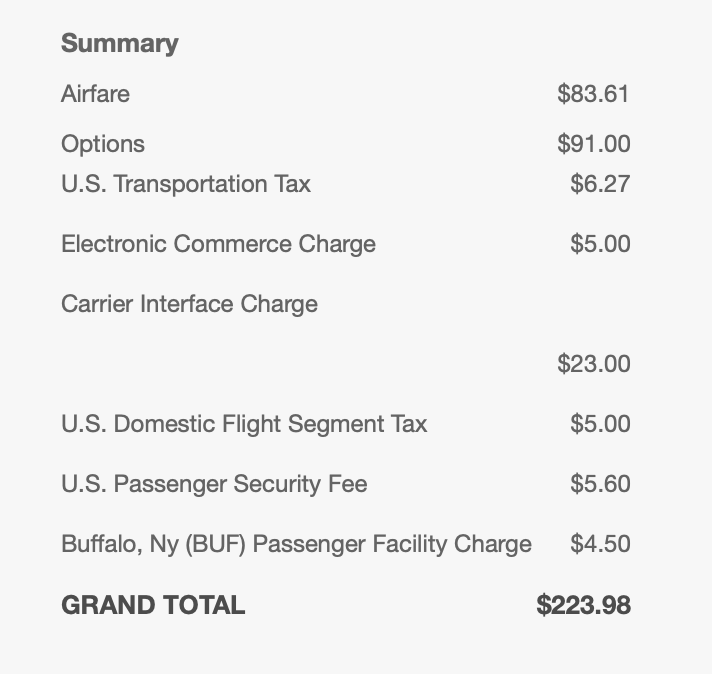

Here’s where it gets interesting for points people: since 1997, a federal excise tax has also applied to the sale to third parties of the right to award frequent flyer miles that can be redeemed for domestic air transportation. In plain English, when a bank buys miles from a U.S. airline to fund a rewards program, there’s an excise-tax cost tied to that purchase.
How You Can See the Excise Tax in Action
A simple way to see this tax is when you purchase miles directly from an airline. Although this is usually not a good value, let’s say you need to buy 50,000 Delta SkyMiles. Those miles might cost $1,750 (3.5 cents per mile). On top of that, you’d pay an additional $131.25 in excise tax, which is 7.5% of $1,750.
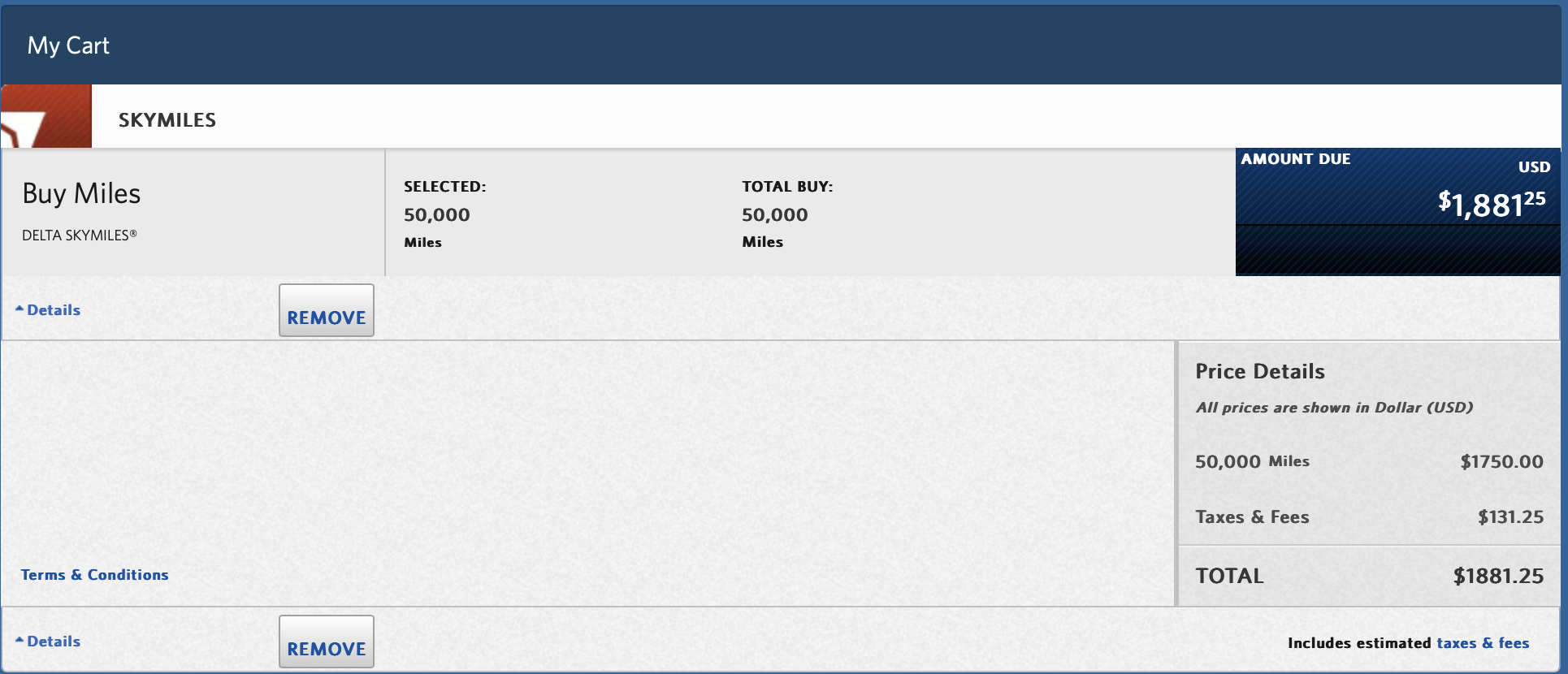
Now imagine that on a massive scale. Instead of $1,750, picture buying $6.5 billion in points, which is roughly what AMEX spent on Delta miles in 2023. Every time a bank buys miles from a U.S. airline, there’s an excise-tax cost baked into that transaction.
How Much Is the AMEX Excise Tax Offset Fee?
AMEX’s fee is straightforward math:
- 10,000 points → $6
- 50,000 points → $30
- 100,000 points → $60
- It caps out at $99 (which you’ll hit at 165,000 points transferred in one transaction).
AMEX also notes that this is an “offset” fee — meaning it’s meant to help cover the excise tax AMEX pays, and it may be more or less than the exact excise tax cost tied to any specific transfer.
Why Only AMEX Charges an “Excise Tax Offset Fee”
Although banks and rewards programs can incur excise taxes when buying miles from U.S. airlines, AMEX is the major transferable-points program that explicitly charges a separate fee to customers when transferring points to U.S. airline partners.
AMEX frames it like this:
“You’ll pay an excise tax offset fee ($0.0006 per point, up to $99) for points transferred to a U.S. airline frequent flyer program. This fee offsets the federal excise tax we must pay when you transfer points. It may be more or less than the actual amount of the excise tax we pay on any individual transfer.”
Other banks (like Chase, Citi, Capital One, and Bilt) generally absorb this cost rather than charging customers a separate “offset” fee when they transfer points. In other words, this isn’t a requirement that AMEX must bill you directly — it’s a business decision about where the cost lands.
Final Thought
Passengers pay an excise tax on domestic airfare, calculated as 7.5% of the base ticket price. A similar excise tax also affects the frequent-flyer ecosystem when miles are purchased in bulk from U.S. airlines. Only AMEX chooses to pass part of that cost on to customers as an “Excise Tax Offset Fee” when transferring points to U.S. airline programs. In contrast, other major transferable-points programs typically absorb it.
Want to comment on this post? Great! Read this first to help ensure it gets approved.
Want to sponsor a post, write something for Your Mileage May Vary, or put ads on our site? Click here for more info.
Like this post? Please share it! We have plenty more just like it and would love it if you decided to hang around and sign up to get emailed notifications of when we post.
Whether you’ve read our articles before or this is the first time you’re stopping by, we’re really glad you’re here and hope you come back to visit again!
This post first appeared on Your Mileage May Vary