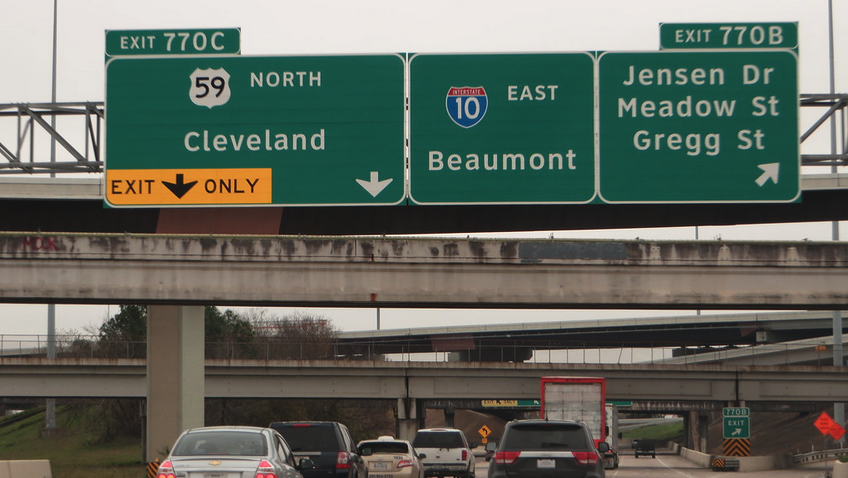
You’re on a road trip – or maybe just going from one town to another. If you’re not familiar with where you’re going, you might pay special attention to the highway signs that will tell you about the next exit. Of course, you know which signs to look for…the green ones with the white writing.
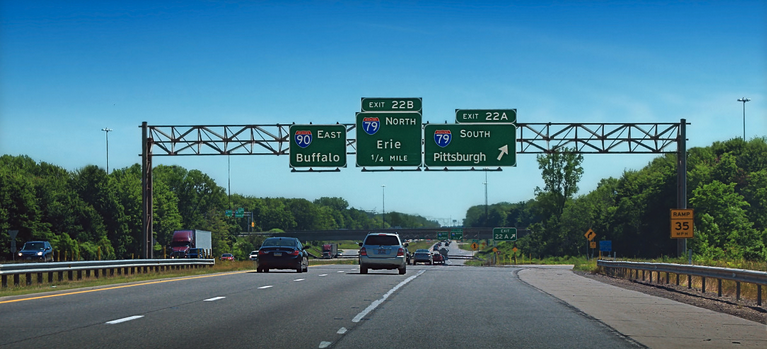
Why green with white lettering?
Why are highway signs green? They were planned that way. Here’s why.
They’re highly visible
Back in the 1950s, hundreds of drivers participated in a survey where they were exposed to a variety of signs, each a different color. 58% of the drivers said that the green signs with white writing were the most visible. And a standardization was made.
Why is white on green so easy to see?
It’s apparently the easiest color for the eye to process. That’s because the photoreceptors in our eyes (think back to science class – rods and cones) detect light at different wavelengths. The color green falls in the middle wavelength (between blue and red), and this is the wavelength where our perception is at its best.
Green is more visible – but not distracting
Green is also used because it is a “cool” color. The sign’s green background tends to blend in with the greens, blues and browns of the natural landscape, while also providing an excellent contrast for white text.
It blends in enough to be considered part of the scenery if you’re not paying attention, but sticks out enough so you notice it when you need to.
When you’re driving on a highway, you want signs that are easy to see, but you also don’t want signs that are going to distract your vision from the road, like a yellow, red or orange sign will (that’s why yellow, red and orange signs are reserved for signs that they’d want to catch your attention.)

They’re less apt to fade
When any color is exposed to daylight for X amount of time, it will fade. But some colors fade faster than others. The International Association of Traffic and Safety Sciences found that:
- Red signs have an estimated lifespan of 12 years
- Yellow signs last about 35 years
- Green signs last roughly 42 years
- Blue signs can last for about 45 years
- White signs have an estimated lifespan of 75 years
What about prior to the 1950s?
Oh, signs went through all sorts of changes back then.
What about other countries?
It depends on the country and their rules. For example, in Europe, you’ll find:
- On motorways, directional signs are green with white lettering.
- On main roads, directional signs with more than one destination are blue with white lettering.
- Within cities, directional signs with more than one destination are white with black lettering.
On main roads and within cities, the color of a directional sign with a single destination depends on the type of destination:
- if the destination is a city that is reached by means of a motorway, the sign is green and carries the motorway name as well as the destination
- in the other cases when the destination is a city, the sign is blue
- if the destination is a city district, a hospital or an airport, the sign is white
- if the destination is a geographical feature or a tourist attraction, the sign is brown
And private property?
Private property can make their signs whatever color they want. Walt Disney World, for example, had purple signs for years – since the 1990s, if not before. They faded terribly over the years and Disney’s in the midst of changing them to blue.
But highway signs in the U.S. are green with white lettering. And now you know why.
Feature Photo: Ken Lund // flickr // CC BY-SA 2.0
Want to comment on this post? Great! Read this first to help ensure it gets approved.
Want to sponsor a post, write something for Your Mileage May Vary, or put ads on our site? Click here for more info.
Like this post? Please share it! We have plenty more just like it and would love it if you decided to hang around and sign up to get emailed notifications of when we post.
Whether you’ve read our articles before or this is the first time you’re stopping by, we’re really glad you’re here and hope you come back to visit again!
This post first appeared on Your Mileage May Vary