According to the FAA database, the ratio of U.S. domestic flights outnumber international flights by roughly 10 to 1 (that’s an estimate, but you can see the statistics on the FAA’s Air Traffic Activity System (ATADS) database). That means a whole lot more of us fly domestically than outside the country.
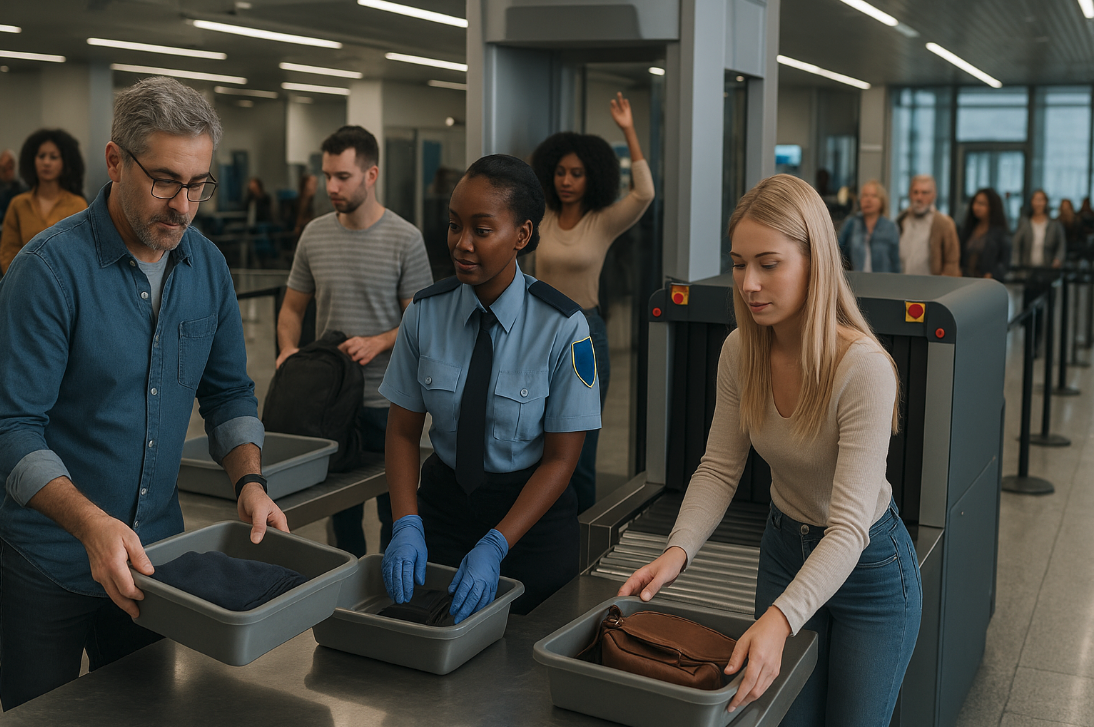
Of course, when you fly, whether it’s within the country or outside of it, there are a whole bunch of rules you have to follow. Some of them, like no guns in your carry-on bag, having to be scanned or patted down at the security checkpoint, etc., happen regardless of whether your flight is domestic or international. But there are some rules that change if you’re leaving the country, as opposed to just flying from one U.S. city to another. And, especially for those who don’t fly outside the country very often, they’re important to keep in mind:
Power banks/portable chargers
For domestic flights
The rules regarding power banks that utilize a lithium-ion battery are, granted, in a state of flux right now. At the moment, we’re permitted to carry them in carry-on or personal bags only, not checked bags. But that’s the only regulation.
For international flights
If you’re flying internationally, the rules are different because the International Air Transport Association (IATA) regulations impose size limits on power banks.
- For power banks up to 100 watt-hours, passengers can carry up to 20 in carry-on luggage.
- Power banks with a capacity of 101-160 watt-hours (Wh) may be permitted, but only with airline approval.
- Meanwhile, power banks that are larger than 160 watt-hours (Wh) are banned.
- Portable batteries with visible damage are also banned.
Alcohol
For domestic flights
If you’re flying domestically, you can only bring alcohol in your carry-on or personal bag if it fits in your 3-1-1 bag. So you might be able to get a few sample sized bottles in, but that’s about it.
If you’re carrying alcohol in your checked baggage, the TSA’s alcohol regulations vary depending on the beverage’s ABV (alcohol by volume).
- There is no limit on beverages with an ABV of 24% or lower in checked baggage.
- Passengers can carry up to 5 liters of alcohol with an ABV of 25%-70% in their checked bags.
- Any alcohol that’s over 70% ABV is banned.
For international flights
Carrying alcohol on international flights, even in your checked bags, varies by country. The rules depend on whether you’re entering or exiting the country, if you’re a resident of said country and what type of alcohol it is (i.e. beer vs wine [and then broken down more if it’s sparkling or fortified] vs spirits). Some Middle Eastern countries don’t allow alcoholic beverages to be imported into the country at all.
3-1-1 liquids
For domestic flights
With some exceptions, the 3-1-1 rule on liquids still stands in the U.S. TSA is starting to hint that these rules may eventually come to an end, but, well, don’t hold your breath if you’re expecting that to happen any time soon.
For international flights
Meanwhile, technology in other countries is surging, and some airports have relaxed, or at least changed, their rules on liquids.
- Shannon Airport, the third-largest airport in the Republic of Ireland, had abolished their liquids rules entirely, then backtracked to be in line with the rest of the EU (their current rule is that all liquids can only be in 100 ml bottles but they don’t have to be in a plastic bag or removed from your carry-on/personal bag).
- Donegal and Kerry Airports also had removed their liquids rules and then went to the EU rules.
- Same goes for Schiphol, Rotterdam, The Hague Airport and Eindhoven Airport.
Want to comment on this post? Great! Read this first to help ensure it gets approved.
Want to sponsor a post, write something for Your Mileage May Vary, or put ads on our site? Click here for more info.
Like this post? Please share it! We have plenty more just like it and would love it if you decided to hang around and sign up to get emailed notifications of when we post.
Whether you’ve read our articles before or this is the first time you’re stopping by, we’re really glad you’re here and hope you come back to visit again!
This post first appeared on Your Mileage May Vary

1 comment
Another thing to note about power banks/portable chargers. Not sure if it’s airline (JL, KE, NH, OZ, etc.) or country dependent (Japan, South Korea, etc.), but some do not permit them to be in overhead compartments. They can’t even be in your underseat bag. They have to be in an accessible seat pocket or on your body/in your hands.