Transferring points to airline and hotel partners is one of the best ways to squeeze extra value out of your rewards. It’s also one of the easiest ways to get annoyed, because every program has its own rules for:
- Minimum transfer amount (the smallest transfer you’re allowed to make)
- Transfer increments (the “step size” you have to use—1 point, 100 points, 1,000 points, etc.)
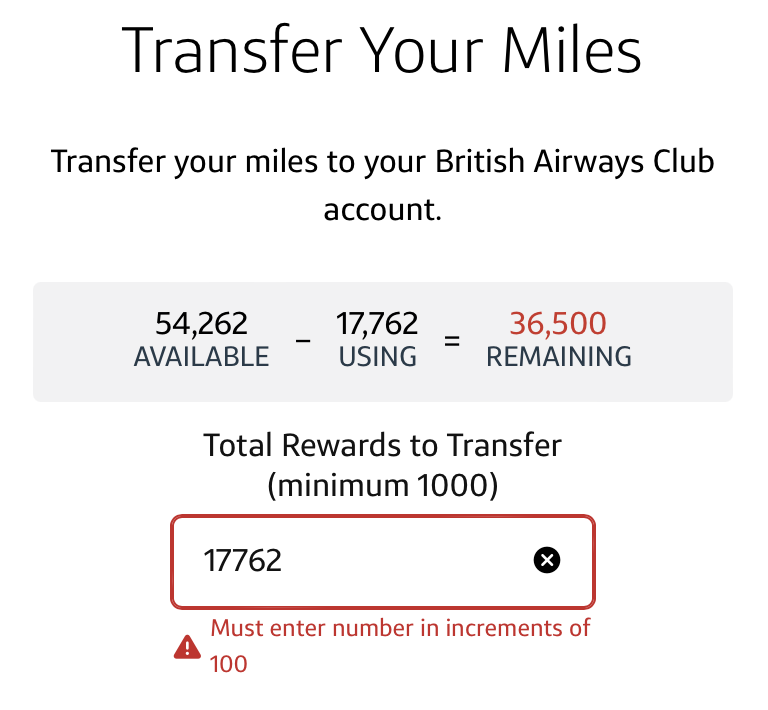
Capital One allows transfers in increments of 100
If you’ve ever tried to transfer an oddball number to “top off” an account and hit an error message like “must be in increments of 100,” you already know why this matters.
Quick comparison chart
| Rewards program | Typical minimum transfer | Typical increment |
|---|---|---|
| American Express Membership Rewards | 1,000 points (most cases) | 1,000-point increments (most cases) |
| Chase Ultimate Rewards | 1,000 points | 1,000-point increments |
| Citi ThankYou Points | 1,000 points | 1,000-point increments |
| Capital One Miles | 1,000 miles | 100-mile increments |
| Bilt Rewards | Varies by status tier | 1,000-point increments |
| Wells Fargo Rewards | As low as 1 point (per program terms) | 1-point increments |
| Marriott Bonvoy (hotel → airline) | 3,000 points | Varies (Marriott uses a daily transfer range vs. a simple “increment” rule) |
Why increments matter more than you think
When you’re transferring for a specific award, you often need an exact number. If you need an additional 17,762 miles to book an award and your points program only allows transfers in 1,000-point chunks, you’re forced to over-transfer (and leave extra points sitting in that airline program).
That’s why a program that allows transfers in 100-point or even 1-point increments can be surprisingly useful—even if the rest of its partner list looks similar.
Program-by-program: the transfer “rules of the road”
American Express Membership Rewards
Amex is usually a 1,000-point minimum and 1,000-point increments situation. The important phrase is “in most cases,” because some partners (or non-U.S. setups) can differ. Bottom line: assume you’re transferring in 1,000-point blocks unless the screen explicitly tells you otherwise.
Chase Ultimate Rewards
Chase keeps it simple: transfers are typically 1,000 points at a time.
Citi ThankYou Points
Citi’s standard rule is also 1,000-point minimum and 1,000-point increments. If you’re short by a few hundred, Citi won’t let you “micro-transfer” to fix it.
Capital One Miles
Capital One is where you often see more flexibility: a 1,000-mile minimum, but transfers commonly can be made in 100-mile increments. That’s exactly the kind of rule that makes topping off an award far less painful.
Bilt Rewards
Bilt transfers are in 1,000-point increments, but the minimum can depend on your status tier (for example, their base “Blue” tier can require a larger minimum than higher tiers). So this is one where you’ll want to check your account’s specific rule before you plan a tight transfer.
Wells Fargo Rewards
Wells Fargo is unusually flexible, with terms that allow transfers in 1-point increments. If you’re trying to move an exact amount (or avoid over-transferring), this is the most “precision-friendly” setup of the bunch.
Marriott Bonvoy (hotel points → airline miles)
Marriott transfers to airlines start at 3,000 points and have a published daily transfer range. Marriott is worth including here because it’s a common “backup currency,” but it’s usually not the best program for tiny top-offs (and the value math is a whole separate conversation).
Transfer bonus gotcha: the increment rule is based on what you send
Transfer bonuses confuse people because the “weird number” shows up on the receiving end.
Here’s the key: the minimums and increments apply to the points/miles you’re transferring out of your bank program (Amex/Chase/Citi/etc.), not the number of miles/points that arrive in the airline or hotel account.
For example, if a program requires transfers in 1,000-point increments and there’s a 30% transfer bonus:
- You still have to transfer 1,000, 2,000, 3,000, etc.
- If you transfer 1,000 points, you’ll receive 1,300 points/miles in the partner program.
What you can’t do is transfer, say, 770 points and hope the bonus “rounds you up” to exactly 1,000 on the other side. The rules are based on what you’re sending, and the bonus is applied after that.
Two practical takeaways
- If you’re topping off an award: Programs that allow smaller increments (like 100 or 1) make it easier to transfer only what you need.
- If you’re transferring during a bonus: Pick an amount that follows the bank’s rules (usually 1,000-point chunks). The “odd” number happens on the receiving end once the bonus is applied.
Final thought
Most people compare transferable points programs by partner lists and transfer ratios. But when you’re trying to book something specific, the boring stuff—minimums and increments—can be the difference between an easy booking and a “why won’t this website let me type the number I want?” moment.
Want to comment on this post? Great! Read this first to help ensure it gets approved.
Want to sponsor a post, write something for Your Mileage May Vary, or put ads on our site? Click here for more info.
Like this post? Please share it! We have plenty more just like it and would love it if you decided to hang around and sign up to get emailed notifications of when we post.
Whether you’ve read our articles before or this is the first time you’re stopping by, we’re really glad you’re here and hope you come back to visit again!
This post first appeared on Your Mileage May Vary