Way back last summer, we wrote that the EU would begin using biometrics for visitors seeking to enter or exit the Schengen zone.
The program, called the Entry/Exit System (EES) started that October, however instead of all countries introducing it all at the same time, they’re using a more modified approach and are introducing the system gradually at their external borders.
Unfortunately, the new system isn’t going well, and it’s questionable if it will be fully implemented by this April, as planned.
New system causing long delays
The biggest problem? It’s causing major delays at airports across the EU.
Under the new system, travelers from countries like the United States and the United Kingdom have to provide fingerprints and a facial scan the first time they enter the bloc.
Those biometrics replace traditional passport stamps and are stored in a shared database accessible to border officials in participating countries.
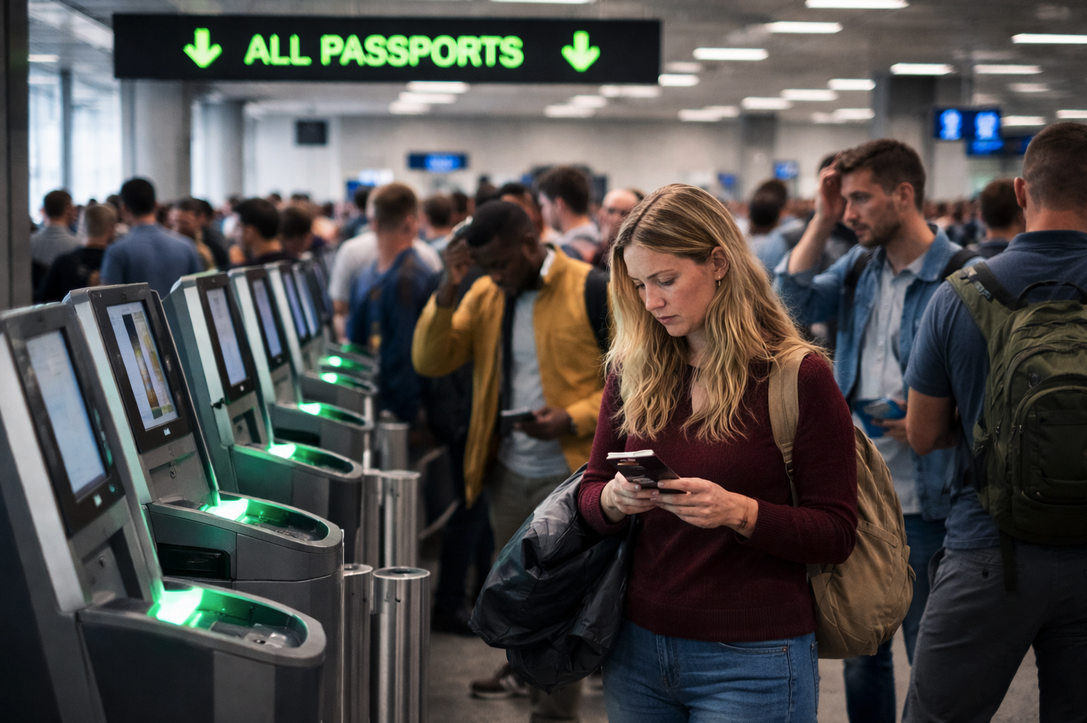
Unfortunately, airport operators say the added steps are causing major slowdowns at passport control at major international hubs.
According to Airports Council International (ACI) Europe, border processing times in some locations have increased by up to 70%, with peak travel periods producing lines of up to three hours.
The organization noted that the delays are hitting hardest at airports with heavy long-haul traffic.
Airports sounding the alarm
As the planned EES rollout progresses, more visitors will be required to provide biometric data over time. Until a few days ago, the threshold was set at 10% of travelers. As of January 9, it was 35%.
But Olivier Jankovec, director general of ACI Europe, said the timeline needs to be reviewed.
“Significant discomfort is already being inflicted upon travelers, and airport operations are being impacted, with the current threshold for registering third-country nationals set at only 10 percent,” Jankovec said before the January 9 increase.
According to Euronews, while some visitors have been able to go through the new system smoothly, others have had to wait so long that they missed their flights.
What’s the problem?
Multiple media outlets describe a processing procedure that’s difficult for first-timers to navigate.
If you’re a visitor to the EU, you have to scan your passport, provide your fingerprint, and have your face scanned before you can join a queue to meet with a border officer. However, there’s no pre-registration available; travelers must use self-service kiosks at the airport to submit their biometric information. Complaints have ranged from kiosks being unfamiliar, unavailable, or broken to a lack of border guards.
Calls for contingency measures
Meanwhile, travel agency association ABTA is requesting that contingency measures be used when delays are extraordinarily long.
“They have contingency measures at their disposal – such as standing down the system or limiting checks – and we want them to be utilised to help manage the flow of people,” said Mark Tanzer, Chief Executive of ABTA.
“Where problems have been experienced so far, some of these could have been avoided if the contingency measures were applied,” Tanzer added.
Recommendation for travelers
ABTA has some advice for first-timers to the EES system:
- “If you are departing the EU, we’re advising passengers to go straight to passport control as soon as they have gone through check-in and security, that way you get the EES checks out of the way as early as possible.”
- “The usual rule is to arrive at the airport for a flight to Europe at least two hours before, so we’d encourage people to apply that as a minimum, but to also check with their transport provider.”
And our advice? Until they figure this mess out, get to the airport early and bring lots of patience. And maybe a sandwich.
Want to comment on this post? Great! Read this first to help ensure it gets approved.
Want to sponsor a post, write something for Your Mileage May Vary, or put ads on our site? Click here for more info.
Like this post? Please share it! We have plenty more just like it and would love it if you decided to hang around and sign up to get emailed notifications of when we post.
Whether you’ve read our articles before or this is the first time you’re stopping by, we’re really glad you’re here and hope you come back to visit again!
This post first appeared on Your Mileage May Vary

4 comments
Getting a lot of conflicting information regarding this. Eu officials disputed the delay due to the ees but airport bosses say there is. No one actually publishes or cites data so hard to believe either of them. My personal experience recently was that the fingerprint didn’t work at all and the immigration officer says it rarely worked but the face recognition worked immediately and I didn’t spend more than 5 mins at the border control. So while I do think that the system is not up to the standard they wanted I am still not sure how reliable this delay claim is…
Traveling from the US to Germany this past December – I have an EU passport along with a US passport. My husband has a US passport. Lots of airport officials at the Munich registration kiosks to assist arrivals pointing to the registration kiosks. All went super smooth for my husband…UNTIL…..he moved to the actual passport control lines. They only had 3 immigration stations open and each person took about 10 minutes to process. Mind you there must have been about 150 people in line !!! The immigration officials wanted all the details of our two week trip. Can we see your return ticket, where will you be visiting, do you have the addresses. We were staying in Germany for ten days then going to The Netherlands for ten days and leaving the EU from Amsterdam. Some people got a million questions and had to provide PAPER proof of return tickets. Most people have it on apps etc. and Wifi for some wasn’t working. Some people got just a few questions. They really should have more immigration officers on hand when full flights come in. Also if travelers are supposed to show proof of travel details it should state ahead of time that this is required so the process goes quicker and smoother. He asked the immigration officer if he needed to allow for a lot of time on departure out of the EU and was told Yes – plan for long waits at the exit.
So we were concerned about the departure out of the EU in Amsterdam. It took all of 10 minutes as it was a simple passport scan and off he went (assuming you have an EU, Canada, USA, UK passport and can use the e-gates biometric gates).
This is truly something that can be highly criticized but {{{REDACTED}}}…
Comment redacted by YMMV to remove portions that were against YMMV’s requirements for approval.
In this case, practically all of it. Womp womp. ¯\_(ツ)_/¯
I landed in Denmark and it took about 2 minutes. Not sure what all the fuss is about. Travelled to Paris, Munich, Lisbon and Vienna since then and sailed straight through.