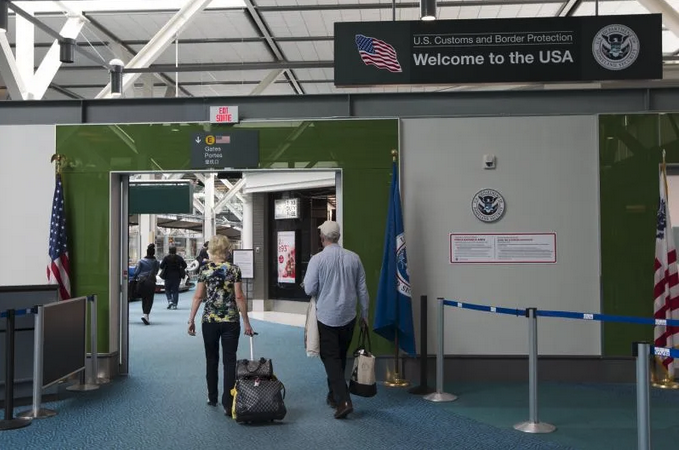
Clearing immigration after an international flight can turn a smooth trip into a slog — long lines, cramped corridors, and the constant fear you’re about to miss a connection. But there’s one behind-the-scenes perk that lets some travelers skip that arrival-day chaos entirely, and it’s quietly getting bigger.
The U.S. Preclearance program, run by U.S. Customs and Border Protection (CBP), has been in operation since 1952.
Customs and Border Protection (CBP) Preclearance is the strategic stationing of CBP personnel at designated foreign airports to inspect travelers prior to boarding U.S.-bound flights. With Preclearance, travelers then bypass CBP and Transportation Security Administration (TSA) inspections upon U.S. arrival and proceed directly to their connecting flight or destination.
(Thanks, CBP!)
Where You’ll Find Preclearance Today
There are currently 17 full U.S. Preclearance sites located in six countries—fifteen by air, one by sea, and one by rail (in pilot form):
Canada
- Calgary International Airport
- Edmonton International Airport
- Halifax Stanfield International Airport
- Montréal–Trudeau International Airport
- Ottawa Macdonald–Cartier International Airport
- Toronto Pearson International Airport
- Vancouver International Airport
- Victoria International Airport
- Winnipeg James Armstrong Richardson International Airport
- Sea: Prince Rupert – Alaska Marine Highway System Ferry Terminal
- Rail (pre-inspection, with plans to expand): Pacific Central Station in Vancouver, British Columbia (Amtrak Cascades service to Seattle and Portland)
Caribbean
- Aruba Queen Beatrix International Airport
- Nassau Lynden Pindling International Airport, Bahamas
- Bermuda L.F. Wade International Airport
Ireland
- Dublin Airport
- Shannon Airport
United Arab Emirates
- Abu Dhabi International Airport
My husband and I experienced Preclearance last year, for the first time, on our way home from Aruba. Here’s what it was like, along with some tips and tricks.
As you can see, the process was relatively painless 😉 and being able to just leave the airport, without going through customs when we landed back in the U.S., was lovely.
Expansion of Preclearance
Over the weekend, the U.S. and Canada announced plans to proceed with two new Preclearance travel screening projects this year.
- Billy Bishop Toronto City Airport will begin its Preclearance program by spring 2026.
- A Preclearance pilot program will begin at Cannon Corners, N.Y., on the border with Quebec (50 mi. south of Montreal)
Both programs had been in the works for quite some time. Construction on the Billy Bishop site was finished in late 2025, while the Cannon Corners site was initially scheduled to open last year.
Expansion is a pleasant surprise
The fact that there are plans to expand the program is news in and of itself.
Last fall, Pete Hoekstra, the U.S. ambassador to Canada, suggested that the U.S. might need to reconsider offering airport Preclearance in Canada because fewer Canadians had been traveling to the U.S.
“…Matter of fact, the numbers are down,” Hoekstra said during the Global Business Forum in Banff. “We’re not sure we can make the numbers work anymore … pre-clearance is something that is done at the expense of the U.S. government. We paid for it.”
“You know, [if] you can’t make the numbers work anymore — you’re all business people. You know what that means,” Hoekstra continued. “You’ve got to take a look at some of these things.”
(Geez. He sounded just like a mob boss, didn’t he? Wonder where he learned that from?)
From CBC:
Colin Robertson, a former Canadian diplomat who served as the forum’s moderator, later pushed back on those remarks.
“Pre-clearance was brought in by [president Dwight] Eisenhower. It’s worked really well,” said Robertson, the vice-president of the Canadian Global Affairs Institute.
“When Canadians go to the States — maybe not as many did a year and a half ago or half a year ago — but we’re still going an awful lot. We’re your biggest source of tourism. If you end pre-clearance, doesn’t that cut off your nose to spite your face?”
Hoekstra responded: “Nobody said we’re ending pre-clearance. Don’t put words in my mouth.”
“I heard you say, ‘We have to look at it,’” Robertson said.
“These are all business people, all right? If you have a business segment that is down 20 to 25 per cent … you take a look at the why, but you would also have a responsibility to your shareholders or the owner of the company in terms of how you will respond,” Hoekstra said.
All told, by the end of 2025, Canadians were taking 28% fewer trips to the U.S. — with trips by car down 35% and trips by air down 27%.
Want to comment on this post? Great! Read this first to help ensure it gets approved.
Want to sponsor a post, write something for Your Mileage May Vary, or put ads on our site? Click here for more info.
Like this post? Please share it! We have plenty more just like it and would love it if you decided to hang around and sign up to get emailed notifications of when we post.
Whether you’ve read our articles before or this is the first time you’re stopping by, we’re really glad you’re here and hope you come back to visit again!
This post first appeared on Your Mileage May Vary