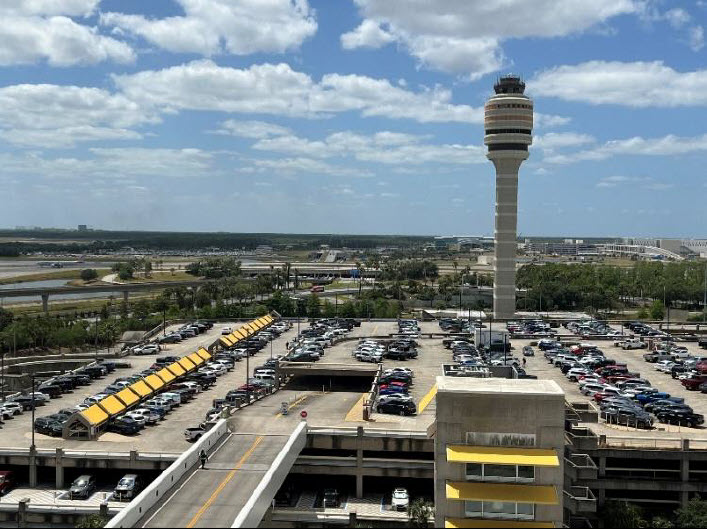
For the past couple of years, Orlando International Airport (MCO) flirted with a big, familiar airport idea: build a single, consolidated rental car facility that would serve Terminals A, B, and C. If you follow airport infrastructure projects, you’ve seen this concept before. Centralize the rental cars. Streamline operations. Reduce terminal-area congestion.
And then MCO backed away from it.
Instead, the Greater Orlando Aviation Authority (GOAA) is now prioritizing a different approach — expanding parking and rental car capacity at the existing terminal garages for A, B, and Terminal C. According to GOAA, this plan is cheaper, faster to deliver, and less disruptive than building an entirely new off-terminal complex.
At first glance, scrapping a consolidated rental car facility might seem like Orlando abandoning a “modern” solution adopted by other airports. But the more you look at how MCO actually works — today and in the future — the more this pivot feels like a rare case of an airport admitting that what works (sometimes) elsewhere isn’t automatically the right fit for Orlando.
The original pitch: free up space and reduce terminal-area traffic
On paper, the consolidated facility made sense. Move rental cars off-site. Reclaim garage capacity. Reduce congestion near the terminals. Connect everything with people movers or shuttles.
But unlike airports with one central terminal complex, MCO has three terminals with very different passenger flows. Any consolidated facility would have needed to funnel passengers from A, B, and C into one location.
And that’s where the concept always felt like a mismatch for Orlando.
Why a consolidated rental car facility is a tough sell at MCO
MCO isn’t a hub airport — rental cars aren’t optional
This is the biggest difference between Orlando and airports like Atlanta.
At hub airports, a large percentage of passengers are connecting. Rental cars matter, but they’re not the default mode of transportation for most travelers in the building.
MCO is overwhelmingly an origin-and-destination leisure airport. People land, collect bags, rent cars, and head to theme parks, resorts, cruise ports, and vacation rentals across Central Florida. When rental cars are central to the airport’s function, every added step affects a huge share of passengers.
Families change the equation
Orlando isn’t full of solo business travelers gliding through terminals with rollaboards.
It’s families traveling with strollers, car seats, oversized luggage, and enough bags to make you wonder how they all fit in the car. Adding a required transfer — whether by train or bus — between baggage claim and the rental car doesn’t just add time; it also adds stress. It adds friction at exactly the wrong moment.
At a hub airport, a transfer step is just part of the routine. At MCO, it would have become the routine — for almost everyone.
The connection problem: people movers vs. buses
This is the part I never could square.
To make a consolidated rental car facility work for three terminals, you need a reliable, high-capacity connection.
- People movers would offer the cleanest passenger experience — but they’re massively cost-intensive, especially if you’re trying to serve multiple terminal complexes well.
- Buses would be cheaper — but completely counterproductive. You’re trying to reduce terminal-area roadway congestion, and the solution is to run more vehicles, more frequently, on roads the airport has already spent years trying to unclog.
So the airport was effectively choosing between “expensive but clean” and “cheaper but self-defeating.”
Terminal C makes a single facility even harder to justify
Terminal C was designed with its own logic and flows, including on-site rental car access. Forcing those passengers into a one-size-fits-all off-terminal rental process would have undermined one of the terminal’s biggest advantages.
Instead of simplifying the airport, a consolidated facility risked creating an uneven experience — some passengers walk downstairs to their car, others add a transfer step.
That’s not modernization. That’s inconsistency.
So what is MCO doing instead?
Rather than betting on a single mega-project that wouldn’t open for years, GOAA is focusing on expanding what already works:
- Additional parking and rental car capacity at Terminals A and B
- Expanded garage capacity at Terminal C
- Projects that can be delivered sooner and at a lower cost
- Improvements that don’t require introducing a new transfer layer
For an airport where “land, grab keys, and drive away” is a core expectation, this approach aligns far better with how passengers actually use MCO.
“But other airports do this,” — and that doesn’t mean it’s right for Orlando
Consolidated rental car facilities can work in the right environment.
Atlanta is a hub airport where most passengers are already conditioned to multiple transfers. Austin operates on a much smaller scale, with different volumes and passenger expectations.
Even at airports where consolidated facilities are considered “successful,” they often trade one type of friction for another — fewer vehicles near terminals, but more transfers, more waiting, and more complexity when something goes wrong.
At MCO — where rental cars are central, not secondary — those trade-offs look a lot worse.
Final Thoughts
Scrapping a high-profile infrastructure project isn’t a failure if the alternative is cheaper, faster, and better aligned with reality.
In this case, MCO didn’t abandon modernization — it avoided an expensive misstep.
Sometimes the smartest airport planning decision is recognizing that what works (even questionably) elsewhere simply isn’t the right fit for MCO’s present — or its future.
Want to comment on this post? Great! Read this first to help ensure it gets approved.
Want to sponsor a post, write something for Your Mileage May Vary, or put ads on our site? Click here for more info.
Like this post? Please share it! We have plenty more just like it and would love it if you decided to hang around and sign up to get emailed notifications of when we post.
Whether you’ve read our articles before or this is the first time you’re stopping by, we’re really glad you’re here and hope you come back to visit again!
This post first appeared on Your Mileage May Vary