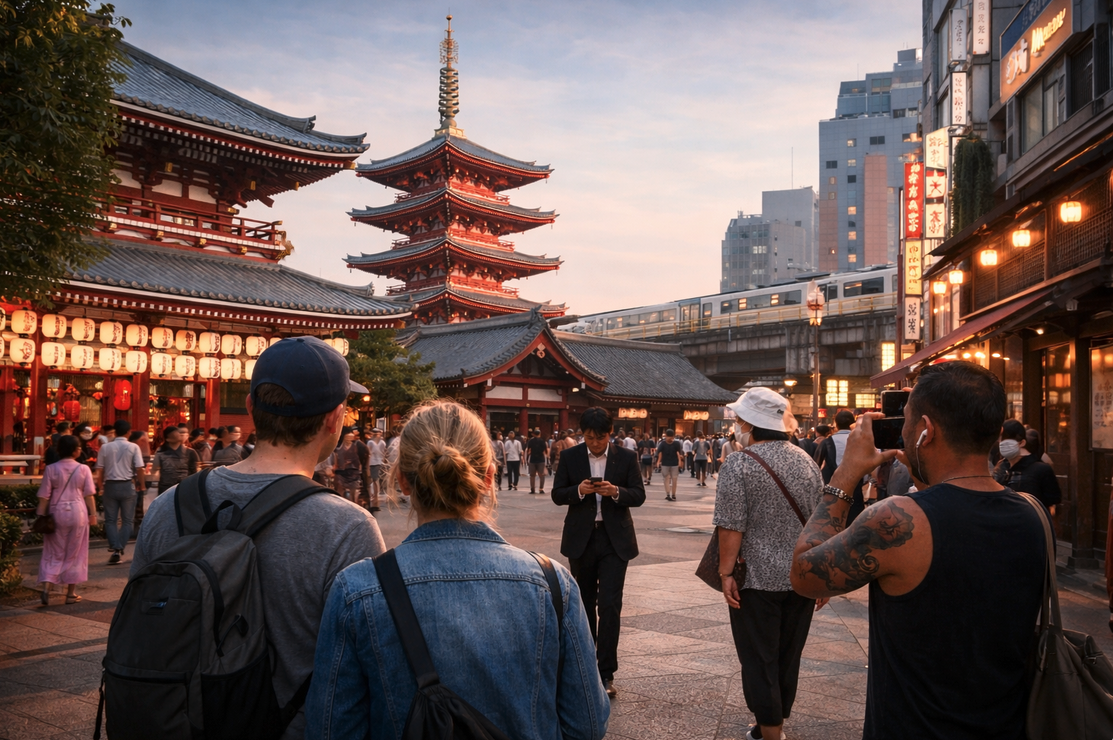
With Japan welcoming a record number of visitors, understanding a few cultural norms can help travelers avoid awkward — or offensive — moments.
According to The Japan Times, Japan welcomed a record 42.7 million visitors in 2025, and with that surge has come a wave of travelers unfamiliar with everyday Japanese customs. While most missteps are unintentional, certain behaviors that feel normal in the U.S. can come across as rude or disruptive in Japan. Knowing a few cultural expectations before you arrive can go a long way toward being a respectful guest — and having a smoother trip overall.
Of course, the social norms of Japan are VERY different from those in the U.S. And yet millions of Americans visit Japan every year (almost 3 million in 2024 alone) with “not a whole lot” of knowledge about what’s OK to do in Japan and what definitely is not.
Hopefully, this can help. Here are 7 things you should not do in Japan.
Public displays of affection (PDAs)
Sure, in the U.S., it’s perfectly fine for a heterosexual couple to hold hands, have a quick kiss, etc. And if a gay couple isn’t in a part of the country where they’re going to be bullied about their sexuality, they can show affection for each other, as well.
In Japan, PDAs, whether it’s a hetero couple or those from the LGBTQIA+ community, are not done, well, publicly. Not even flirting. In Japan, any sort of romantic behavior is expected to be done privately, not where everyone can see.
Wearing shoes in your hotel
Save for business establishments (and even then, there are exclusions), the Japanese don’t wear shoes indoors. It’s a mixture of their sense of fastidiousness, along with the delicate nature of tatami mats, which could be damaged by a shoe’s hard soles.
Entryways of homes, hotel rooms, temples, and some businesses will have a small area called a genkan, where you can leave your shoes while you’re indoors. These places will also have slippers for you to wear indoors.
Being a “typical loud American”
Americans are well known for being loud and boisterous. That doesn’t work well in Japan, where “social harmony” is the name of the game.
Keep your voice down, don’t watch videos in public places, and if you get a phone call on the train, bus or other public transportation, make sure (A) your sound is off and (B) you don’t talk to them (unless it’s an emergency); call them back when you exit the train, bus, etc.
If you have tattoos
Historically, the only people in Japan who had tattoos were the mafia. With that, it was difficult to find ryokans (Japanese-style bed & breakfasts) or onsens (Japanese baths) that allowed customers who had tattoos.
Times have changed, and SOME places allow guests with tattoos. Or they’ll have certain visiting times for those who have them. Or they may just require the person to cover up their tats.
Gee, I guess I have something to worry about now, huh?
Pointing at people
The Japanese don’t like to single people out, so pointing at someone is just “not done” in the land of the rising sun. Pointing can also be taken as you’re suggesting you are angry or aggressive.
Don’t point, please.
Bowing
The first time I went to Japan, back in the mid-1990s, I had a friend, Kiyoko, who lived in Yokohama. This was my first “big” trip, and I wanted to make a good impression, so I specifically asked her to write down the system for bowing (Kiyoko and I were pen pals). She did, but I completely didn’t understand it, LOL!
However, times have changed, and nowadays it’s easy to find a primer on the ins and outs of proper bowing. Migaku has you covered ;-).
Tipping
For better or for worse, tipping is a natural part of the U.S. However, it is most definitely NOT a part of Japanese culture. If you try to tip someone in Japan, they may well take it as an insult.
The only place you may incur a tip is at a ryokan – a customary service charge, often around 10% to 20%, is included in the final bill. You don’t need to leave anything extra.
In conclusion
Traveling to Japan is incredibly rewarding, but it comes with a different set of social expectations than many Americans are used to. A little awareness goes a long way: being quieter, more observant, and respectful of local customs not only helps you avoid awkward moments but also shows appreciation for a culture that values consideration and harmony. You don’t have to be perfect — just thoughtful — and doing so can make your experience in Japan smoother, more welcoming, and far more memorable.
Want to comment on this post? Great! Read this first to help ensure it gets approved.
Want to sponsor a post, write something for Your Mileage May Vary, or put ads on our site? Click here for more info.
Like this post? Please share it! We have plenty more just like it and would love it if you decided to hang around and sign up to get emailed notifications of when we post.
Whether you’ve read our articles before or this is the first time you’re stopping by, we’re really glad you’re here and hope you come back to visit again!
This post first appeared on Your Mileage May Vary