For a long time, international data wasn’t something I spent much energy thinking about.
When we traveled abroad, I simply used my T-Mobile plan. It worked well enough for maps, messages, and the occasional upload, and I never felt the need to chase every new eSIM provider popping up online.
But a few things changed recently.
Our newest phones only support eSIMs, eliminating the need to swap SIM cards when we travel. Credit cards have started offering international data perks. And suddenly I found myself wondering whether the way I’ve handled mobile data overseas still made sense — or if I needed to rethink everything before our next trip.
Instead of jumping straight into buying a new plan, I decided to step back and review what I already had.
Here’s what I considered — and why I’m planning to test a layered approach instead of switching carriers or buying a dedicated roaming eSIM right away.
Why I Started Rethinking My Setup
The biggest trigger wasn’t a bad experience — it was how the technology around us changed.
Moving to eSIM-only phones shifts the way you think about connectivity. Years ago, trying a new provider meant physically swapping SIM cards or committing to a permanent plan. Now it’s just a toggle buried in the settings menu.
At the same time, I realized I hadn’t seriously researched international data options in years. Meanwhile, travel blogs were suddenly filled with comparisons between Airalo, Holafly, Nomad, and a growing list of eSIM providers — along with the suggestion that travelers should just switch to something like Google Fi and be done with it.
That’s when I paused and asked myself a simple question:
Do I really need something new, or do I already have enough built into my existing setup?
What T-Mobile Already Gives Me Overseas
One reason I never chased dedicated eSIM plans is that T-Mobile has always been a reliable baseline for our trips. It keeps my U.S. number active, handles texts without any extra effort, and gives me enough data to get around without thinking too much about it.
For years, that was all I needed.
The tradeoff shows up once the high-speed data runs out. Speeds don’t just slow down — they drop to the point where everything starts to feel like it did a decade ago. Maps still work. Messaging is fine. But uploading photos or relying on heavier apps quickly becomes frustrating.
That’s what made me start looking for a way to add faster data — without throwing away a system that already works most of the time.
Discovering The Credit Card eSIM Option
While digging into options, I was reminded that some Visa cards now include international data through GigSky.
That immediately changed how I looked at the problem.
Instead of assuming I needed to buy something new, I realized I might already have a way to supplement my existing plan. Rather than replacing T-Mobile, I could potentially layer another data source on top of it — one that was already included as a card benefit.
Nick at Frequent Miler wrote about successfully using the GigSky perk, which made the idea feel more practical. This wasn’t just a hidden benefit sitting unused in the background — it was something travelers were actually testing in the real world.
That was the moment my thinking shifted from “What should I buy?” to “What should I try first?”
Why I’m Not Jumping Straight To A Dedicated eSIM (Or Google Fi)
Spend enough time reading about travel tech, and it starts to feel like the logical next step is to buy a dedicated eSIM or move to a completely different carrier.
But the more I looked at my own setup, the less convinced I was that I needed to change anything yet.
Between T-Mobile’s included roaming, the newer credit card data perks, and the flexibility of dual-SIM phones, I already have multiple layers of connectivity without committing to a new ecosystem. That doesn’t mean dedicated eSIM providers or alternative carriers are bad options — it just means they may no longer be the starting point.
For now, I’d rather see how far the tools I already pay for can take me.
The Plan I’m Going To Test On This Trip
So instead of replacing my current setup, I’m going to experiment with it.
T-Mobile will remain my primary line. It keeps everything familiar — my number works the same way, messaging stays seamless, and I always have a baseline connection available.
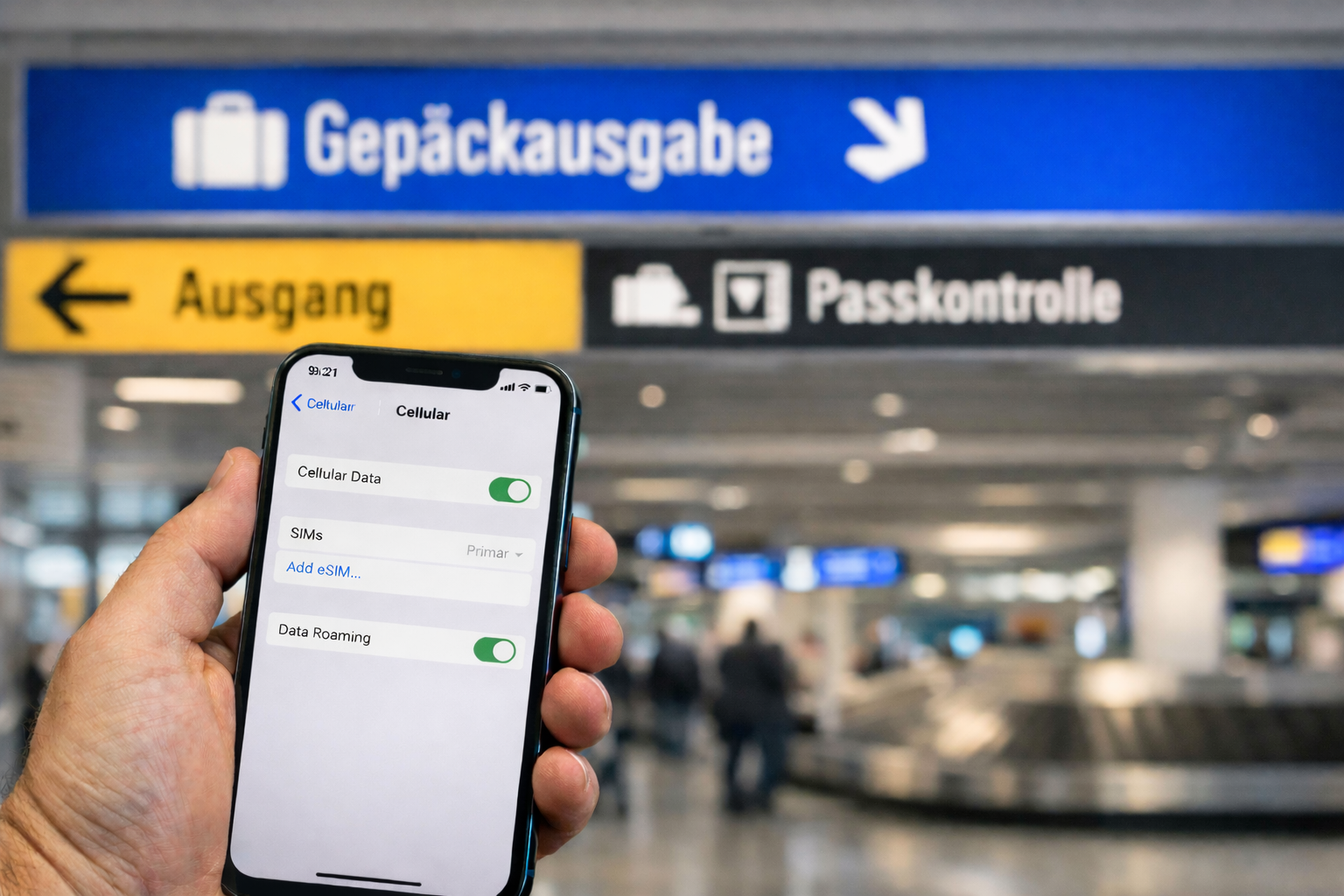
At the same time, I’ll install the GigSky app and keep the Visa eSIM ready in case I want faster data. If roaming speeds start to feel sluggish, switching data lines should be as simple as flipping a setting.
And for now, that’s where the plan stops. I’m not buying another eSIM or committing to a new carrier unless I discover I actually need one.
It’s less about finding the perfect solution ahead of time and more about testing what’s already in my pocket.
Why This Approach Makes Sense For How We Travel
Our trips tend to involve multiple countries, a lot of on-the-fly navigation, and plenty of moments when we’re sharing photos or coordinating plans in real time. Having T-Mobile as a safety net while using a credit-card eSIM for bursts of faster data feels like a balance between simplicity and flexibility.
More than anything, this trip gives me a chance to see how these newer eSIM perks actually perform — something I haven’t had a reason to test in years.
Final Thought
For a long time, I assumed that if I ever wanted faster international data, I’d need to switch carriers or buy a dedicated eSIM plan before I even left home.
But after looking more closely at what’s already included with my phone plan and my credit cards, I realized the smarter first step might be to test what I already have.
Instead of chasing the latest travel tech trend, I’m starting with a layered setup and seeing how far it gets me. If it works, it might be the simplest international data strategy available.
Want to comment on this post? Great! Read this first to help ensure it gets approved.
Want to sponsor a post, write something for Your Mileage May Vary, or put ads on our site? Click here for more info.
Like this post? Please share it! We have plenty more just like it and would love it if you decided to hang around and sign up to get emailed notifications of when we post.
Whether you’ve read our articles before or this is the first time you’re stopping by, we’re really glad you’re here and hope you come back to visit again!
This post first appeared on Your Mileage May Vary

4 comments
T-Mobile is fine, but Google Fi is the way. If you use so much data that you exceed the 100GB, then you need to use wifi more. You can even get an extra sim for tablets, hot spots, etc. It’s totally seamless. You turn off airplane mode or maybe at worst reboot your phone, and it just works.
If you are an extreme off-grid user, then the Visa benefit sounds interesting.
Had tmobile and switched to Xfinity. Only 10gb vs 15gb of high speed data but afterwards 14mbps (at least “up to” – have not travelled yet) vs the Tmobile dial-up speed.
Long time T-Mobile customer always with their top-tier plan. Currently called “Beyond” something or other. With international calling and high-speed data. I do a fair amount of international travel so this may not be for everyone. But dealing with only my T-Mobile number worldwide is seamless and painless. For me, makes no sense scratching around trying to save a couple of bucks when my time is worth far more. But for those who travel internationally once in a blue moon, I certainly see how the subject can be of interest. But even 2–3 times a year? Go with T-Mobile and focus on enjoying your trip.
You neglected to mention that if you have T-Mobile and your phone isn’t completely paid off, you’re screwed. They keep the phone locked and won’t allow any other eSIM products like GigSky, Airalo, etc. If you go for their “free” phone, they split up the credits over 2 years to keep your phone locked so that you must get extra data through T-Mobile. Once the phone is unlocked, it works ok. If you pay off your phone early, then you no longer receive any of the credits.