I knew airlines were charging more for seats these days.
I just didn’t expect to hit a point where even the worst seat on the plane wasn’t included anymore.
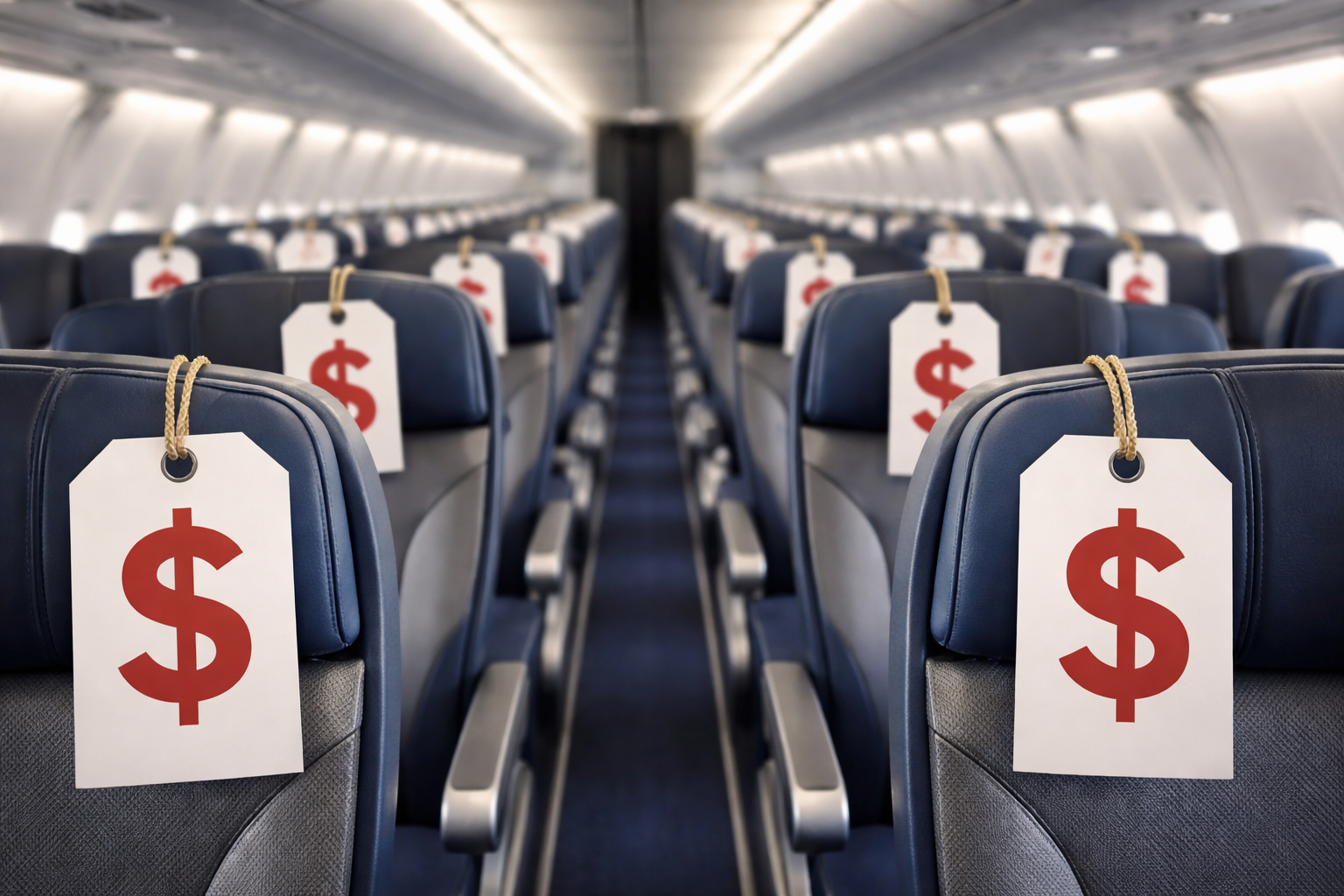
We’re flying British Airways and Austrian Airlines on award tickets, and if we want to pick any seat — window, aisle, or even a middle seat in the last row — we have to pay.
Not extra legroom.
Not preferred rows.
Any seat.
Sure, technically, we can wait until check-in and choose whatever is left for free.
But that’s exactly the problem — whatever is left.
Maybe we end up together. Maybe we don’t. Maybe the only free options are scattered middle seats near the back. And honestly, I don’t want to relive the old Southwest Airlines routine of hovering over my phone at T-24, refreshing like it’s a concert ticket drop, hoping to grab two seats together before everything disappears.
I didn’t expect that level of seat-selection anxiety on a “full-service” airline — especially on an award ticket.
And that’s when it hit me: flying some European legacy airlines now feels a lot like booking a low-cost carrier… or maybe like where U.S. airlines are already heading.
The baseline experience is quietly shrinking
Let me be clear — U.S. airlines charge for seats too. Anyone who’s opened a seat map recently knows how much of the plane has turned into an upsell.
But there’s still a subtle difference.
On most American carriers, there are usually some free option if you’re willing to sit in a less desirable spot. It might be a middle seat or in the back, but at least there’s a baseline.
On these European flights, that baseline has disappeared.
Even premium cabins aren’t immune. On Virgin Atlantic, some Premium Economy window seats were going for around £75 — and the only free options were in the middle section of a 2-4-2 cabin. When even premium seats start feeling like a menu of add-ons, you know the model has shifted.
Calling seat selection “free at check-in” might be technically true — but it turns the experience into a game of leftovers.
Europe’s airline landscape is starting to feel familiar
The more I thought about it, the more it felt like Europe’s airline market is starting to resemble the U.S.
Instead of dozens of independent legacy carriers, much of Europe now revolves around a few major airline groups, alongside a powerful ecosystem of ultra-low-cost airlines such as Ryanair and easyJet.
That combination feels oddly familiar.
In the U.S., we ended up with a handful of mega-carriers surrounded by budget airlines. And once a market settles into that kind of structure, pricing strategies tend to converge.
- Seat selection becomes a revenue stream.
- Extras become optional.
- The distinction between “legacy” and “low-cost” is blurring.
Years ago, choosing between European airlines sometimes meant choosing between very different philosophies about what was included. Today, the differences often feel more cosmetic than structural.
Maybe this isn’t just policy — maybe it’s cultural
Europe went through its low-cost airline revolution earlier than the U.S. did.
Ryanair and easyJet trained travelers to think of airfare as completely unbundled. The base fare is just a starting point, and everything else is optional.
Legacy airlines didn’t fight that trend forever — they adapted to it.
In the U.S., expectations evolved differently. Legacy carriers defined the experience first, so when ultra-low-cost airlines like Spirit or Frontier pushed aggressive unbundling, it felt like something was being taken away. That might explain why European ULCCs thrive while American ones constantly seem to be searching for the right formula.
Now it feels like the two markets are meeting in the middle.
Europe’s legacy airlines look more like U.S. carriers in structure.
U.S. airlines look more like Europe when it comes to fees.
Award tickets don’t feel special anymore
Another thing that stood out on this trip: award tickets increasingly get treated like the lowest fare bucket.
You might be redeeming miles you spent years earning, but the experience can feel stripped down:
- No advance seat selection included
- Limited flexibility
- Add-ons everywhere
That doesn’t make the redemption bad — but it does change the psychology. Redeeming points used to feel like unlocking something premium. Now it sometimes feels like you’re just buying into the airline’s version of Basic Economy.
Where is this all heading
If you zoom out, the trend line looks pretty clear.
Europe consolidated first — a few giant airline groups surrounded by strong ULCC competition. The U.S. followed a similar path, just with different timing and passenger expectations.
And when markets settle into that kind of structure, airlines tend to make similar decisions.
Charging for better seats becomes charging for most seats.
Extras become optional.
“Standard” slowly shrinks.
It doesn’t mean European airlines suddenly became low-cost carriers.
But the line between legacy and budget keeps getting thinner — and if this trajectory continues, it’s not hard to imagine U.S. airlines moving the goalposts a little further too.
Because once travelers get used to paying just to choose their seat, it’s hard for airlines to leave that revenue on the table.
Want to comment on this post? Great! Read this first to help ensure it gets approved.
Want to sponsor a post, write something for Your Mileage May Vary, or put ads on our site? Click here for more info.
Like this post? Please share it! We have plenty more just like it and would love it if you decided to hang around and sign up to get emailed notifications of when we post.
Whether you’ve read our articles before or this is the first time you’re stopping by, we’re really glad you’re here and hope you come back to visit again!
This post first appeared on Your Mileage May Vary

1 comment
BA charges for seat assignment even in business class. I am good with any business class seat (even “European business class” w middle seat blocked) so never pay. Now if traveling to economy I would pay to avoid the middle seat next to the lavatory