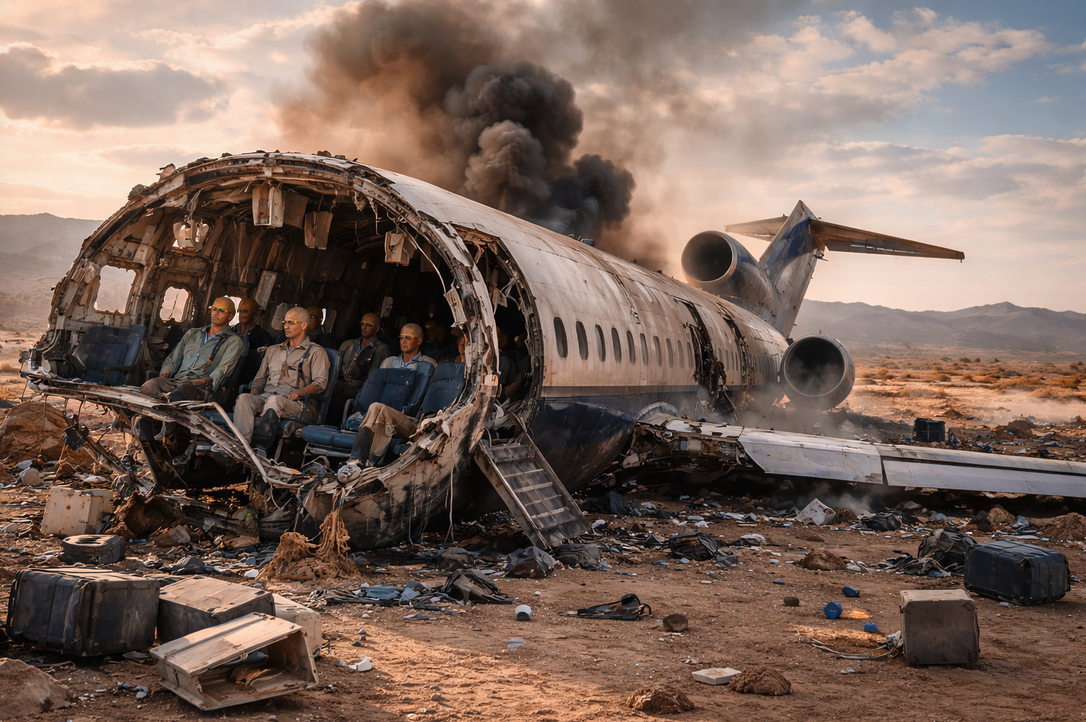
In one of the wildest aviation experiments ever attempted, researchers intentionally crashed a Boeing 727 in the Mexican desert to find out which seats gave passengers the best chance of surviving.
For years, researchers have been fascinated by one uncomfortable question: are some seats on a plane actually safer than others?
Some studies have suggested that passengers seated in the rear third of an aircraft may have slightly better survival odds than those in the front. That’s one reason this crash test drew so much attention.
In 2012, a multinational team of television studios set out to answer that question in a dramatic way. They staged a controlled airplane crash in the Mexican desert near Mexicali to study what would happen to passengers in different parts of the aircraft.
Why did the crash test happen in Mexico
The experiment couldn’t take place in the United States because regulators wouldn’t allow it. Instead, organizers obtained permission from Mexican authorities to conduct the test there.
Mexican officials agreed to allow the experiment—but with one important condition. Because the aircraft would briefly pass over populated areas, human pilots had to be aboard during the early part of the flight.
The plane used in the experiment
The aircraft used for the test was a Boeing 727-200 that had originally flown for Singapore Airlines. After changing hands several times, it eventually ended up with Broken Wing LLC of Webster Groves, Missouri, the company behind the crash experiment.
Before the flight, researchers filled the aircraft with:
- Crash-test dummies
- Dozens of cameras
- Sensors and measuring equipment
The desert crash zone was carefully cordoned off to protect the public.
The dramatic setup
Six people were aboard the aircraft for the final flight:
- Three members of the flight crew
- Three support jumpers
Just minutes before the crash, all six parachuted safely out of the plane.
After they exited, control of the aircraft was handed over to a remote pilot flying in another aircraft behind the 727.
The unmanned jet then continued its descent toward the desert crash zone.
The impact
The Boeing 727 hit the ground at approximately:
- 140 miles per hour
- 1,500 feet per minute descent rate
The aircraft broke apart into several sections on impact. The main landing gear collapsed, and the cockpit section tore away from the fuselage.
One seat near the front of the aircraft, 7A, was thrown nearly 500 feet from the crash site, which researchers said would almost certainly have been fatal for a real passenger.
What the crash experiment revealed about the safest seats
Doctors and scientists analyzed data collected from sensors embedded in the crash-test dummies.
Based on that analysis, they estimated which passengers would likely have suffered:
- Fatal injuries
- Spinal cord injuries
- Broken limbs
- Minor or no injuries
Their findings suggested that two areas offered the best odds of survival in this specific crash scenario:
- Seats near the wings, where the aircraft’s structure is strongest
- Seats toward the rear of the plane
Researchers stressed, however, that there was an important caveat.
In this test, the nose of the plane hit the ground first, taking the brunt of the impact. If the aircraft had struck tail-first instead, the results could have been very different—potentially making the front of the aircraft the safer place to sit.
The importance of the brace position
Researchers also studied the effectiveness of the brace position, which passengers are sometimes instructed to take during emergency landings.
They found that it helped reduce the risk of:
- Concussions
- Spinal injuries
However, it also increased the load on passengers’ legs, which could lead to broken legs or ankles.
The crash also demonstrated another hazard: interior aircraft components, such as wiring and panels, can collapse into the cabin during impact and create obstacles during evacuation.
What happened after the crash
Once the experiment was complete, the crash site underwent a full environmental cleanup under the supervision of authorities.
Large sections of the wrecked Boeing 727 were later salvaged. Some debris is reportedly still found in a field near Federal Highway 5 south of Mexicali.
And the television studios that funded the experiment? They turned the whole thing into a documentary.
So what did the crash prove? Mostly that there’s no single “safest” seat on an airplane in every scenario. In this test, seats near the wings and toward the rear performed best—but the results depended heavily on how the aircraft hit the ground.
FAQ
What is the safest seat on a plane?
Studies suggest seats near the wings and toward the rear of the aircraft may offer better structural protection in some crashes. However, the safest seat can vary depending on how an aircraft impacts the ground.
Want to comment on this post? Great! Read this first to help ensure it gets approved.
Want to sponsor a post, write something for Your Mileage May Vary, or put ads on our site? Click here for more info.
Like this post? Please share it! We have plenty more just like it and would love it if you decided to hang around and sign up to get emailed notifications of when we post.
Whether you’ve read our articles before or this is the first time you’re stopping by, we’re really glad you’re here and hope you come back to visit again!
This post first appeared on Your Mileage May Vary