Earning points on recurring charges, like your cell phone bill, is one of the easiest ways to build up rewards without changing your spending habits. Just set your monthly bill to the card that earns the highest bonus and let it run in the background.
But I don’t always use the card that earns the most points.
Sometimes, I’m willing to earn fewer points if it means getting a useful benefit in return. And when it comes to paying a cell phone bill, that tradeoff can be worth a closer look.
I originally wrote about this a couple of years ago, but the numbers have changed enough that it’s worth revisiting. Phones cost more now, Apple’s coverage options have changed, and some of the outside insurance alternatives have gotten more expensive, too.
So the question remains: Is it better to use the card that earns the most points or the one that offers cell phone protection?
The Cards I’m Comparing
For this example, I’m still looking at two Chase business cards that many points-and-miles readers already know well.
The Ink Business Cash earns 5% cash back on the first $25,000 spent each account anniversary year at office supply stores and on internet, cable and phone services.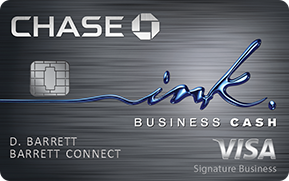
The Ink Business Preferred, meanwhile, earns 3X Ultimate Rewards points on the first $150,000 spent each account anniversary year on travel, shipping, advertising, and internet, cable and phone services.
So if you only looked at earning rates, the Ink Cash would seem like the obvious choice for paying a cell phone bill.
But the Ink Business Preferred has one important advantage: cell phone protection.
Cell Phone Protection Changes The Equation
When you pay your monthly cell phone bill with the Ink Business Preferred, you can receive up to $1,000 per claim in coverage for covered theft or damage for phones listed on the bill, with a $100 deductible and a maximum of 3 claims in a 12-month period.
That’s a meaningful perk, especially now that replacing a phone can easily cost close to four figures.
Apple’s current iPhone lineup starts at $599 for the iPhone 17e, $799 for the iPhone 17, $999 for the iPhone Air, and $1,099 for the iPhone 17 Pro or Pro Max. If you’re carrying one of the higher-end models, the cost of replacing a phone is even harder to ignore.
For this updated example, I’m going to use a $799 iPhone 17 as a baseline. That feels like a fair middle ground for many readers, even if plenty of people are carrying phones that cost more.
Looking At The Other Coverage Options
If you don’t use a card with built-in phone protection, you can always buy coverage separately. But that comes at a cost.
- Allstate Protection Plans charges $8.99 per month for phone protection, with a $149 deductible on smartphone claims.
- T-Mobile Protection 360 currently ranges from $7 to $26 per month per device, depending on the phone.
- AppleCare+ with Theft and Loss for current iPhones ranges from $119.99 to $139.99 annually, depending on model.
- AppleCare One now costs $19.99 per month for up to three Apple devices, with each additional device costing $5.99 per month.
AppleCare One is a new wrinkle that didn’t exist when I first wrote this post. It could make sense if you want to cover multiple Apple devices under one plan. But if you’re just looking at one phone line, it still makes sense to compare the cost of separate coverage to the value of the points you’d earn by using a different card.
Running The Numbers
Let’s use the same simple example as before.
Assume our phone bill is $120 per month for two lines, or $60 per line.
If I use the Ink Business Preferred, I earn 3X on that $60 monthly charge.
If I use the Ink Business Cash, I effectively earn 5X instead.
That means I’m giving up the equivalent of 2 points per dollar by using the Ink Preferred instead of the Ink Cash.
Here’s the math per line:
- $60 monthly bill
- Difference between 5X and 3X = 2 points per dollar
- $60 x 2 = 120 points per month not earned
- 120 points x 24 months = 2,880 points over two years
If I value Ultimate Rewards points at 1.5 cents each, those 2,880 points are worth:
2,880 x 0.015 = $43.20
So, over two years, using the Ink Preferred instead of the Ink Cash “costs” me about $43.20 per line in forgone rewards.
Comparing That To Insurance Costs
Now let’s compare that lost value to buying separate phone coverage.
If I bought AppleCare+ with Theft and Loss for an iPhone 17, the current annual cost is $119.99. Over two years, that’s about $239.98.
So the comparison looks like this:
- Use Ink Cash: earn an extra $43.20 in value over two years, but pay about $239.98 for AppleCare+ with Theft and Loss
- Use Ink Preferred: give up $43.20 in rewards, but get built-in cell phone protection from the card
Even if you use Allstate’s cheaper standalone coverage at $8.99 per month, that’s still about $215.76 over 24 months, plus a deductible if you file a claim.
In other words, the value of the extra points still doesn’t come close to covering the cost of separate protection.
One Important Caveat
There’s one wrinkle that’s become more relevant in recent years: some carriers make this decision more complicated by limiting autopay discounts when you pay with a credit card instead of a bank account.
That doesn’t change the basic math in this post, but it does mean your own numbers may look different depending on your carrier and plan. If paying with a credit card causes you to lose a meaningful autopay discount, you’ll want to factor that into the equation separately.
Your Cards Might Change The Math
The numbers in this example are based on a specific comparison between the Ink Business Cash and the Ink Business Preferred. But your own calculation will look different depending on which cards you have.
Several cards now offer some form of cell phone protection if you pay your monthly bill with the card. Coverage limits, deductibles, and claim limits vary widely. Some cards offer up to $1,000 per claim, while others cap coverage at $600 or $800, and deductibles can range from $25 to $100. Most cards allow two or three claims per year. If you’re curious which cards offer this benefit, I put together a list in a separate post about credit cards with cell phone protection.
For example, some premium cards offer around $800 in coverage with a $50 deductible, while others—like the Ink Business Preferred—provide up to $1,000 per claim with a $100 deductible. No-annual-fee cards such as the Chase Freedom Flex or Wells Fargo Autograph also include cell phone protection with similar limits. The details can vary, so it’s always worth checking the specific benefits guide for the card you’re using.
One other thing worth mentioning: I rarely think it makes sense to apply for a credit card just to get cell phone protection. It’s a nice perk, but it usually shouldn’t be the primary reason to open a new card.
That said, the good news is that this benefit has become much more common in recent years. Banks like American Express, Chase, Capital One, and Wells Fargo now offer cell phone protection on a growing number of cards, so there’s a good chance you may already have coverage in your wallet without realizing it.
Final Thought
Even with updated 2026 pricing, I still come to the same conclusion I did before.
In most cases, it makes more sense to use a card that includes cell phone protection than one that earns the most points.
Yes, you’re giving up some rewards. But in this example, that trade-off is worth only about $43 per line over two years. That’s nowhere near the cost of buying separate protection for a phone that now costs from $599 to $1,099 before tax.
If you already have a card that offers solid cell phone insurance, using it for your monthly phone bill is still one of the easiest ways to buy yourself a little peace of mind without paying for another standalone plan.
Want to comment on this post? Great! Read this first to help ensure it gets approved.
Want to sponsor a post, write something for Your Mileage May Vary, or put ads on our site? Click here for more info.
Like this post? Please share it! We have plenty more just like it and would love it if you decided to hang around and sign up to get emailed notifications of when we post.
Whether you’ve read our articles before or this is the first time you’re stopping by, we’re really glad you’re here and hope you come back to visit again!
This post first appeared on Your Mileage May Vary


1 comment
You talk about the caveat, but a quick Google AI enhanced search says T-Mobile, Verizon, AT&T, and Xfinity all require a debit card or checking account to keep your auto-pay discount. The caveat being that if you use their co-branded credit card (I’m aware T-Mobile and Verizon have them) you still get the auto-pay discount and enhanced earnings on their credit card. I am a T-Mobile customer and will not sign up for their co-branded card because it counts as a new card and almost all credit card issuers now have velocity limits. The T-Mobile card has no signup bonus and no credit card protection, just 2% back (redeemable only on your bill and T-Mobile store/online purchases).
Then it comes down to me as T-Mobile customer to the question is losing a $5 a line discount worth it for credit card worth the credit card protection. For now, the answer is no because both my wife and I use carrying cases and are careful. Neither of us has lost or had a cell phone stolen in the last 10 years. I know I may reassess after having a lost/stolen phone or a major repair.