Bulkhead seats are one of those airplane seating options that sound simple in theory but can be surprisingly inconsistent in real life.
In general, the first row of a cabin comes with a familiar set of trade-offs. You may get extra legroom and avoid having someone recline into your space, but you’ll often give up under-seat storage, deal with a tray table in the armrest, and sometimes end up with a seat that feels less comfortable than it first appeared. That’s part of the reason why I’ve written before about whether bulkhead seats are really worth choosing in the first place.
But there’s another version of the bulkhead seat that doesn’t get talked about as much: the kind that isn’t really a bulkhead at all.
When The “Bulkhead” Isn’t A Wall
On some aircraft, the first row of economy sits directly behind first class with only a curtain separating the cabins. Airlines may still price and label these seats like bulkheads, but the experience can be very different from the traditional setup most travelers expect.
I ran into this on an American Airlines 737-800 with the airline’s Oasis interior, where I was seated in the first row of Main Cabin Extra.
Instead of staring at a wall, I was sitting directly behind a pair of first class seats.
That changed the experience in several ways.
Main Cabin Extra On American’s 737-800
My aircraft had American’s Oasis interior, which removed the more traditional divider between first class and economy. So while I was technically in the first row of the economy cabin, there wasn’t a true bulkhead in front of me.
I was in the window seat behind a row of two first class seats, and that created a setup with some real advantages—along with a few drawbacks.
Advantages
Or maybe I should say AAdvantages. I couldn’t help myself.
The biggest plus of this setup was the amount of legroom. Since there was no wall in front of me, I could stretch my legs far enough under the first class seat to make the space feel much more open than a normal bulkhead row.
Even better, I could store my personal item under the seat in front of me.
That may not sound like a huge deal, but it’s one of the most common complaints about bulkhead seats. In a traditional bulkhead row, your bag usually has to go in the overhead bin for takeoff and landing. Here, I still got the first-row legroom without giving up easy access to my backpack.
American had even installed separators under the first class seat so each passenger had a rough idea of how much storage space belonged to them.
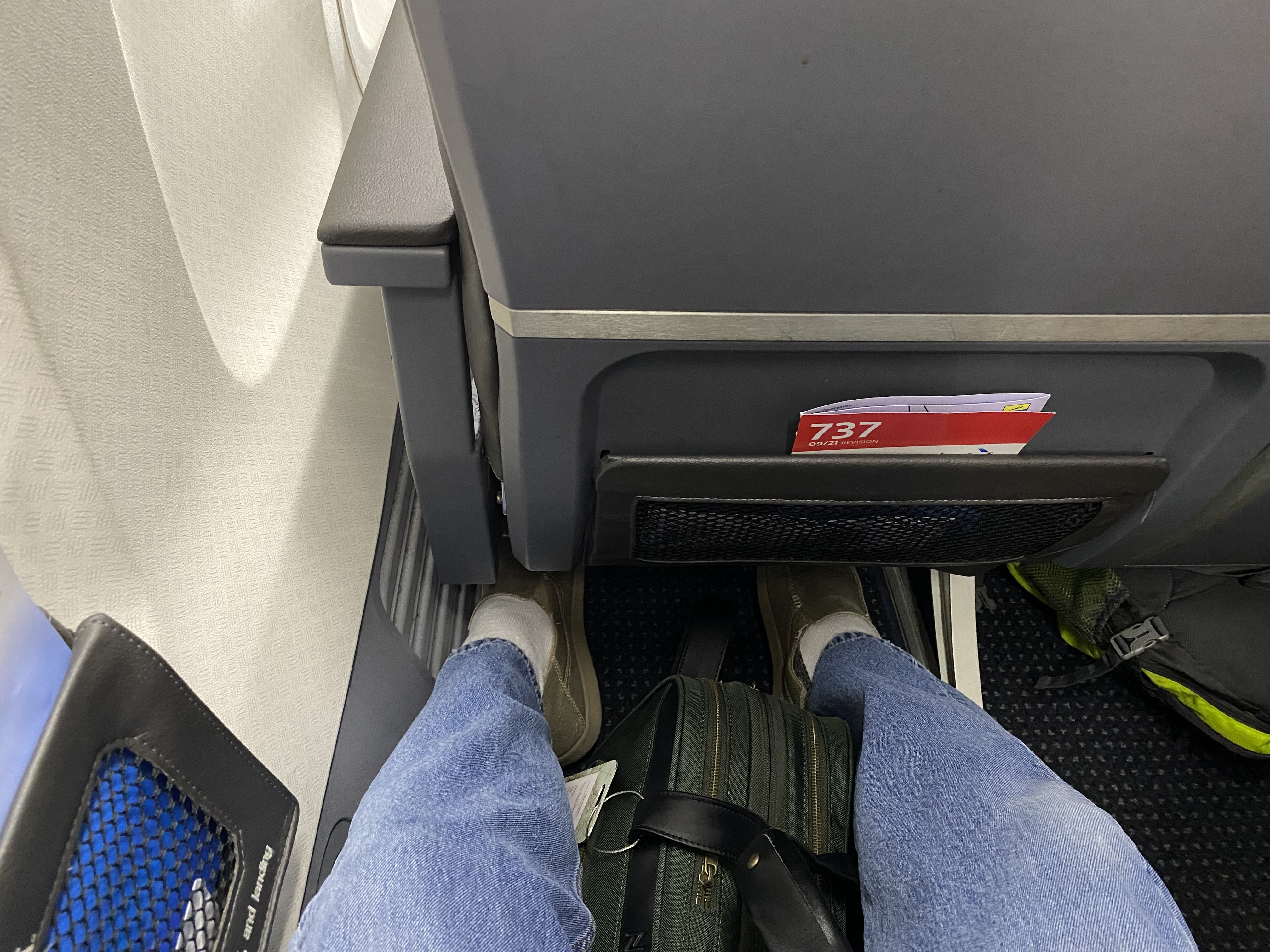
In other words, this felt like a bulkhead seat that managed to avoid one of the usual bulkhead frustrations.
Negatives
Of course, this setup wasn’t perfect.
Because there wasn’t an economy seat in front of me, I also lost some of the features that usually come attached to that seat.
On American’s Oasis-configured 737-800, I wasn’t missing out on a seatback screen because these planes didn’t have them in economy to begin with. American had already gone all-in on a bring-your-own-device approach to entertainment.
That made the rest of this row’s quirks stand out more.
In the rows behind, passengers had device holders built into the seatback and power that was easier to find. In my row, since there was no economy seat in front of me, American instead used a modified tray table with a small fold-up flap for leaning a phone or tablet.
It worked, but it wasn’t nearly as intuitive.
I only learned after the flight that there were power outlets underneath the seat. The bigger issue was that there was no obvious indication they were there, and actually plugging something in required some awkward maneuvering.
So while this version of the “bulkhead” solved some of the normal problems, it introduced a few quirks of its own.
Why This Setup Stands Out
What makes this kind of seat interesting is that it sits somewhere between a traditional bulkhead and a regular extra-legroom seat.
You still get the benefits people usually want from the first row of a cabin:
- Extra legroom
- No one reclining into you
- A more open feeling
But depending on the aircraft, you may also get some things that bulkhead seats usually take away:
- Under-seat storage
- More usable foot space
- A less claustrophobic feel without a wall in front of you
That’s part of what makes seat selection so tricky. Two seats can both be called “bulkhead,” but the actual experience can be very different depending on the aircraft layout.
It’s Not Just About American Airlines
While this flight was on an American Airlines 737-800, the broader point is more universal. Not all bulkhead seats are created equal, and the label alone doesn’t tell you everything you need to know.
That’s especially true now that airlines have moved toward denser cabin layouts, fewer hard dividers, and more bring-your-own-device entertainment setups. A seat that looks like a standard bulkhead on a seat map may end up feeling much better—or much worse—than expected once you’re onboard.
That’s why I tend to think of bulkhead seats less as a category and more as a question mark. Sometimes they’re worth paying extra for. Sometimes they come with enough trade-offs that I’d rather sit a few rows back. And sometimes, as in this case, they turn out to be a better version of the bulkhead seat than I expected.
Final Thought
I’m usually not eager to book a bulkhead seat. I don’t love having the tray table in the armrest, and I really don’t like losing access to my personal item during takeoff and landing.
But this setup was different.
Without a wall in front of me, I had much more usable legroom and still had a place to store my backpack under the seat ahead. That made the seat feel much more practical than a traditional bulkhead, especially on a flight where the seatbelt sign might stay on for a while after takeoff.
That might seem like a small thing, but if you’re in a window seat and your bag is stuck in the overhead bin, it can feel like a long wait before you can get what you need.
Your Mileage May Vary on this one.
Are you Team Bulkhead or Team Curtain?
Want to comment on this post? Great! Read this first to help ensure it gets approved
Want to sponsor a post, write something for Your Mileage May Vary, or put ads on our site? Click here for more info
Like this post? Please share it! We have plenty more just like it and would love it if you decided to hang around and sign up to get emailed notifications of when we post.
Whether you’ve read our articles before or this is the first time you’re stopping by, we’re really glad you’re here and hope you come back to visit again!
This post first appeared on Your Mileage May Vary

1 comment
I’m not a big fan of bulkhead (or aisle) seats. I like having my seat bag with me at all times during the flight. And it’s nice to have an entertainment screen available during the entire flight, instead of a screen one can only access (out of the armrest) above a certain altitude. I was stuck in a bulkhead aisle seat recently, in an outside row. It was in a premium cabin so I thought it would be okay. It turned out, though, that the aisle turned outward at the first row of seats, as it went into the galley. That meant that about a third of what should have been my leg space ended up being taken by the aisle! The entire flight I could only use the outer two-thirds of my leg space or I was in the “keep everything out of the aisles!” zone. Pretty uncomfortable. And disappointing, to say the least, since it was supposed to be a premium cabin. Lesson learned.