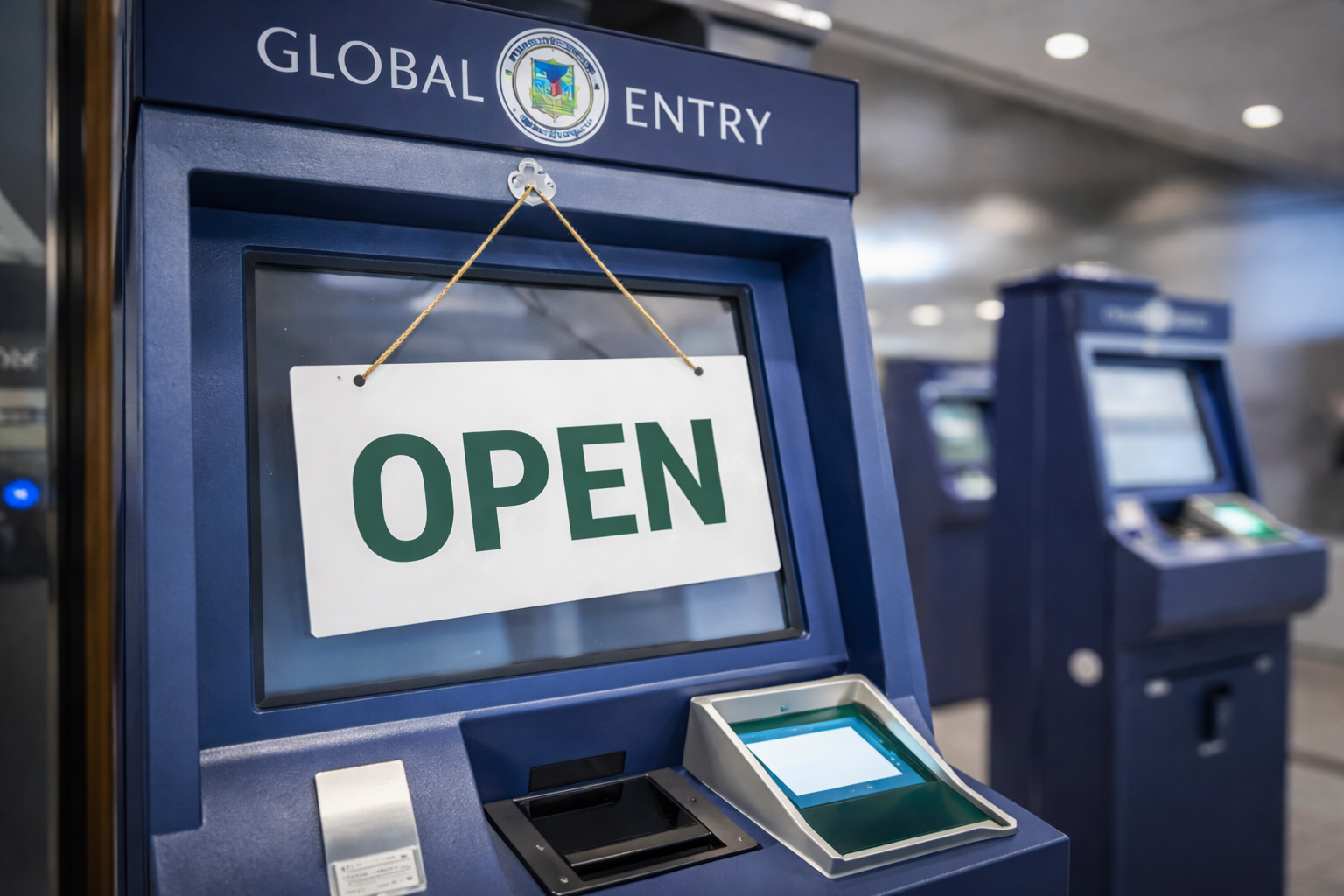
After more than two weeks offline, the Global Entry trusted traveler program has reopened. That’s welcome news for frequent international travelers, especially those who’ve gotten used to breezing past the regular immigration lines after a long flight home.
But while the reopening is the headline, it’s not really the most interesting part of the story. The bigger question is why Global Entry was shut down at all.
The program had been suspended since February 22, during the Department of Homeland Security shutdown, and from the beginning, the decision struck many people as bizarre. After all, Global Entry exists to move pre-vetted, low-risk travelers through the airport faster. Shutting it down seemed less like a solution and more like a way to make the whole system work worse on purpose.
What Global Entry Is Supposed To Do
Global Entry is one of several trusted traveler programs run by U.S. Customs and Border Protection. Travelers apply, pay a fee, go through background checks, and complete an interview. Once approved, they can use automated kiosks or facial recognition processing when returning to the United States.
The idea behind the program is pretty straightforward. If the government can identify lower-risk travelers in advance, those passengers can be processed more quickly, freeing officers to spend more time on others. It’s one of those rare airport programs designed to help both travelers and the agency that runs it.
Why DHS Said It Was Paused
When the shutdown began affecting DHS operations in late February, officials said they needed to prioritize staffing and resources. According to reports at the time, personnel who normally supported Global Entry operations were being reassigned to handle the general traveling public.
On the surface, that explanation sounds reasonable enough. If you’re short on staff, you move people where they’re needed most. But that logic falls apart the more you look at what Global Entry actually does.
Why So Many People Thought That Made No Sense
The whole point of Global Entry is to reduce the burden on officers by speeding up processing for people who have already been vetted. Suspending it meant that travelers who would normally use kiosks or expedited entry lanes were suddenly pushed back into the regular immigration lines.
That’s why the backlash came so quickly. Critics argued that the move didn’t save resources at all. It just shifted more travelers into the slower process, increasing congestion and forcing officers to spend more time handling passengers who had already been cleared as low risk.
The U.S. Travel Association was especially blunt, saying the suspension “doesn’t save resources—it wastes them” and adding that there was “no fiscal—or logical—rationale” for the decision. That criticism landed even harder because Global Entry is largely funded by its own application fees, which made the shutdown look even more like a self-inflicted problem than a necessary budget move.
The Backlash Kept Growing
Travel groups, airlines, and bloggers all piled on, and not because they were making some abstract policy argument. Their point was much simpler: this program was designed to make airport processing more efficient, and turning it off was almost guaranteed to have the opposite effect.
Ben at One Mile at a Time summed up the confusion well when he questioned how staffing issues were supposed to improve by making immigration processing take longer. Other writers made similar points, noting that previous shutdowns hadn’t led to the same kind of disruption and that trusted traveler programs are supposed to help airports function better when things get strained, not worse.
Airlines for America also pushed back, with CEO Chris Sununu saying travelers were being used as a “political football.” Even if you stay away from the politics of the shutdown itself, it was hard to miss the practical problem: the people getting caught in the middle were travelers, and the decision seemed to create exactly the kind of delays these programs are meant to prevent.
What Travelers Saw On The Ground
For passengers arriving while Global Entry was offline, the impact varied by airport. Some travelers reported that kiosks were simply turned off, sending everyone into the same standard lines. Others described airports improvising with alternate processing methods to keep things moving.
That inconsistency only added to the frustration. If some airports were finding workarounds anyway, it raised an even more obvious question of whether the shutdown of the program itself was ever really necessary.
Why It Took Until Now To Reverse Course
DHS announced on March 11 that Global Entry would resume, roughly 17 days after the suspension began. In its statement, the agency said it was restoring the program while continuing to work to “alleviate disruptions” for travelers caused by the shutdown.
That’s a neat bit of phrasing, because it allows DHS to present the reopening as a solution without admitting it was suspending Global Entry that created the problem in the first place. And that may be the part that makes this whole episode such a head scratcher.
If the goal was to reduce strain on the system, shutting down one of the tools designed to do so was always going to be a tough sell. The longer it stayed offline, and the more crowded the airports became, the harder it was to defend that decision.
Final Thought
For travelers, the good news is simple: Global Entry is back, and international arrivals should be a little smoother again. But the reopening doesn’t really make the original decision look any smarter.
In the end, this is what made the whole thing so puzzling. Global Entry is meant to make airport processing faster, more efficient, and less burdensome for both travelers and officers. Shutting it down was always likely to have the opposite effect. And it’s not like we’re going to get a refund of our fee for the time it was not working.
Want to comment on this post? Great! Read this first to help ensure it gets approved.
Want to sponsor a post, write something for Your Mileage May Vary, or put ads on our site? Click here for more info.
Like this post? Please share it! We have plenty more just like it and would love it if you decided to hang around and sign up to get emailed notifications of when we post.
Whether you’ve read our articles before or this is the first time you’re stopping by, we’re really glad you’re here and hope you come back to visit again!
This post first appeared on Your Mileage May Vary