Airlines know several ways to board passengers much faster. But using those methods could cost them billions.
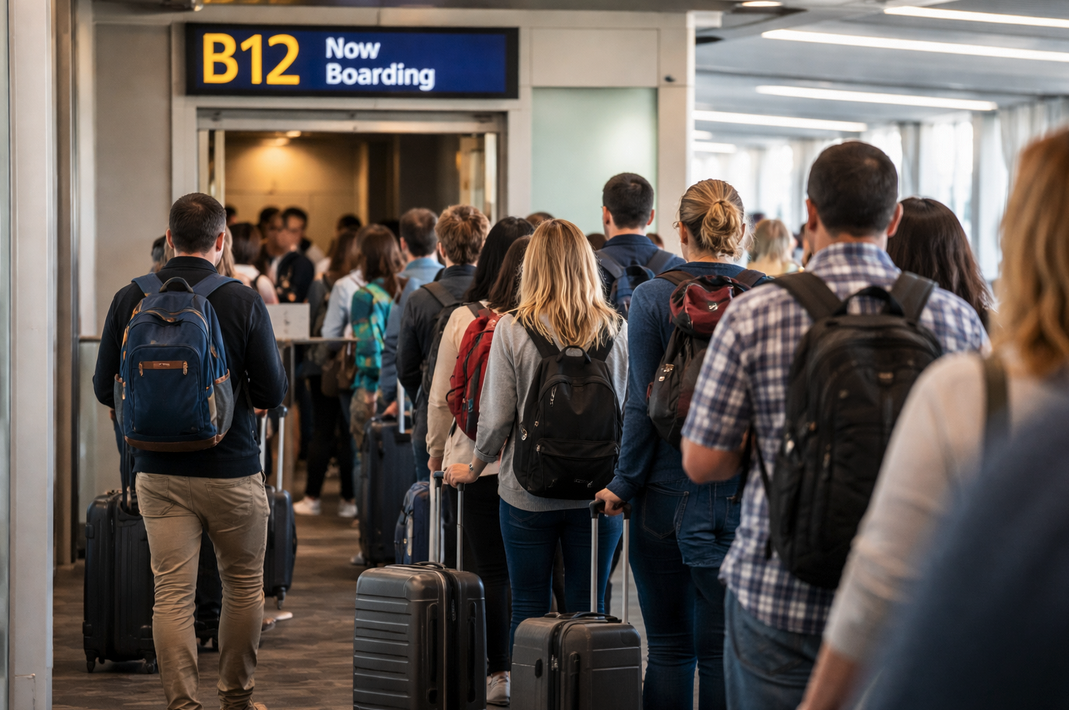
Waiting to board a plane for a U.S. domestic flight is a test of patience. You have to wait until your group is called, then wait behind everyone in the same group as yours who’ve been gate lice since the very first group was called. Then you usually have to wait on the jetway. Once you’re actually on the plane, you still have to wait for every single person who’s (still) in the aisle. Once you get to your seat in Row 24, you cross your fingers there’s still overhead space left. And THEN you can finally sit down.
All told, it typically takes well over half an hour to board the plane, and it’s an arduous process for everyone involved.
Meanwhile, according to Airlines for America, ground time costs airlines more than $100 per minute. Multiply that by the number of flights each airline operates every day, and it adds up to millions of dollars per year. Airlines can also be dinged by the FAA if they don’t take off on time frequently enough (JetBlue was slapped with a $2 million fine early last year because of chronic flight delays).
With passengers now taking longer to get settled, often because they’re trying to cram everything into carry-ons instead of paying checked bag fees, some airlines have simply added five minutes or so to the boarding process. Instead of beginning to load the plane 45 minutes in advance, some start 50 minutes in advance, so they can take off on time.
Ways airlines could load faster
The thing is, airlines already know several ways to board passengers faster.
Mythbusters had an entire episode devoted to the best loading plan for planes.
Astrophysicists determined a procedure that could potentially load planes with 28% more efficiency.
And over the years, some airlines did indeed figure out ways to board faster:
- According to Forbes, United tinkered with using the WILMA window-to-aisle boarding for a short period of time in 2023 and it shaved an average of two minutes per flight.
- American West pioneered a “reverse pyramid” style of boarding process. It combined the advantages of boarding from the back of the plane with the WILMA outside-in approach. The airline reported this method removed over two minutes from the boarding process, with full flights boarding about 20% faster.
- Until it was recently changed to assigned seating, Southwest’s random seating was remarkably efficient.
- Ryanair boards from the front AND the back – it cuts the passenger flow in half, logically, even with assigned seats (of course, this is possible for planes that use a jetway.
- easyJet and Gatwick Airport trialled a hybrid method called bingo boarding. It was a variation of the reverse pyramid strategy, combining back-to-front and outside-in. It shaved about 10% off boarding time
Why airlines won’t adopt any of these techniques
So if airlines have all these options to speed up boarding, why do they keep using such slow, inefficient methods?
Simple…money.
Over the years, airlines have learned a lot about what’s going on in the heads of people who are waiting to get onto a plane.
- They want to ensure there’s room for their stuff in the overheads
And therefore…
- They want to be in their seat and settled as quickly as they can
And airlines, being smart, have figured out ways to monetize both of those wants.
If the goal for passengers is to get onto the plane as quickly as they can, airlines have developed ways so they can do that. But it’s going to cost them.
Paying for priority boarding, paying for a credit card that gets you earlier boarding, giving people status for paying to fly more often with them are all ways to get onto the flight faster.
And if that’s not enough, some airlines have increased their number of groups (or zones) that will go onto the plane, (if you include the groups before their “numbered” groups, one airline has 12 groups!) complete with a promise/threat that if you’re in the last handful of groups, there’s no way there will be room for your carry-on in the overhead bin. The metacommunication of THAT is, of course, pay to be in one of the earlier groups.
This ancillary revenue, which also includes seat selection fees, checked bag fees, Wi-Fi purchases and onboard refreshments, is a multi-billion-dollar business. (Airlines worldwide earned somewhere around $157 billion in ancillary revenue in 2025). When Southwest Airlines saw how much money other U.S.-based airlines got by making people pay for assigned seats, to get onto the plane earlier, etc., it’s no wonder they switched from open seating to assigned seats.
Airlines absolutely know how to board planes faster. Researchers, airlines, airports and even TV shows have been testing more efficient methods for years.
But faster boarding doesn’t necessarily mean more profit. As long as passengers are willing to pay extra for early boarding and a better shot at overhead bin space, airlines have very little reason to make the process more efficient for everyone.
Want to comment on this post? Great! Read this first to help ensure it gets approved..
Want to sponsor a post, write something for Your Mileage May Vary, or put ads on our site? Click here for more info.
Like this post? Please share it! We have plenty more just like it and would love it if you decided to hang around and sign up to get emailed notifications of when we post.
Whether you’ve read our articles before or this is the first time you’re stopping by, we’re really glad you’re here and hope you come back to visit again!
This post first appeared on Your Mileage May Vary