A TSA policy change made airport security a little easier for travelers—but a new report suggests it may have come with unintended risks.
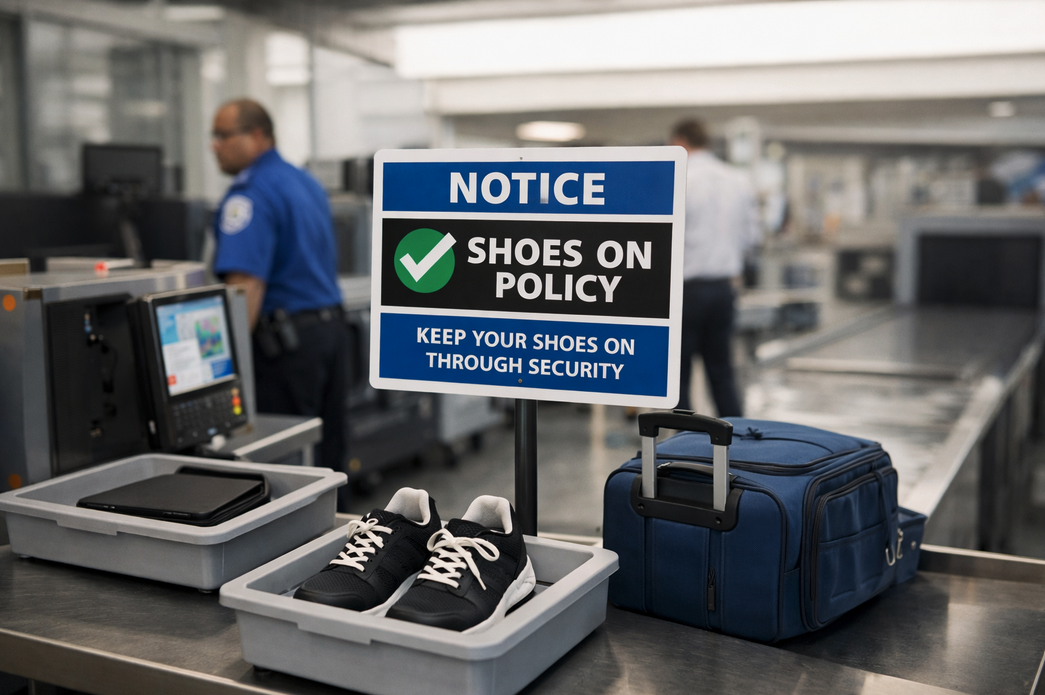
In July 2025, the Department of Homeland Security (DHS) made a sudden policy change: all passengers traveling through domestic airports, not just those with TSA PreCheck, could now keep their shoes on at the TSA security checkpoint.
For years, most travelers had to follow the same routine: shoes off, laptops out, and liquids separated. TSA PreCheck, introduced in 2013, allowed approved “trusted travelers” to skip many of those steps—but everyone else still had to follow them.
Passengers cheered the new rule since, let’s face it, having to take your shoes off and then put them back on—especially when you’re juggling your own stuff (and possibly your kids’ too)—is a pain. So the policy change was especially popular with travelers who didn’t have TSA PreCheck.
Why The Shoes-Off Rule Existed In The First Place
A high-ranking DHS official said: “We are excited with the fact that we have the technology now that we have the multi layers of screening in place that we’ve built in over the recent several years, they give us the ability to allow our travelers to keep their shoes on.”
However, CBS is reporting that a new internal watchdog report – one that appears to have been ignored and largely “buried” by the Department of Homeland Security (DHS) – suggests that the new policy may have created potentially “serious vulnerabilities” at the checkpoints.
The “shoes off” policy came about after “shoe bomber” Richard Reid tried to detonate explosives hidden in his sneakers while on a flight from Paris to Miami. Fortunately, his attempt failed, but it changed the structure of our aviation security. By 2006, the TSA had implemented its mandatory “shoes off” policy to ensure that footwear wasn’t used to conceal liquid or plastic explosives.
Of course, this meant spending even more time in lines. But it offered a layer of protection against Reid’s type of threat, which had nearly been successful.
However, in 2025, the government was pushing for a “shoes on” policy to help streamline the queues and make them run faster. Investigators are now questioning whether the decision was made before screening technology could reliably detect threats in footwear.
The Report’s Findings Were More Serious Than Travelers Realized
In fact, according to the Wall Street Journal, “a classified November report by the Department of Homeland Security’s inspector general, the agency’s top watchdog, found that some of the TSA full-body scanners that most airline passengers pass through” were actually unable to scan shoes, according to people familiar with the report’s contents.
From CBS:
After a classified inspector general audit deployed “red team” testing of airport checkpoints — undercover audits in which investigators attempt to slip simulated weapons or explosives past screeners — investigators raised serious concerns about vulnerabilities in TSA screening procedures.
But potentially even more concerning than the findings themselves is how they were handled. The report, which identified these critical security risks, was reportedly provided to the Department of Homeland Security (DHS) five months ago. According to internal communications reviewed by CBS News, the report was largely “buried.”
Leadership at the time had told lawmakers on Capitol Hill that the agency had responded to and addressed the concerns in the inspector general’s report. However, it appears that might not be the case. As per CBS, a recent March 4 memo from Inspector General Joseph Cuffari says his office has not received any evidence to support that claim.
The journalism outlet also recently obtained internal communications provided to House Homeland Security Committee staff. It says that TSA has also not submitted a required response to the audit – which would be typical – even though the audit was released five months ago.
From CBS:
In fact, auditors say they are still waiting for even the most basic step in the oversight process: A formal “management decision” outlining whether TSA agrees with the findings and what corrective actions it plans to take.
Without that, the recommendations remain, in official terms, “open and unresolved.”
Why The Findings Weren’t Widely Shared
Unfortunately, according to the International Business Times, the red team’s key findings were elevated to Top Secret status. With that, DHS made the list of people who could see the report very small—only 13 people designated by the DHS secretary herself. The list included “three Members of Congress; two employees in OIG; seven employees in the [DHS]; and one employee in the Executive Office of the President.”
None of them were TSA officials. And the department also mandated that “any further distribution had to have … written permission.”
So the auditors had discovered a potentially significant national security risk, and the agency expected to fix it hadn’t been given access to the findings for five months.
Auditors repeatedly asked DHS for permission to share the testing results. Cuffari also asked for TSA to have access. But DHS didn’t reply. Nor did it meet basic procedural obligations, according to CBS.
Of course, DHS now has a new leader. Perhaps his interactions with other agencies will be different.
But for now, passengers continue to pass through airport security with their shoes on—even as questions remain about whether current screening technology can fully account for the change.
Want to comment on this post? Great! Read this first to help ensure it gets approved.
Want to sponsor a post, write something for Your Mileage May Vary, or put ads on our site? Click here for more info.
Like this post? Please share it! We have plenty more just like it and would love it if you decided to hang around and sign up to get emailed notifications of when we post.
Whether you’ve read our articles before or this is the first time you’re stopping by, we’re really glad you’re here and hope you come back to visit again!
This post first appeared on Your Mileage May Vary

2 comments
Forgive the cynicism, but is anyone surprised by this?
Not one bit.
But I’m very proud of myself for not sounding biased. 😉