We’ve all been there…you board your plane, headed somewhere nice and warm, so you’re dressed for where you’re landing. Probably in shorts and a T-shirt.
As you get all settled for your 3-hour flight, you notice it’s a little chilly inside the plane. But you figure it’s because the passenger door is still open, it’s cold outside, and air is blowing in from the jet bridge. It’ll warm up once you get on your way.
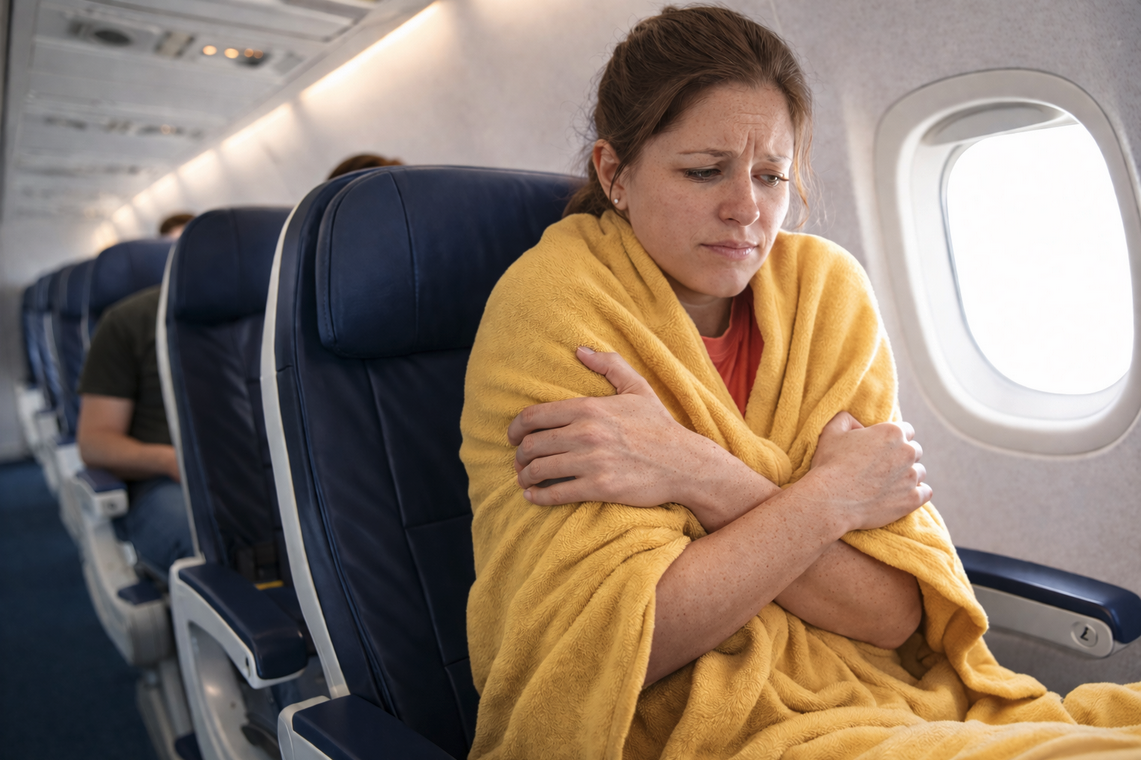
The plane takes off, and as you sit there, you realize it’s still pretty cold inside the plane. It never does warm up, and by the time you land in sunny, warm Pick A Place, you’re freezing.
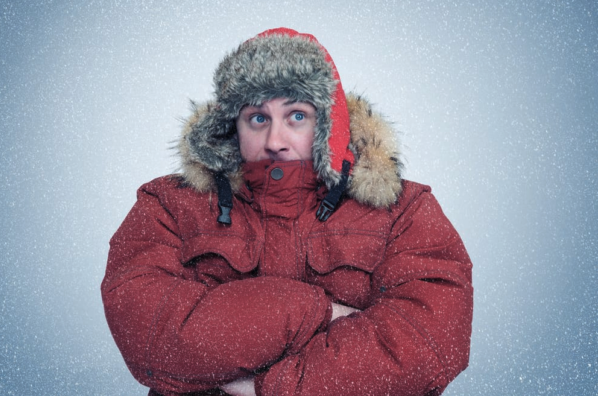
Why is it so cold?
So what’s up with that? Why is it so cold on planes? It turns out there’s an actual, medically-based reason, far beyond the usual theories you might’ve heard.
ASTM International (formerly known as American Society for Testing and Materials) is an international standards organization that develops and publishes voluntary consensus technical standards for a wide range of materials, products, systems, and services. Including planes. They conducted a study examining the correlation between people fainting in flight and the plane’s cabin pressure and temperature.
A medical reason
They discovered that the risk of people fainting (the medical term is “syncope” [SINK-oh-pee]) in-flight was about 3–9 per 1000 passenger flight hours, depending on the type of aircraft. They also realized this was happening because of a medical condition known as hypoxia. Hypoxia is when body tissues don’t receive enough oxygen, and ASTM International’s study determined that high cabin pressure and warm temperatures can both increase the chance of this reaction, even in otherwise healthy people.
Airlines can’t control cabin pressure the same way they can control temperature, but they can keep the cabin temperature on the cooler side to help reduce the risk of syncope.
At what temperature do they keep planes?
Despite the study and its findings, federal agencies don’t have specific guidelines for the temperature inside a plane cabin. However, the Association of Flight Attendants, the union representing 50,000 members working at more than 20 airlines, has been campaigning for years to get the federal government to put standards in place for cabin temperatures (The only temperature regulation now requires the cabin temperature to be within 5 degrees of the cockpit, but it doesn’t set minimums or maximums). They recommend a range of 65 to 75 degrees Fahrenheit.
Of course, the fact that you tend not to move around and just stay in one space just reinforces the feeling of being cold. If you were moving around the plane, you wouldn’t feel the chilliness as badly.
Oh, and if you could swear that planes used to be warmer years ago, you’d be right. The study was done in 2005 and published in 2008.
So if you tend to get chilly easily, bring a sweater with you on that plane. Just in case you need it.
Want to comment on this post? Great! Read this first to help ensure it gets approved.
Want to sponsor a post, write something for Your Mileage May Vary, or put ads on our site? Click here for more info.
Like this post? Please share it! We have plenty more just like it and would love it if you decided to hang around and sign up to get emailed notifications of when we post.
Whether you’ve read our articles before or this is the first time you’re stopping by, we’re really glad you’re here and hope you come back to visit again!
This post first appeared on Your Mileage May Vary

2 comments
Colder cabins are also helpful for people prone to motion sickness, as lower temps help with regulation of that.
Like I said, there are the “theories” that everyone has. Air sickness. Keeping people awake. Sadistic FAs ;-). But the main reason is syncope.