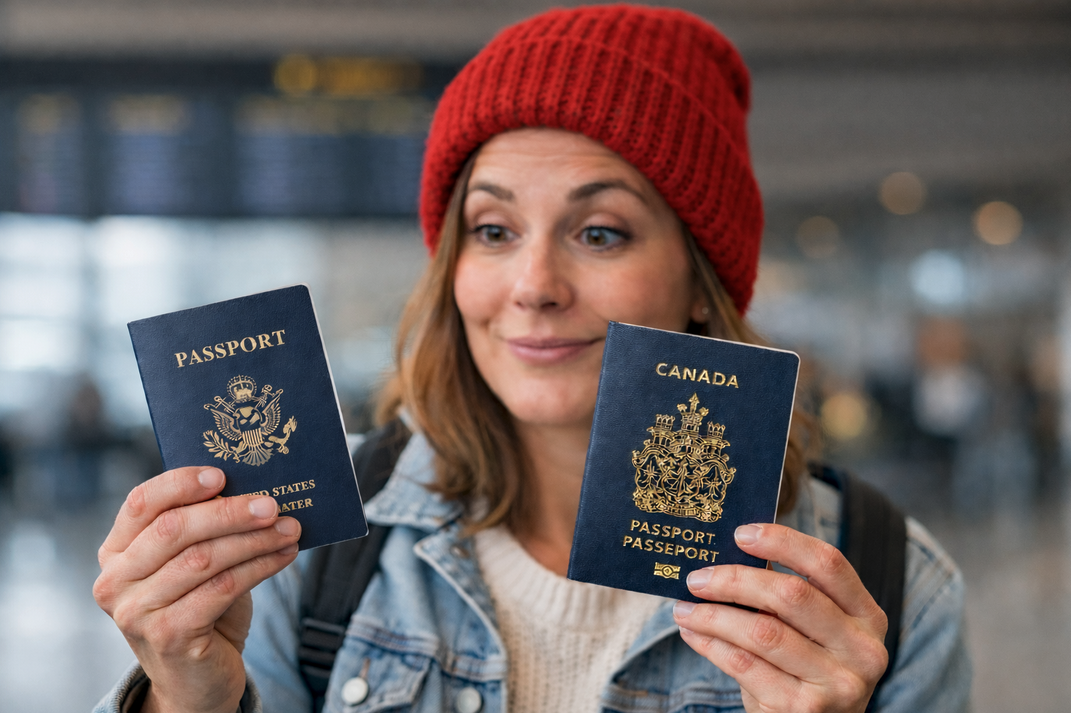
You’ve probably heard of people having dual citizenship. Having citizenship in two countries can be incredibly useful, since it allows you to work and own property in more than one country. It also gives you the ability to have two passports, and therefore greater potential ability to travel.
As it turns out, millions of Americans may now qualify for Canadian citizenship — and therefore obtain a Canadian passport.
For years, Canada’s government imposed a “first-generation limit” on obtaining Canadian citizenship. The ruling said that if you were the child of someone who was a Canadian citizen, you were also a Canadian citizen, even if you were born outside Canada. However, that ability was limited to those who were the ‘first generation’ from that original Canadian citizen. That Canadian’s grandchildren, for example, couldn’t claim Canadian citizenship if they had been born outside Canada.
They updated the rules several times, but citizenship still didn’t go beyond one generation of foreign-born descendants.
However, Canada’s citizenship landscape changed this past December, when a new law, Bill C-3, went into effect. Under that bill, if any ancestor in your direct line was born in Canada or held Canadian citizenship, you may have automatically acquired Canadian citizenship at birth — retroactively.
Here’s how to determine your eligibility:
Scenario 1: Your parent was born in Canada
If your parent was born in Canada, there’s a very good chance you’re already a Canadian citizen—no matter when you were born.
That was true even before this newest law. If you’ve never officially confirmed it, you can apply for a citizenship certificate to make it official.
Scenario 2: Your grandparent was born in Canada (but your parent wasn’t)
This is where things get interesting—and where the new law really matters.
As we said earlier, in the past, Canada had its “first-generation limit,” meaning citizenship didn’t automatically pass down beyond one generation born outside the country.
That restriction has now been removed. So if your grandparent was born in Canada and your parent was born before December 15, 2025, your parent is now considered a Canadian citizen retroactively—which means you are, too.
Scenario 3: Your great-grandparent (or earlier) was born in Canada
You might still qualify—but this is where it gets a little more complicated.
For people born on or after December 15, 2025, there’s a new “substantial connection” rule. Basically, the Canadian-born ancestor’s child (the next generation) needs to have spent at least 1,095 days (three years) physically in Canada before passing citizenship down.
However—and this is the key part—for anyone born before that date (which includes pretty much all current adults), that requirement doesn’t apply.
So in many cases, citizenship can still flow down through multiple generations.
So now what?
If you think you’re now eligible to claim Canadian citizenship, and you think it would benefit you if you did (remember – if you have Canadian citizenship, you can get a Canadian passport, which is currently ranked as 7 on the Henley Passport Index. U.S. passports are currently ranked as 10 – the lowest it’s been in the past 20 years), you can start the application process to get all the documentation you need to get a Canadian certificate of citizenship.
The documents you need
Obviously, the documents you need will depend on your family history. But this is a good start:
Required documents for a citizenship-by-descent application:
- Your birth certificate (long form, showing parents’ names)
- Your parent’s birth certificate (long form)
- Your grandparent’s birth certificate (if claiming through grandparent)
- Your great-grandparent’s birth certificate (if applicable)
- Marriage certificates for each generation (to establish name changes and lineage)
- The Canadian ancestor’s proof of Canadian birth or citizenship
I’m a good example of how this could work. My maternal grandmother was born in Montreal but had immigrated to the U.S. at some point and married my grandfather, an American. According to Canadian law, their daughter, my mother, was both an American and Canadian citizen, because her mother had been born in Canada.
So to prove my citizenship-by-descent, I would need:
- My marriage license (to prove my name change)
- my birth certificate
- My parents’ marriage license (to prove my mom’s name change)
- My mother’s birth certificate
- My grandparents’ marriage license (to prove my grandmother’s name change)
- My grandmother’s Canadian birth certificate
How to obtain Canadian vital records
Similar to how it’s done in the U.S., each province maintains its own records. Refdesk.ca has a list of the official entities you can contact to try to get the required paperwork, as well as a step-by-step of the process.
Heads up that a LOT of Americans are suddenly trying to go through this process, to the tune of a 3000% increase in record requests, as per CBC News. Getting the proper documentation could take several months.
FAQ: Should you pursue this?
That’s not something that a travel blogger can tell you. 😉
Of course, all it costs is your time to research genealogy records to see if you have grandparent, great-grandparent, etc. who is/was Canadian. If it appears that you do, you most likely already have Canadian citizenship; it’s just a matter of whether or not you want to invest the time and money to pursue getting a certificate to make it “official,” and then potentially jumping through the hoops to obtain a Canadian passport after that.
Whether or not you should do all of that is definitely a Your Mileage May Vary decision.
One other caveat
Before you start this journey, heads up that the U.S. government is currently considering something called the Exclusive Citizenship Act of 2025.
Introduced by Senator Bernie Moreno (R – Ohio) in December 2025, if voted into law, it would ban dual citizenship for Americans. So your Canadian citizenship would be finished before it even got started (unless you decided to renounce your U.S. citizenship instead, of course).
Legal and policy experts give it about a 3% chance of passing. Constitutional limits, real-world enforcement problems, and weak bipartisan support make it very unlikely that the bill will be passed and become law.
For now, dual citizenship is still fully legal today.
At the end of the day, this isn’t about whether you should get Canadian citizenship and potentially a Canadian passport—it’s about knowing you might already have the option.
And for some people, that option could open a lot of doors.
Want to comment on this post? Great! Read this first to help ensure it gets approved.
Want to sponsor a post, write something for Your Mileage May Vary, or put ads on our site? Click here for more info.
Like this post? Please share it! We have plenty more just like it and would love it if you decided to hang around and sign up to get emailed notifications of when we post.
Whether you’ve read our articles before or this is the first time you’re stopping by, we’re really glad you’re here and hope you come back to visit again!
This post first appeared on Your Mileage May Vary