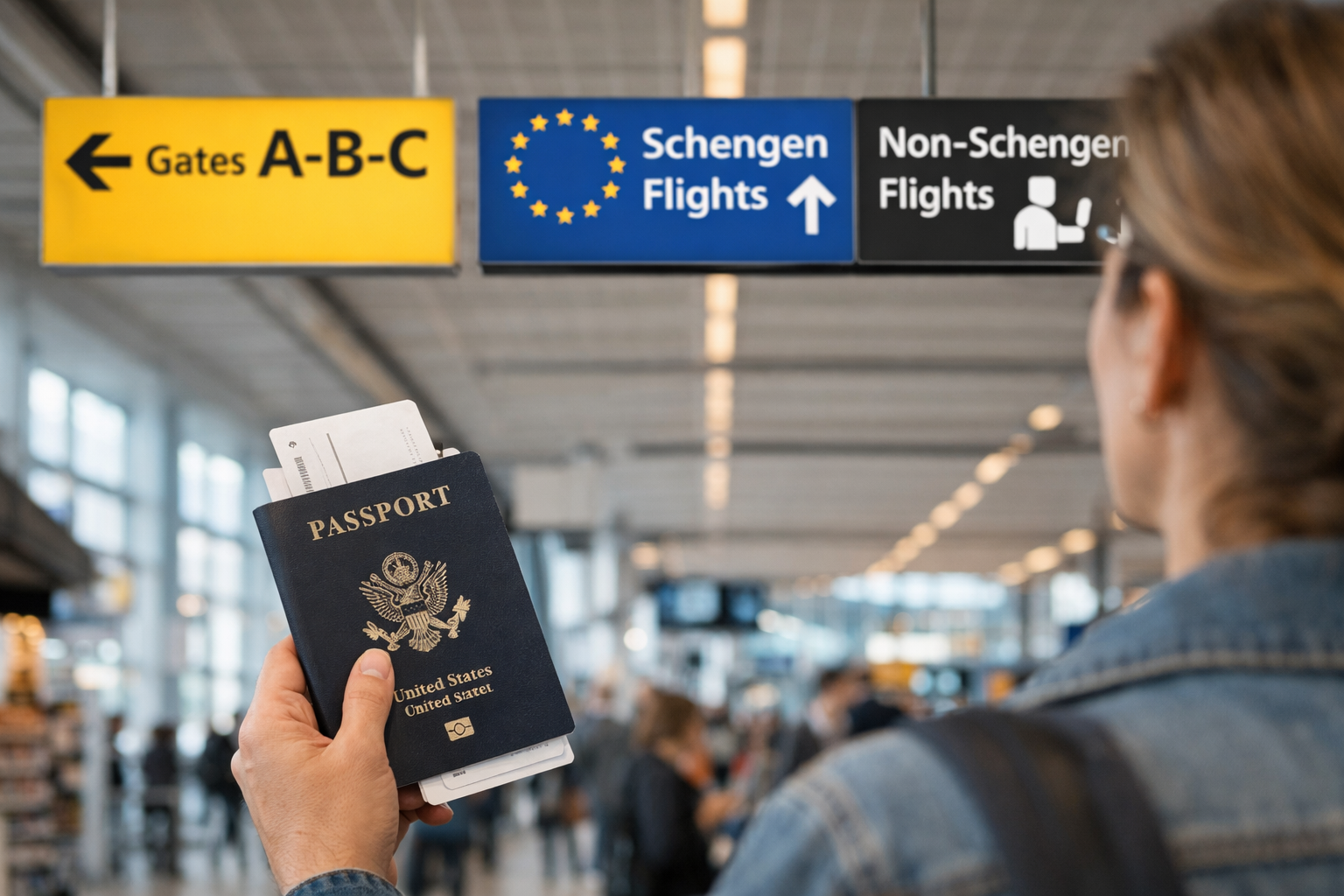
If you’re used to flying within the U.S., the rules are pretty straightforward:
Domestic flight? No passport.
International flight? Passport.
Then you fly through Europe… and suddenly none of that logic seems to apply.
You might land in one country, go through passport control there, and then fly to another country without showing your passport again. Or you might not go through passport control until the end of your trip.
It feels backward.
And the confusing part? It’s actually working exactly the way it’s supposed to.
Understanding why this happens can save you a lot of confusion—and help you avoid missing a connection because you didn’t expect where (or when) passport control would happen.
It’s Not About Countries—It’s About Schengen
The biggest shift for Americans?
It’s not about countries—it’s about the Schengen Area.
Once you’re inside that zone, travel between countries works a lot like a domestic flight in the U.S.—no passport control.
That’s why you might not need to show your passport when visiting multiple European countries, something we wrote about in more detail here:
Why Don’t You Need To Show Your Passport When Visiting Multiple European Countries?
The Three Types of Flights in Europe
Once you understand Schengen, flights fall into three categories:
- Non-Schengen → Schengen: You’re entering the zone, so you’ll go through passport control.
- Schengen → Schengen: No passport control. These feel like domestic flights.
- Schengen → Non-Schengen: You’re leaving the zone, so you’ll go through exit passport control.
Simple enough—until you add connections.
Where It Gets Confusing
The complexity comes from how these flight types get mixed together.
You might:
- Arrive in one Schengen country and connect to another
- Fly within Schengen and then leave the zone on a connecting flight
- Or connect between two non-Schengen flights and never officially enter the zone at all
And depending on your itinerary, passport control might happen at the beginning of your trip, in the middle, or right before you leave.
For many travelers, that’s the part that feels completely backward.
A Real Example: How This Played Out For Us
On a previous trip, we flew from London Gatwick to Berlin, then connected from Berlin to Salzburg.
Here’s how that worked:
- London Gatwick → Berlin:
The U.K. is not part of Schengen, so this was a non-Schengen → Schengen flight. We went through passport control when we landed in Berlin. - Berlin → Salzburg:
This was a Schengen → Schengen flight, so there was no additional passport control. It felt just like a domestic connection.
Even though Austria was our final destination, we technically entered the Schengen Area in Germany.
If you weren’t expecting that, it can feel like you’re going through immigration in the “wrong” country—but that’s exactly how the system is designed.
That’s why your passport might get stamped in a country you’re only connecting through.
A common mistake travelers make
One of the most common mistakes travelers make is assuming they’ll go through passport control at their final destination.
In Europe, that’s often not the case—you usually go through it at your first stop inside the Schengen Area.
And Then There Are Non-Schengen Connections
It gets even stranger when you’re connecting between two non-Schengen flights.
In some cases, you can transit through a Schengen airport without ever officially entering the Schengen Area. That usually means:
- No passport control at your connection point
- Staying in a designated international transit area
But—and this is important—not every airport handles this the same way.
When in Doubt, Check the Airport (or Airline) Website
Even if you understand the rules, every airport has its own layout and procedures.
That’s why many major European airports publish detailed connection guides.
For example, Amsterdam Airport Schiphol has a detailed transfer guide explaining what happens depending on your routing. Airlines do the same—Air France provides step-by-step connection guidance for Paris airports.
These guides can tell you:
- Where you’ll go through passport control
- Whether you’ll need to clear security again
- If you can stay airside or need to change terminals
Even when you think you know what’s going to happen, it’s worth checking—because small differences in routing can completely change the experience.
Final Thought
The easiest way to think about it is this:
You’re not entering or leaving a country—you’re entering or leaving the Schengen Zone.
Once you understand that, everything else starts to make more sense—even if it still feels a little backward the first time you experience it.
Because in Europe, you’re not really traveling between countries—you’re crossing in and out of a shared border system that doesn’t work the way most Americans expect.
Want to comment on this post? Great! Read this first to help ensure it gets approved.
Want to sponsor a post, write something for Your Mileage May Vary, or put ads on our site? Click here for more info.
Like this post? Please share it! We have plenty more just like it and would love it if you decided to hang around and sign up to get emailed notifications of when we post.
Whether you’ve read our articles before or this is the first time you’re stopping by, we’re really glad you’re here and hope you come back to visit again!
This post first appeared on Your Mileage May Vary