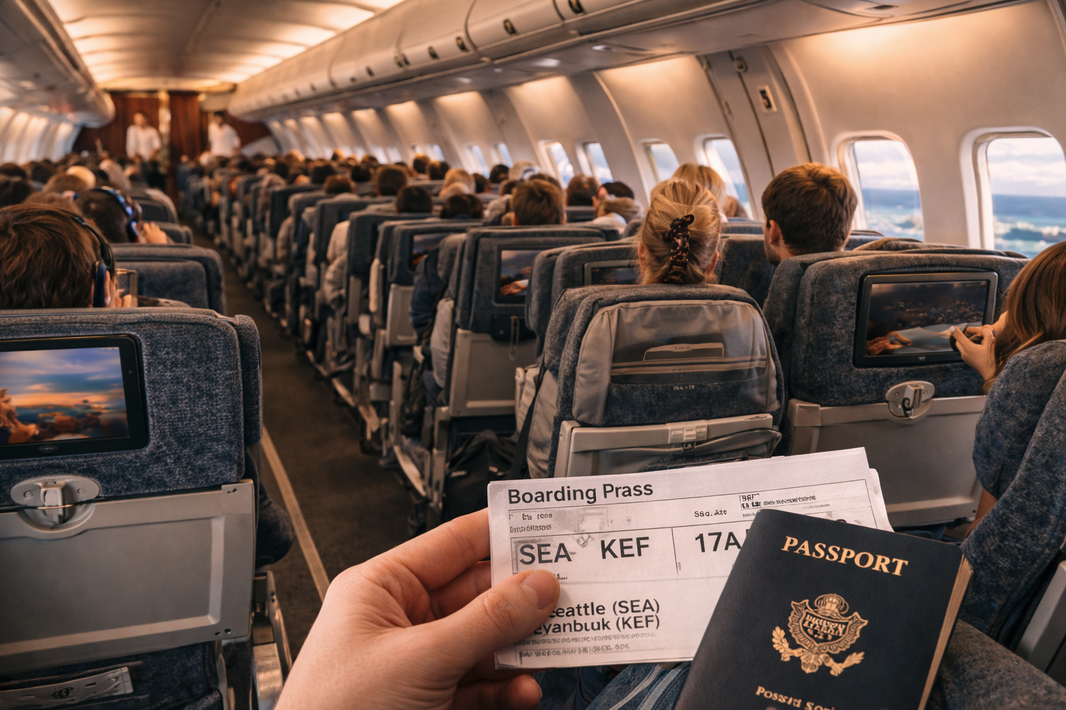
Airlines are stretching narrowbody flights longer than ever. At what point does it become too much?
For years, U.S. travelers have gotten used to flying long distances on narrowbody planes.
Flights like Orlando to Seattle, Los Angeles to New York, or San Francisco to Boston routinely push 5 to 6 hours on a single-aisle aircraft. It’s not always comfortable, but it’s become normal enough that most of us don’t think twice about it, especially if it’s nonstop.
Now, airlines are starting to stretch that idea even further.
As reported in this MSN article about Alaska’s new Seattle-to-Iceland route, Alaska Airlines is planning to fly a Boeing 737 MAX across the Atlantic. That’s a pretty big jump from the long domestic narrowbody flights most of us are used to.
And it raises an interesting question:
At what point does a narrowbody flight feel too long?
To be fair, narrowbody aircraft have been doing this kind of flying for a while.
Icelandair built much of its business on getting travelers between North America and Europe on smaller planes. We’ve even made that trip ourselves, although in our case we lucked out with a widebody. When we flew Icelandair from JFK to Keflavík, it was on a 767-300, and having two aisle seats made the trip much more bearable than it otherwise might have been.
If you want to see what that experience was like, here’s our review of Icelandair’s 767-300 in economy between JFK and KEF.
That’s part of what makes Alaska’s new route so interesting. It’s a similar type of journey, but potentially a very different onboard experience.
We’ve already been easing into this
It’s not like this trend came out of nowhere.
In the U.S., plenty of us already spend 5 or 6 hours on narrowbody aircraft without thinking much about it. We’ve done it ourselves, including an Orlando-to-Los Angeles flight on Delta’s A321neo. It wasn’t luxurious, but it was perfectly fine for a nonstop domestic trip.
You can read about that flight here: our unexpected flight on Delta’s first A321neo.
That’s probably the closest comparison most U.S. travelers have today. Long narrowbody flights already feel normal when they’re domestic. But once you push them closer to 8 hours and send them over the Atlantic, it starts to feel like something else.
Is 8 hours different…or just more of the same?
There’s something about crossing the 7-hour mark that changes expectations.
Up to a certain point, a narrowbody flight just feels like a longer version of a domestic trip. You bring a tablet, download a few shows, log onto the Wi-Fi, and deal with it.
But once you get closer to 8 hours, it starts to feel like a true long-haul flight. And with that comes different expectations. You start thinking more about how much room you’ll have, whether you can sleep, what the food will be like, and how the cabin will feel after several hours in the air.
That’s where the difference between narrowbody and widebody really starts to show—not just physically, but mentally.
But nonstop still matters
Of course, there’s one big advantage to flights like this: they’re nonstop.
That changes the equation for a lot of people.
A narrowbody flight that’s a little less comfortable may still win if it saves a connection, cuts travel time, or opens up more options on either end. That’s especially true for travelers who might connect onward from Iceland to somewhere else in Europe, or who might use Seattle as a gateway to other oneworld flights.
So the real question might not be whether a narrowbody is ideal for a route like this.
It might be whether the convenience of a simpler itinerary outweighs the comfort of a bigger plane.
How long is too long?
Most of us probably have a personal threshold, even if we’ve never really defined it.
For some people, 3 or 4 hours on a narrowbody is easy. Five or 6 hours is manageable. Beyond that, opinions start to split.
Some travelers will look at an 8-hour narrowbody flight and shrug. If the price is right and it’s nonstop, they’re in.
Others will hit a point where aircraft type starts to matter more, and that’s when they’ll begin choosing a widebody or a different routing, even if it takes longer.
So…would you do it?
This isn’t about whether the plane can make the trip. Clearly, it can.
It’s more about whether the experience matches what you want from a flight of that length.
As airlines keep opening long, thin routes with more efficient aircraft, flights like this are only going to become more common.
Would you book an 8-hour narrowbody flight if it meant going nonstop? Or is that where you draw the line?
Want to comment on this post? Great! Read this first to help ensure it gets approved.
Want to sponsor a post, write something for Your Mileage May Vary, or put ads on our site? Click here for more info.
Like this post? Please share it! We have plenty more just like it and would love it if you decided to hang around and sign up to get emailed notifications of when we post.
Whether you’ve read our articles before or this is the first time you’re stopping by, we’re really glad you’re here and hope you come back to visit again!
This post first appeared on Your Mileage May Vary