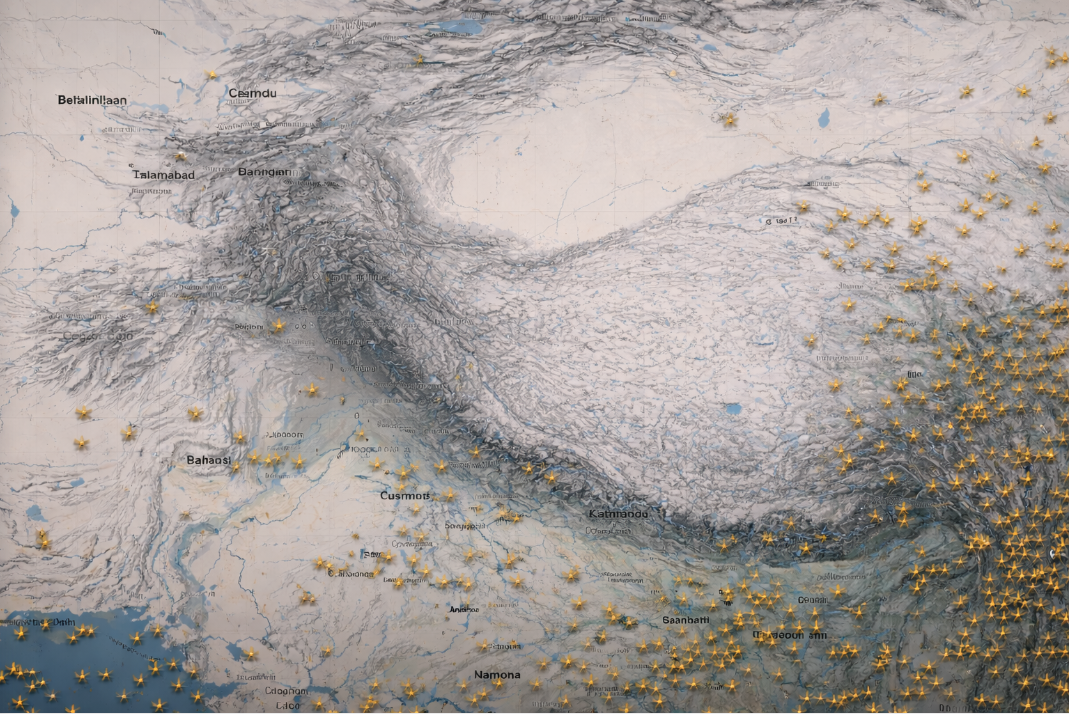
It’s not restricted airspace—so why do airlines avoid it? The answer has more to do with safety than politics.
If a location is a no-fly zone (also known as an air exclusion zone), then planes generally won’t fly over it—unless air traffic control directs otherwise. ATC typically has the final say.
Areas experiencing conflict (such as Russia and Ukraine) are often designated no-fly zones. So are locations with high security, such as Nevada’s Area 51.
But sometimes, planes avoid certain places for entirely different reasons.
For example, Walt Disney World and Disneyland have had limited no-fly zones for years. (Several members of Congress have called for those restrictions to be lifted, but so far, they remain in place.)
Planes also tend to avoid flying over large stretches of the Pacific Ocean unless necessary (here’s why). And for completely different reasons, United and Hawaiian often avoid flying over Mexico.
And then there’s Tibet.
An autonomous region of China, Tibet spans about 970,000 square miles, yet much of it is sparsely populated.
The region sits on the Tibetan Plateau, which is surrounded by massive mountain ranges. The relatively flat northern portion, known as the Qiangtang, stretches more than 800 miles from west to east and sits at an average elevation of about 16,500 feet above sea level.
And that’s where things start to get complicated.
This video does a great job breaking down why flying over Tibet isn’t as simple as it might seem:
Why planes avoid Tibet
Commercial aircraft typically cruise between 30,000 and 35,000 feet. In an emergency—such as cabin depressurization or engine failure—pilots need to descend quickly to around 10,000 feet, where passengers can safely breathe without supplemental oxygen.
But over Tibet, that’s not always possible.
The mountains are simply too high.
Yes, oxygen masks can deploy—but they only provide about 10–15 minutes of oxygen, which is typically just enough time for the aircraft to descend to a safer altitude. If the terrain below is already near or above that altitude, it creates a serious safety concern.
There’s also the issue of demand. Despite covering nearly 13% of China’s landmass, Tibet accounts for only about 0.2% of the country’s population, so there’s limited need for routes over the region.
Turbulence is another factor. Mountain ranges disrupt airflow, forcing air currents upward and creating more unstable conditions. That can lead to rougher flights compared to routes over flatter terrain.
And finally, temperatures at high altitudes over mountainous regions can be extremely cold. While rare, there is a small risk that prolonged exposure could affect fuel temperatures.
The bottom line
Tibet isn’t off-limits—but it’s not ideal, either.
Between the extreme elevation, limited emergency options, and challenging flying conditions, most airlines simply choose routes that are safer and more practical.
In other words, it’s not that planes can’t fly over Tibet—it’s that, in most cases, they’d really rather not.
Want to comment on this post? Great! Read this first to help ensure it gets approved.
Want to sponsor a post, write something for Your Mileage May Vary, or put ads on our site? Click here for more info.
Like this post? Please share it! We have plenty more just like it and would love it if you decided to hang around and sign up to get emailed notifications of when we post.
Whether you’ve read our articles before or this is the first time you’re stopping by, we’re really glad you’re here and hope you come back to visit again!
This post first appeared on Your Mileage May Vary