You undoubtedly know the story about Miracle on the Hudson. On January 15, 2009, US Airways Flight 1549 made an emergency landing in the Hudson River shortly after takeoff due to a dual engine failure caused by a bird strike (the plane struck a flock of Canada geese at an altitude of 2,818 feet). Due to the quick thinking of pilots Chesley “Sully” Sullenberger and Jeffrey Skiles, there were no fatalities and all 155 people on board the Airbus A320 were rescued.
More recently, Delta Flight 2606 was leaving LAX on its way to Seattle when the plane—carrying 93 passengers and six crew members—had to turn around and land safely after a bird was sucked into one of the engines shortly after takeoff.
In the aftermath of a bird strike, you typically hear about what we’ve just reported:
- Information about the plane (airline, where it was going, type of plane, the people on the plane, etc.)
- Where/how many birds hit the plane
- What happened to the plane due to the bird strike
As well as, of course, a rehashing of what happened, moment by moment, second by second.
What you don’t hear
Know what you never hear about? How do they clean all that bird gunk from the plane?
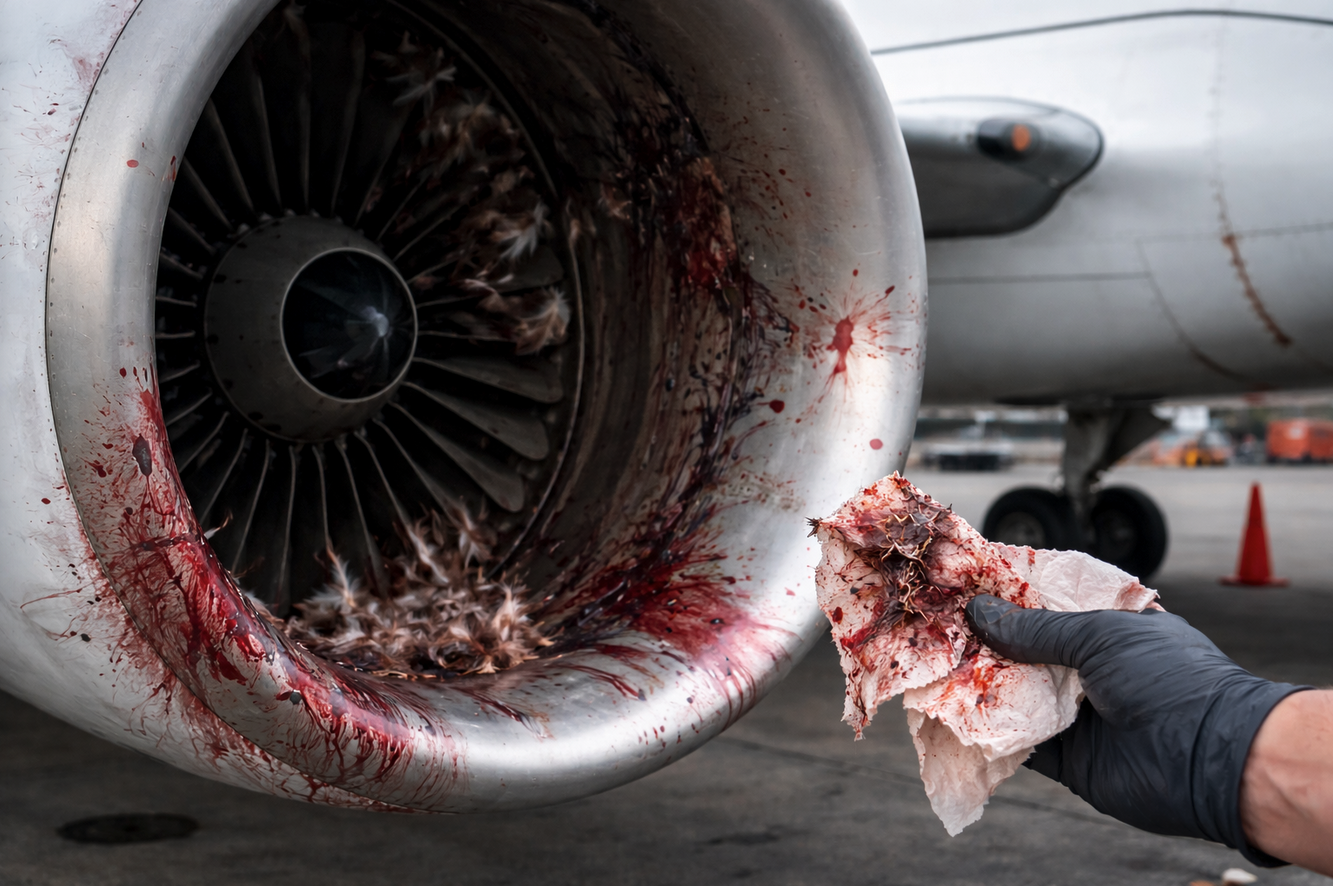
I mean, think about it — the poor bird(s) never make it. So you’ve got a plane that’s got blood and guts and feathers and beaks stuck on it. What happens there?
The name of the stuff & what’s done with it
Welp, believe it or not, the bird gunk has an official name – it’s called snarge.
And snarge isn’t just washed off – it’s carefully collected.
Yep.
There’s actually a standard technique to remove the snarge – the area is sprayed with water and then wiped with a paper towel. The towel is then sent to (I kid you not) the Feather Identification Lab at the Smithsonian in Washington, D.C. The FAA even has a few pages with specific directions for what to do (and not do!) to collect the snarge from the plane and ship it down to D.C.
A 2003 article in Flying Safety magazine said that the term snarge was invented at the Lab. However, one of its researchers, Carla Dove, says they didn’t make the word up but instead borrowed it from the experts who prepared bird specimens for the collections: “Everyone referred to the bird goop, guts, tissue, etc. as snarge. I think anyone who works in a museum and prepares bird specimens for research collections is familiar with the word.”
Or, as she once told the New York Times:
Snarge can be a wad of a Canada goose lodged inside an airplane engine. Or it can be a broken and burned gull feather littered along the runway. Snarge can even be as small as a rusty-red smear on the nose of an airliner.
But no matter what form it takes, every bit of snarge is different — and all snarge is important.
Skybrary suggests the word snarge came from U.S. military slang – a combination of the words “snot” and “garbage.”
World Wide Words claims that its source is unknown, although they did refer to a 1925 British book, Soldier and Sailor Words and Phrases, by Edward Fraser and John Gibbons, in which they identify snarge as “any ugly or unpleasant person”.
So really, nobody seems to know for sure.
Why is snarge such a big deal?
Because bird strikes are, obviously, potentially deadly events – definitely for the bird(s), but potentially for the humans in the plane. There were close to 17,500 strikes in 2019 alone, although most, happily, caused little to no damage to the planes.
If the Smithsonian knows what sort of bird(s) hit the plane, that can help the FAA and airport in question try to figure out the circumstances that lead to the bird strike and, more importantly, avoid further incidents (typically by capturing and relocating the remaining birds, sometimes by scaring them away, removing the reasons why they’ve settled there [read: typically water, food sources, etc.], etc.).
The Lab has been working with the FAA since the 1960s, as well as wildlife biologists at major airports to identify birds that are causing a problem and discourage them from hanging out near airports (some of their techniques are hysterical!).
And now you know.
Want to comment on this post? Great! Read this first to help ensure it gets approved.
Want to sponsor a post, write something for Your Mileage May Vary, or put ads on our site? Click here for more info.
Like this post? Please share it! We have plenty more just like it and would love it if you decided to hang around and sign up to get emailed notifications of when we post.
Whether you’ve read our articles before or this is the first time you’re stopping by, we’re really glad you’re here and hope you come back to visit again!
This post first appeared on Your Mileage May Vary