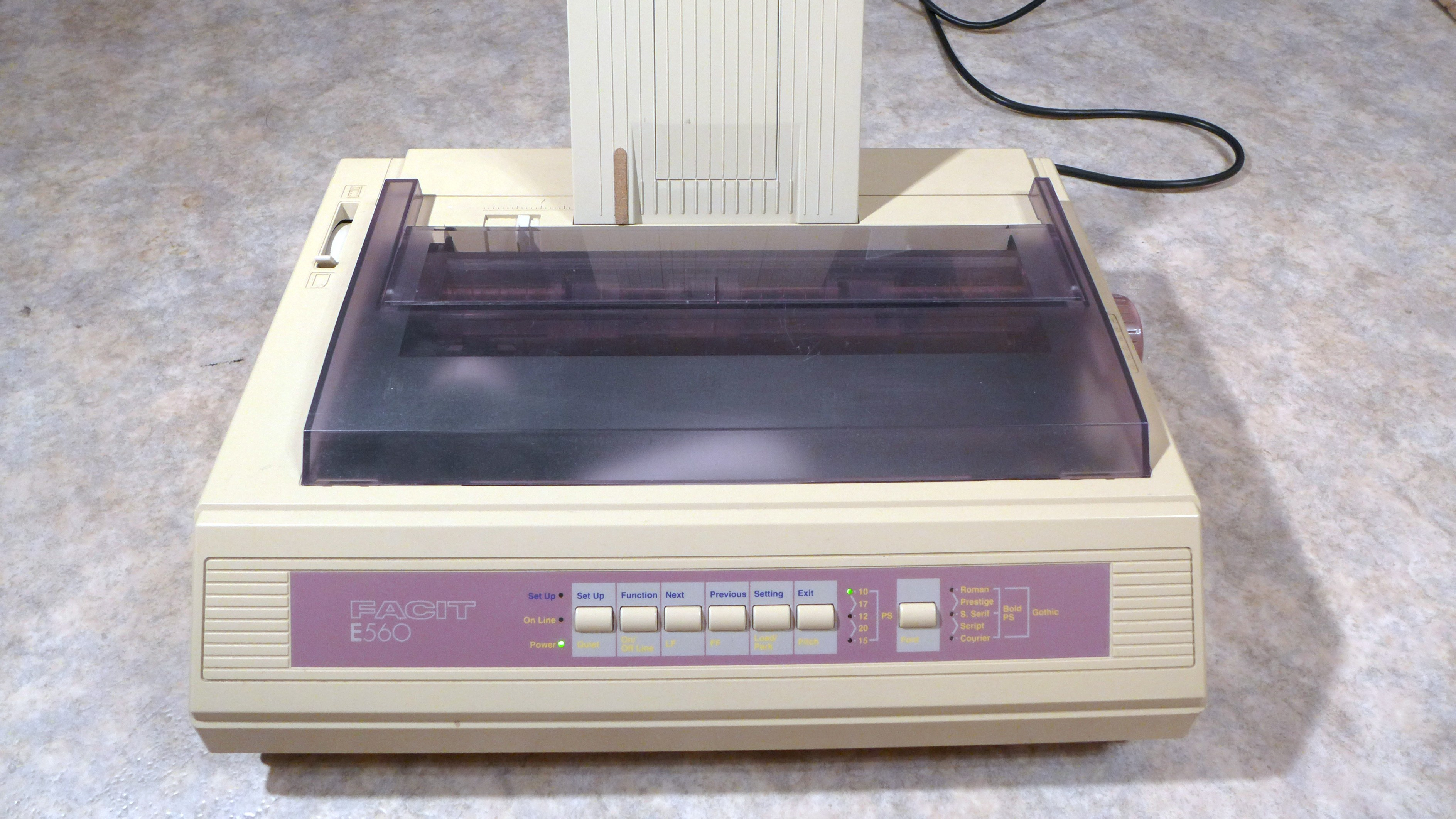
If you’ve ever been sitting or standing near an airport gate before a flight, there’s a chance that you’ve heard a printer that’s spewing out seemingly infinite amounts of paper. I know some of you reading this might not have seen one before. That device is a dot matrix printer. Long before PDFs, mobile boarding passes, and thermal label printers became standard, dot-matrix printers were the workhorse for high-volume operational printing.
I thought they might be going away, but I just found one of these dinosaurs sitting on the counter at MCO.
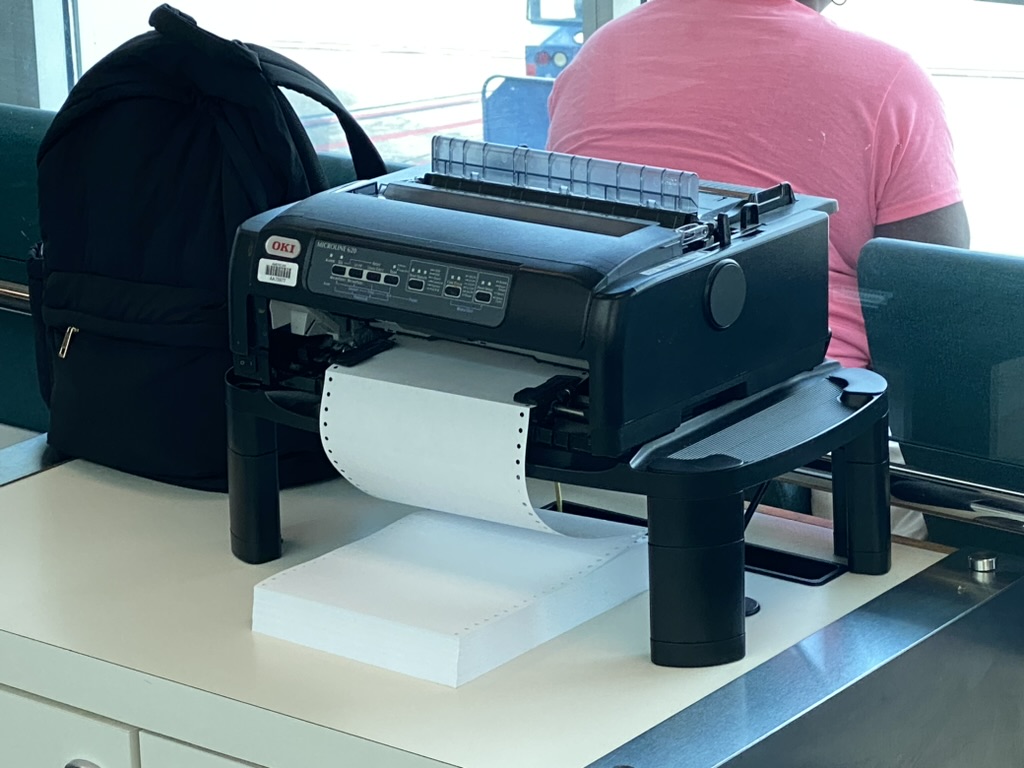
The paper is fed by a tractor system, meaning the pages have perforated edges that align with spokes that keep the paper moving. After you’re done printing, tear off these edges, leaving you with something that looks like this.

The printing is done by a head that moves across the page from one side to the other. Using a series of “pins” and an ink ribbon, you slowly but surely get your printed document.
Well, unless the paper is misaligned and the sprockets miss the holes, but let’s try to forget that if we can.
This technology is decades old, so why do they still use it at the airport?
I’ve found many instances of people asking this question online, but there doesn’t seem to be a single definitive answer.
Here are some of the most common explanations:
Technology
A lot of what happens behind the scenes at an airport still runs on legacy airline systems — the kind that were built for simple, text-based output and rock-solid reliability. Even when airlines modernize the front end (apps, kiosks, mobile boarding passes), the operational side often still relies on older workflows that expect a printer to accept plain, no-frills print jobs all day long.
That’s where dot matrix printers hang on. They’re easy to integrate into older setups, they don’t need fancy drivers, and they can spit out continuous pages of text without drama. Replacing them isn’t just “buy a new printer” — it can mean updating how the system generates and delivers output, reworking integrations, testing it in a high-stakes environment, and training staff across dozens (or hundreds) of stations.
And yes, you’ll still hear some truly old-school stories from smaller stations and outstations about how data gets to the gate. I can’t confirm any specific example, but the larger point stands: not every airport setup is as modern (or as well-connected) as people assume, and airlines tend to keep what works until there’s a strong reason to change it.
Cost
Dot matrix printers can be cheap to run. Ribbons are generally less expensive than laser toner, and the machines themselves are built to take a beating. They’re also easier to keep going in the field — fewer “this won’t print until you replace the cartridge” moments, fewer finicky errors, and less downtime when the printer is expected to crank nonstop.
The bigger cost issue is the one people forget: switching away from dot matrix isn’t just about hardware. If an airline replaces a printer type at airport counters, they may also need to update software, integrations, supplies, and procedures across multiple stations — plus the time and labor to roll it out and support it.
So even if a modern printer is cheap to buy, the transition can be expensive. And while dot matrix printers aren’t always bargain-bin items anymore (new models can still cost several hundred dollars, depending on the vendor), many airlines already have them deployed and standardized. If it’s working, the easiest answer is often: leave it alone.
Functionality & Dependability
Dot-matrix printers are reliable. Even when they break, it’s not catastrophic. The paper doesn’t get stuck, so you don’t have to take the printer apart, unlike with a laser printer. When ink runs out on the ribbon, it’s a gradual process. You don’t have a printer that refuses to print because the counter on the cartridge has reached zero.
With a dot matrix printer, you have an (almost) endless paper length. Need to print five pages of a passenger manifest? No problem. There’s also no need to staple those pages, since dot matrix paper isn’t fed individually.
Regulations
One of the more interesting reasons dot matrix printers still show up in airport operations is the same reason they haven’t vanished in other paperwork-heavy industries (think: the dealership desk when you’re buying a car). Some documents still need to be produced in multiple copies — and dot matrix printers can handle multi-part “carbon” forms (yes, the triplicate paper) in one shot.
That matters for certain operational and compliance-style paperwork where signatures are required and multiple parties need their own copy — for example, a form that has to be signed and then split between the flight crew and the local station.
Could all of this be digital someday? Probably. But adoption isn’t universal, and not every process is fully electronic end-to-end across every airport, airline, and jurisdiction. As long as some workflows still require printed, signed, multi-copy documents, dot matrix printers will keep hanging around because they’re simply the easiest tool for that specific job.
Final Thoughts
I do feel a bit nostalgic when I hear those printers at the airport. I spent hours at home printing out baseball stats and bowling score sheets (which were in triplicate). I also printed most of my school papers on a dot matrix until laser printers became more affordable.
I also remember that when I started my “real” job, I had to work with one of those printers running almost non-stop in my ear all day long. All the while, I was expected to work and be friendly to customers. I don’t miss trying to talk on the phone when one of those printers was running at full speed.
When it comes to the reason why dot matrix printers are still in use at airports, I will bet it’s a combination of all of the reasons mentioned above. They work, they’re affordable, replacing them would be expensive, and they might even be necessary under current laws.
I wouldn’t expect that buzzing sound from these printers to disappear from the airports any time soon.
Want to comment on this post? Great! Read this first to help ensure it gets approved.
Want to sponsor a post, write something for Your Mileage May Vary or put ads on our site? Click here for more info.
Like this post? Please share it! We have plenty more just like it and would love it if you decided to hang around and sign up to get emailed notifications of when we post.
Whether you’ve read our articles before or this is the first time you’re stopping by, we’re really glad you’re here and hope you come back to visit again!
This post first appeared on Your Mileage May Vary