There’s a specific moment that tells you whether your international phone plan is going to be a lifesaver… or a problem.
It’s the second you land, turn off airplane mode, and wait to see if your phone connects — or if you’re about to start hunting for Wi-Fi like it’s 2012.
For us, that moment is one of the reasons we switched to T-Mobile.
In 2017, my wife Sharon and I broke up with AT&T and switched to T-Mobile. It was a big change for us, and we’ve been saving money ever since. (In retrospect, best decision EVER!)
We still have the same horrible reception at our house as we had with AT&T (Note from Sharon: even though there’s a frickin’ cell phone tower less than a mile from our house. What’s up with that???). But the big reason we originally switched was simple:
T-Mobile made international travel feel “normal.”
Instead of landing, hunting for a SIM card, and hoping we didn’t accidentally trigger a phone-bill disaster… we could just turn off airplane mode and keep going.
Back then, it felt like an industry-leading perk. Since then, other carriers have copied parts of the idea — but T-Mobile’s version is still one of the easiest to use.
What T-Mobile offers internationally in 2026 (the simple version)
T-Mobile’s international roaming benefits depend on which plan you’re on, but the structure is basically:
- Texts: Included in 215+ countries and destinations on qualifying plans.
- Data: Included, but often at slow speeds unless your plan includes a high-speed bucket (or you buy a pass).
- Calls: Typically $0.25/minute while roaming internationally (unless you add an International Pass, which includes unlimited calling for the pass period).
If you want to skip ahead and check your exact destination list and details, T-Mobile keeps everything here:
T-Mobile International Roaming Plans (official page)
Which T-Mobile plans get what when you travel
Here’s the good news: across most T-Mobile plans, the basics are the same when you travel — unlimited texting in 215+ countries/destinations, and calls are $0.25/minute.
The big difference is how much high-speed roaming data you get before your data slows down.
- Essentials: No built-in high-speed bucket for most international destinations — if you want reliable speed, you’ll usually be looking at an International Pass.
- Go5G (standard): Up to 5GB of high-speed data in 11 European countries, then slower speeds after that.
- Go5G Plus (and legacy Magenta MAX): Up to 5GB of high-speed data in 215+ countries/destinations, then unlimited data at slower speeds (up to 256kbps).
- Go5G Next: Up to 15GB of high-speed data in 215+ countries/destinations, then unlimited data at slower speeds (up to 256kbps).
- Better Value: Up to 30GB of high-speed data in 215+ countries/destinations, then unlimited data at slower speeds (up to 256kbps).
Important: T-Mobile changes plan names over time, and plenty of people are still on older “Magenta-era” plans. If you’re not sure what you have, it’s worth checking your account before a trip — because this is the section where the details actually matter.
The part people miss: T-Mobile’s “included” data may be slow
Even if your plan includes international data in 215+ destinations, a lot of that benefit is still designed around “basic connectivity” — messaging, quick searches, rideshare, maps, and email.
If you need your phone to behave as it does at home (uploading photos, constant navigation, hotspot for a laptop, etc.), you’ll either want:
- a plan that includes a high-speed bucket (like Go5G Plus/Next), or
- an International Pass, or
- an international eSIM.
T-Mobile International Passes (this is the upgrade)
If you want more high-speed data abroad — or you want to stop thinking about per-minute calls — T-Mobile sells International Passes that work in the same 215+ covered countries/destinations.
These passes include high-speed data + unlimited calling for the pass period:
- $5: 1-Day International Pass (24 hours) with 512MB high-speed data
- $35: 10-Day International Pass with 5GB high-speed data
- $50: 30-Day International Pass with 15GB high-speed data
Official details here:
T-Mobile International Passes (official page)
How it works when you land (the “why we love this” part)
Let’s compare this to how we used to travel internationally.
Back when we were locked into AT&T, we’d either:
- use an older phone that wasn’t locked,
- buy a SIM card when we landed (or order one ahead of time), and
- limit the second phone to Wi-Fi only.
With T-Mobile, our international trips feel weirdly normal.
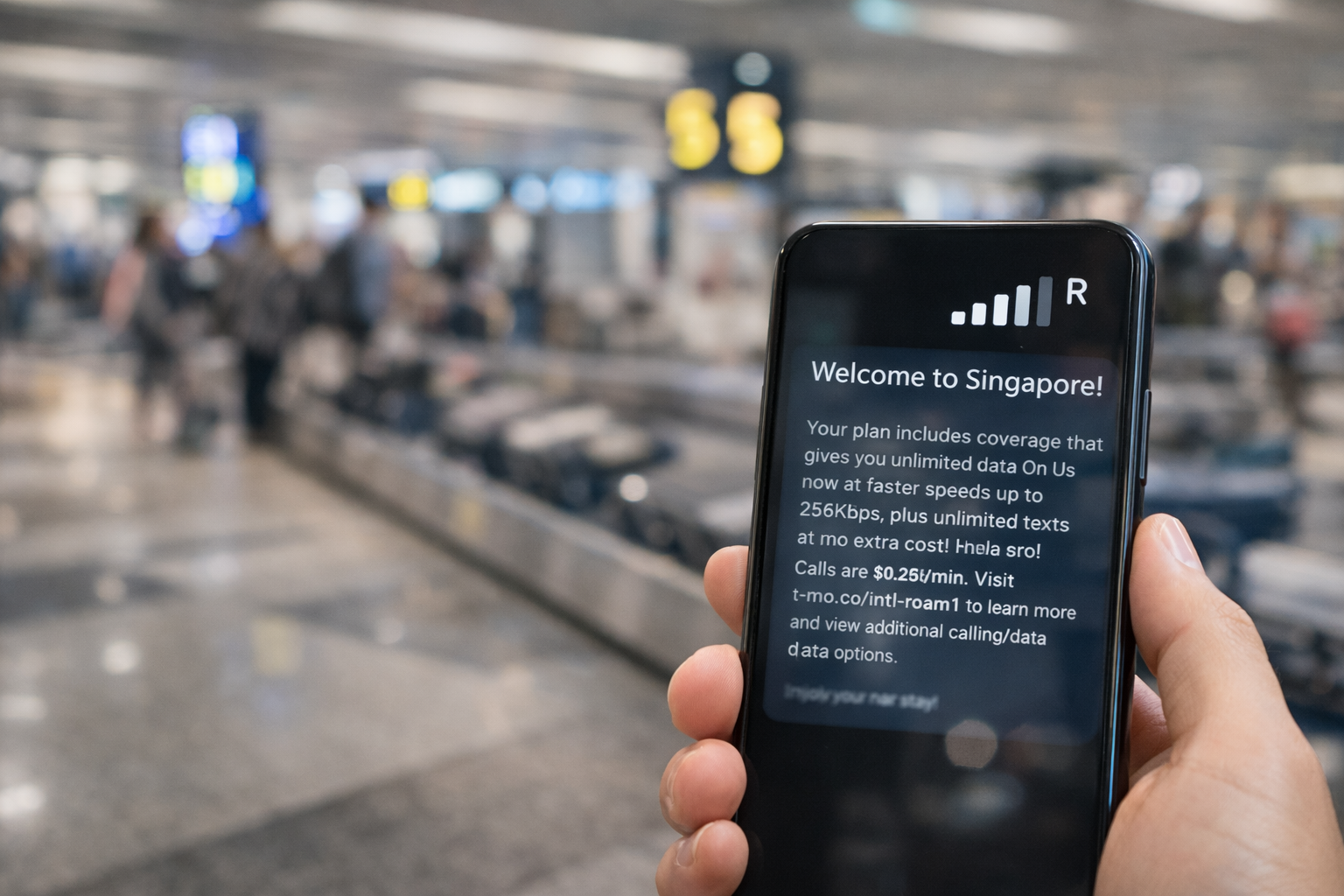
After a long flight to Singapore, I remember walking off the plane, turning off airplane mode, and waiting to see if everything worked. With T-Mobile, it did — and the “welcome text” spelled it all out:
T-Mobile: Welcome to Singapore! Your plan includes coverage that gives you unlimited data On Us now at faster speeds up to 256Kbps, plus unlimited texts at no extra cost! Calls are $0.25/min. Visit t-mo.co/intl-roam1 to learn more and view additional calling/data options. Enjoy your stay!
No SIM hunt. No “hope this doesn’t cost $400.” Just service.
We still get calls — including the “Scam Likely” calls — that we ignore because we’re not paying $0.25/minute to learn about an extended warranty. (Note from Sharon: Geesh, what kind of spam do YOU get? I got 3 calls in 3 days from 3 different numbers, and all the voicemails were just someone saying, “Hello? Hello?”)
And honestly, the best part wasn’t the data. It was simply the ability to text each other, as we do at home. If we got separated in a museum, it was easy to regroup. (Note from Sharon: and much more polite than yelling, “Marco?” “Polo!”)
Three practical tips before your next trip
- Download offline maps before you leave. International roaming is great, but maps can eat data quickly — and slow data speeds make it worse.
- Use data-based calling apps when you can. If you’re trying to avoid the $0.25/minute charge, FaceTime Audio / WhatsApp / Signal calls over data or Wi-Fi can help (just be mindful of hotel Wi-Fi quality).
- This is meant for travel, not “living abroad.” T-Mobile’s terms are clear that international roaming is for short-term use, and they can restrict service if most of your usage is roaming for extended periods.
Final Thoughts
T-Mobile’s international roaming was one of the selling points for us back in 2017, and it’s still one of the reasons we’ve stayed.
Is it perfect? No — the “included” data can be slow depending on your plan, and per-minute calling adds up fast if you actually like making phone calls.
But if your goal is to land in another country and immediately have your phone work well enough to navigate, message, and move through the day… it’s hard to beat the convenience.
And while we’ve loved having international coverage built into our plan, one thing has changed the game since we first switched to T-Mobile: international eSIM plans.
I’m currently researching whether eSIMs are a better deal than paying for T-Mobile’s daily or multi-day passes — and I’ll have more on that soon.
Want to comment on this post? Great! Read this first to help ensure it gets approved.
Want to sponsor a post, write something for Your Mileage May Vary, or put ads on our site? Click here for more info.
Like this post? Please share it! We have plenty more just like it and would love it if you decided to hang around and sign up to get emailed notifications of when we post.
Whether you’ve read our articles before or this is the first time you’re stopping by, we’re really glad you’re here and hope you come back to visit again!
This post first appeared on Your Mileage May Vary

3 comments
T-Mobile is awesome. Since most international hotels offer great wi-fi now, the limited amount of fast data we use when overseas seems to consistently be enough for us. Plus, the free unlimited airline wi-fi on AS, AA, DL, and UA is awesome (espcially on international UA flights, where it alwyas seems to work!).
Plus, you can’t beat the “old people’ discount they give.
I didn’t mention the free wi-fi but we used it on our flight to the UK on United and it worked fine. Pity their domestic Wi-Fi is still occasionally trash.
Better deal is Google Fi 50 GB high speed data while roaming internationally and the data can be used as a hotspot. Service is the same as T-Mobile since it runs on T-Mobile and is the only service that is not reprioritized like mint mobile and it’s much cheaper. There’s no upcharge to use your credit card. Using T-Mobile internationally is just expensive and silly. Not a very good choice.