There are plenty of airport signs you can ignore without consequence.
And then there are the ones that make you do a double-take… even when you’re sitting in seat 18C watching the scenery crawl by at 12 miles an hour.
That happened to me while taxiing at Orlando International Airport. As we rolled up onto one of the taxiway bridges near the terminal area, I noticed a sign with an oddly specific instruction:
Planes do not stop on the bridge.
My first thought was the obvious one: physics. If a bridge is involved, the brain immediately goes to weight, structural limits, and “surely there’s a reason you don’t want a fully loaded jet sitting there.”
But the more I thought about it, the less that explanation made sense. Airports don’t casually route aircraft over structures that can’t handle aircraft. If it’s safe enough to taxi across, it’s safe enough to exist under the weight of a plane.
So why the “no stopping” rule?
Airport taxiway bridges exist because airports are… complicated
If you only fly in and out of smaller airports, it’s easy to forget how many moving parts a major hub has to manage.
You’ve got:
- Aircraft movement (runways, taxiways, ramps)
- Passenger access (terminal roads, parking, rental cars, buses)
- Service traffic (fuel trucks, catering, maintenance, emergency response)
At a certain scale, those systems can’t all live on the same flat surface without becoming a nightmare. So airports use the same solution cities use for traffic: grade separation.
That can mean:
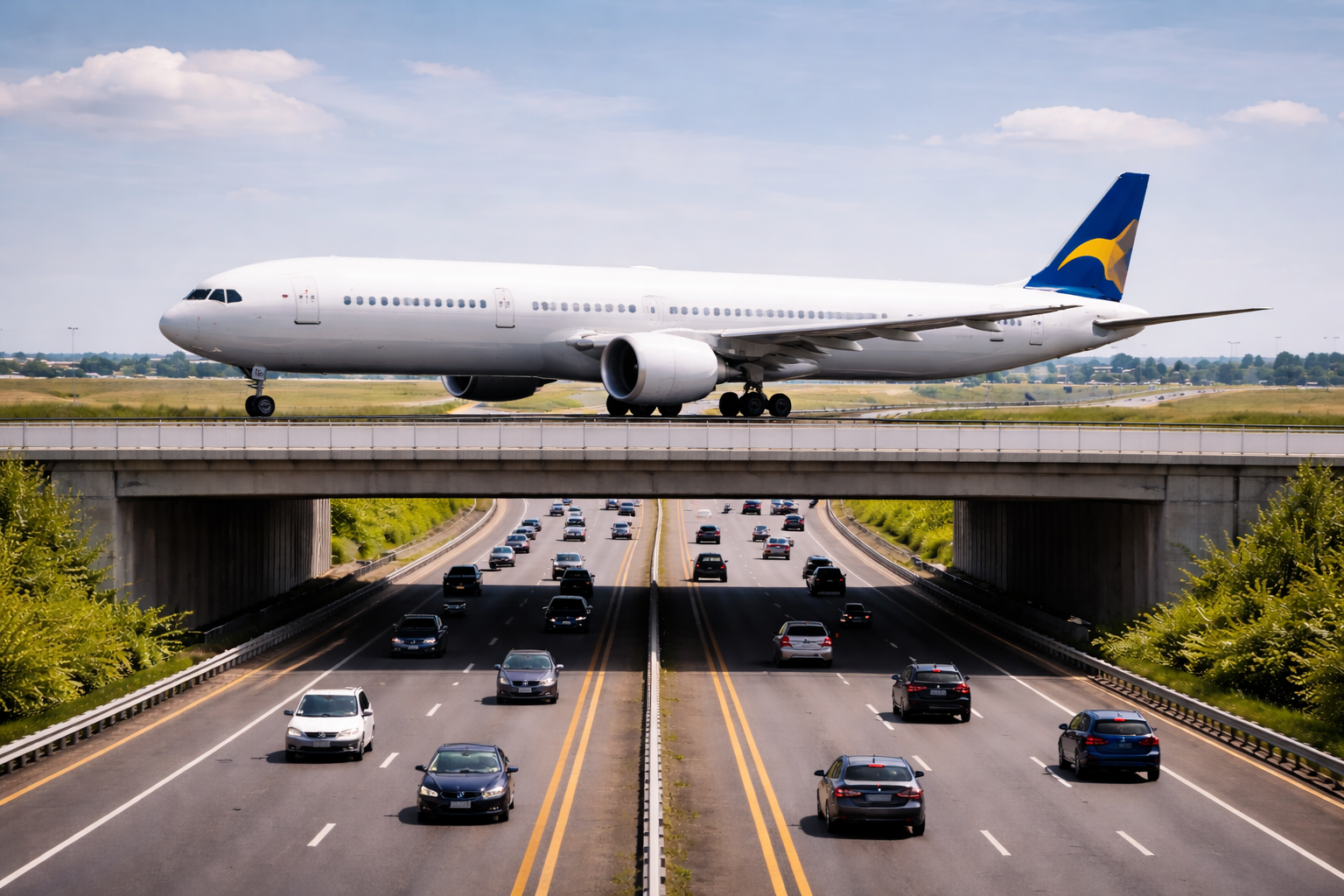
- Cars go under planes (taxiway bridges)
- Planes go over cars (also taxiway bridges… just depends on your point of view)
- Road tunnels under the airfield
It looks wild the first time you notice it… especially when you’re driving under a taxiing aircraft.
If you want a quick visual of what I mean, this Instagram post shows a plane taxiing over one of those bridges: here’s an example.
The “physics” explanation sounds right… but it’s not the real reason
This is where most people (including me) go first:
- “A bridge can’t support a plane sitting still.”
- “Stopping puts more stress on it than rolling.”
- “They’re worried about weight distribution.”
Those ideas feel logical because bridges + heavy things = engineering limits. But airports don’t guess on that stuff.
The FAA’s airport design guidance explicitly discusses designing runway and taxiway bridges to handle the loads imposed by aircraft (including both static and dynamic considerations), and treats airfield bridges as serious engineered infrastructure—not “maybe it’ll be fine” construction. If you’re curious, the FAA airport design advisory circular is AC 150/5300-13B (Airport Design).
So if the bridge is open for taxiing, you can assume it’s built for aircraft loads.
So why can’t planes stop on the bridge?
The simplest explanation I’ve seen (and the one that actually holds up) is this:
A taxiway bridge is a terrible place to deal with an emergency.
When things are normal, it’s just a slightly elevated piece of pavement.
But if something goes abnormal—smoke in the cabin, a brake issue, a mechanical problem, anything that requires an immediate stop—you’ve suddenly got a fully loaded aircraft sitting on a narrow, constrained structure… with limited options around it.
Here’s what makes a stopped aircraft on a bridge such a problem:
- Evacuation is harder. Even if the bridge is structurally sound, you don’t have the same room you’d have on a normal taxiway shoulder. Slides deploy into space that may not be “normal ground,” and a bridge can create awkward, unsafe geometry for getting people out quickly.
- Emergency access is tighter. Airport Rescue and Fire Fighting (ARFF) vehicles need room to reach, stage, and work. Bridge designs have to account for access constraints—again, the FAA airport design guidance talks about ARFF access considerations as part of airfield geometry planning.
- It’s a choke point. A stopped aircraft can block an entire connection between parts of the airfield. On a normal taxiway you might route around the problem. On a bridge, “route around” may not exist.
- There may be public road traffic underneath. Even if everything above is handled perfectly, you’ve now got an incident scene elevated over an active roadway.
Put differently: the bridge is built to carry planes — it’s just not built to be the place you want to get stuck.
This isn’t just an Orlando thing
Once you start noticing taxiway bridges, you’ll realize they’re all over major airports—especially ones that were designed around a central terminal road system.
A few examples:
- Dallas/Fort Worth (DFW): DFW’s layout is famous for having the main access road (International Parkway) bisect the airport—so aircraft bridges were part of the design from the beginning. There’s a fun historical note that when DFW opened in 1974, it “boasted four taxiway bridges” crossing International Parkway. (Source)
- Frankfurt (FRA): Frankfurt’s north-west runway project required multiple taxiway bridges so aircraft could cross major infrastructure like the A3 Autobahn and ICE rail line. Fraport’s own expansion overview explains that the two taxiways consist of five separate bridge structures used to cross the highway and rail line. (Source)
- Munich (MUC): Munich has taxiway bridges over public roads as well (and yes, German spotters have a word for it: “Rollwegbrücke”). There’s even a Wikimedia Commons photo page describing two taxiway bridges above an automobile road called Südring. (Source)
- Orlando (MCO): And yes, Orlando has its own version near the terminal area—which is what made me notice the “no stopping” sign in the first place.
The specific geometry and signage may differ from airport to airport, but the logic is consistent: these structures exist because airports need to separate traffic flows… and they come with operational constraints you don’t have on ordinary taxiways.
Final Thought
A lot of aviation rules sound technical until you realize what they’re really designed to prevent.
The bridge isn’t the danger. The danger is what happens if you have to stop there—because once you do, you’ve turned a clever piece of airport design into a worst-case scenario location.
Want to comment on this post? Great! Read this first to help ensure it gets approved.
Want to sponsor a post, write something for Your Mileage May Vary, or put ads on our site? Click here for more info.
Like this post? Please share it! We have plenty more just like it and would love it if you decided to hang around and sign up to get emailed notifications of when we post.
Whether you’ve read our articles before or this is the first time you’re stopping by, we’re really glad you’re here and hope you come back to visit again!
This post first appeared on Your Mileage May Vary

3 comments
ORD
Terrorism. They don’t want to expose the plane to the general public for that long. Pretty surprised it wasn’t even mentioned.
Same at ORD, with two parallel bridges over the main airport access road. I had often wondered why stopping was not allowed. Your explanation makes perfect sense. Thank you.