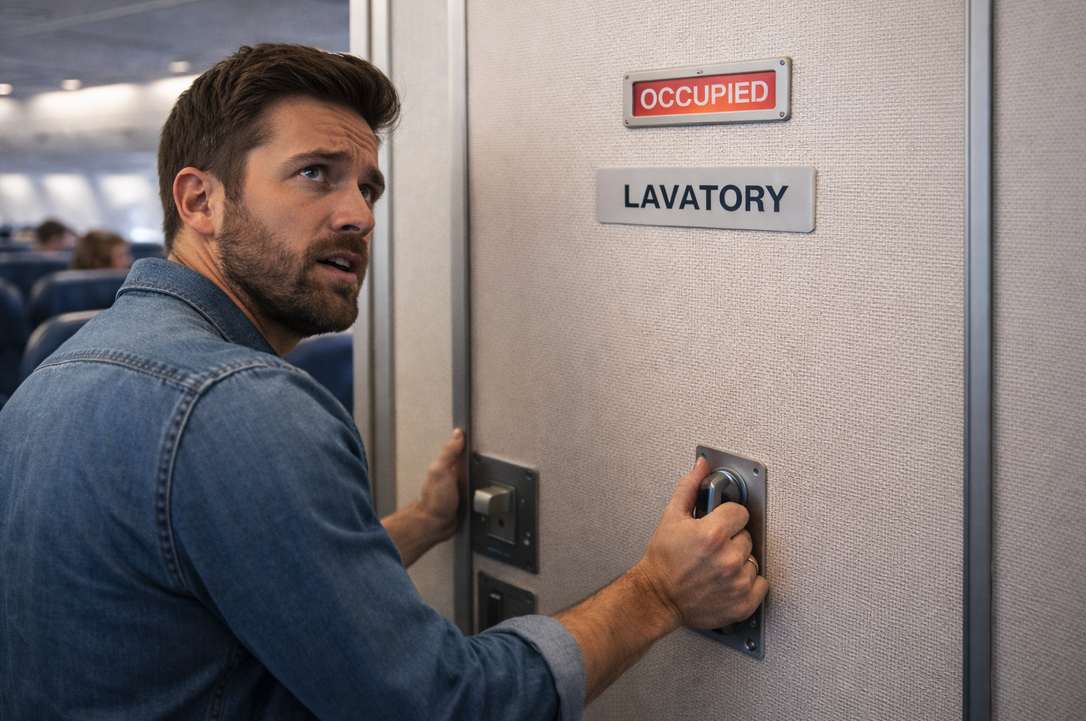
Toilets (a.k.a. “lavatories,” or “lavs” for short) on planes are nothing like toilets on land. Well, except for why they’re there (cuz when you gotta go, you gotta go) and their general function of “collect the waste and put it somewhere where it doesn’t bother people.”
Other than that? Very few similarities.
Toilets on land are pretty simple technology. You can get an understanding of how they work on this page by wikiHow.
Toilets on a plane, though? Very different.
How toilets on a plane work
The toilet bowls themselves are non-stick, and the airlines use something called Skychem (or a similar solution, if they don’t use that particular brand), which is a (typically blue) disinfecting liquid.
When you flush the lav, a trapdoor in the base of the toilet bowl opens, that blue liquid is released, and everything is sucked out of the bowl at a high rate of speed, thanks to a powered vacuum of suction that goes 300mph. The suction is what pulls all the waste material and the liquid ensures that (A) everything goes down and (B) the toilet is disinfected between flushes.
You can typically use the lav at any time the seat belt sign is off and you’re allowed to walk around the cabin – so that would be during embarkation (or disembarkation, although the flight attendants would probably rather you do your business in the airport, by that time) or, of course, while you’re up in the air.
A reader’s recent situation
However, a reader recently wrote to us and brought up an interesting situation. They said they were on a domestic flight on an A319 and, when they boarded, decided to use the lavatory. But when they got back there, the door had a sign on it that said the lav was inoperable and not in service unless the plane was above 16,000 feet.
They checked the other lavs on the plane and they all had the same sign. They were all locked, too.
And lest anyone think it was any sort of joke, our reader said that the captain came on the PA just before they left the gate and reiterated what the signs said – the lavs wouldn’t be available until the plane reached 16,000 feet.
So they asked us what was up with that.
We discovered why
I’ve always said that I’m “the queen of the Google.” If there’s some information to be found, I’ll be able to find it. Google has made that skill a whole lot harder after it “broke Google” in late 2023 (which, in turn, made us here at YMMV lose about 90% of our readership. That, travel friends, has SUCKED. We’ve never recovered. Like, at all. Hey Google, can you PLEASE fix this for us???), but I still do OK.
And I did.
I found a thread on FlyerTalk from early 2016, where user vincentharris described the exact same situation that our reader was asking about:
GA today kept saying the lavatories do not work until you are in the air so go no. I laughed at it and figured it’s a way for people to not swim upstream during boarding.
After boarding i made made a joke to the FA’s about it and they looked at me dead serious (one did the other looked perplexed) saying it came straight from the captain not working until 16,000 feet.
I guess this is he is he one of a kind A319 with non functioning bathrooms?

Several responses suggested that the flight crew was lying and acting patronizingly to the pax. But then one reply, from davetravels (RIP) said something that suggested the sign was correct.
I used a lav at the gate once, and, the toilet didn’t flush. A319/320, I think. I commented about it to a FA and was told it would work in the air – – and it did!
Something about pressure. I don’t remember, exactly.
But THEN we got the answer, from a user named wingtip428:
Sounds like the vacuum pump which provides suction for the lavatories on the ground was unserviceable. The 16,000ft figure is from the Airbus MEL (minimum equipment list) instructions for dispatching with the pump unserviceable, as an estimate of when the differential between the cabin and outside air pressure is sufficient to provide suction to the system again.
Had this a fair few times as a pilot on A320s, we normally kept the seatbelt signs on and lavatory doors locked until they were usable again.
And to go into even more nitty-gritty, I eventually found this excellent description from Satellite Industries, which bills itself as one of the leading innovators in the portable sanitation industry:
The Role of Altitude in System Operation
Altitude changes how the system operates, and the vacuum toilet system in aircraft adapts automatically.
When cruising above 16,000 feet, the pressure difference between the cabin and the outside air creates a natural vacuum. No extra power is needed; the physics of high-altitude flight does all the work, pulling waste into sealed holding tanks.
During takeoff, landing, or at lower altitudes, the electric vacuum generator kicks in. These pumps switch on automatically when the natural pressure difference isn’t strong enough. The aircraft’s control systems monitor altitude and pressure, seamlessly switching between natural vacuum and electric assistance to ensure consistent performance.
So yeah…if the electric vacuum generator on an A319/A320 wasn’t working, neither would the toilets until they got to 16,000 feet.
And now you know. 🙂
Want to comment on this post? Great! Read this first to help ensure it gets approved.
Want to sponsor a post, write something for Your Mileage May Vary, or put ads on our site? Click here for more info.
Like this post? Please share it! We have plenty more just like it and would love it if you decided to hang around and sign up to get emailed notifications of when we post.
Whether you’ve read our articles before or this is the first time you’re stopping by, we’re really glad you’re here and hope you come back to visit again!
This post first appeared on Your Mileage May Vary