When Bilt rolled out its 2.0 refresh, many people rushed to sign up at zero hour. Others rushed to declare it the end of Bilt altogether.
I did neither.
Part of that is procrastination. Part of it is experience. And part of it is knowing that any major card refresh is going to have predictable kinks — early denials, strange credit lines, backend issues — all of which we’ve already seen and which Bilt is actively trying to address.
More importantly, I didn’t have the time (or interest) to do the kind of deep dive I usually like to do before making a decision. So I waited.
Now I don’t really have that luxury anymore.
My existing Bilt card with Wells Fargo is set to convert to a Wells Fargo Autograph card, which I plan on keeping. That transition—and whether it makes sense on its own—will be a separate post. But if I want to stay in the Bilt ecosystem and continue earning Bilt points with a credit card, I need to apply for one of the new cards.
And that’s where things get interesting.
I’m Not in the “Bilt Is Dead” Camp
There have been plenty of hot takes suggesting that Bilt has effectively nuked its own program. I’m not in that camp.
If anything, Bilt has always felt like one of the few loyalty programs that genuinely understood us — the people who know why having Hyatt and American Airlines as transfer partners actually matters. Even as Bilt has expanded its partner list (including Spirit, which adds value for certain members), the core idea has been flexibility.
That said, my first impression of the refresh wasn’t exactly enthusiastic.
The introduction of Bilt Cash adds a layer of complexity that didn’t exist before. Points-and-miles people will absolutely break down the math and optimize it. Most people won’t. And when a program starts to feel like it’s getting a little too clever for its own good, that’s usually a warning sign.
Bilt used to stand out by being relatively straightforward. Bilt Cash feels like a step toward the coupon-book model we’ve seen from other issuers — credits for Walgreens, Grubhub, Lyft, and rotating partners that only deliver value if you remember to use them.
I understand why they did this. I’m just not convinced it makes the program better.
How I’ve Always Looked at the Bilt Card
I’ve never thought of the Bilt card as a typical no-annual-fee card.
In my head, it competed with cards like the Chase Sapphire Preferred and Citi Strata Premier — cards you keep open specifically because they unlock transferable points. The difference was that Bilt offered similar (and sometimes better) earning opportunities and access to valuable partners… without charging an annual fee.
That’s what made it compelling.
Now that’s changed.
Where the New Cards Sit
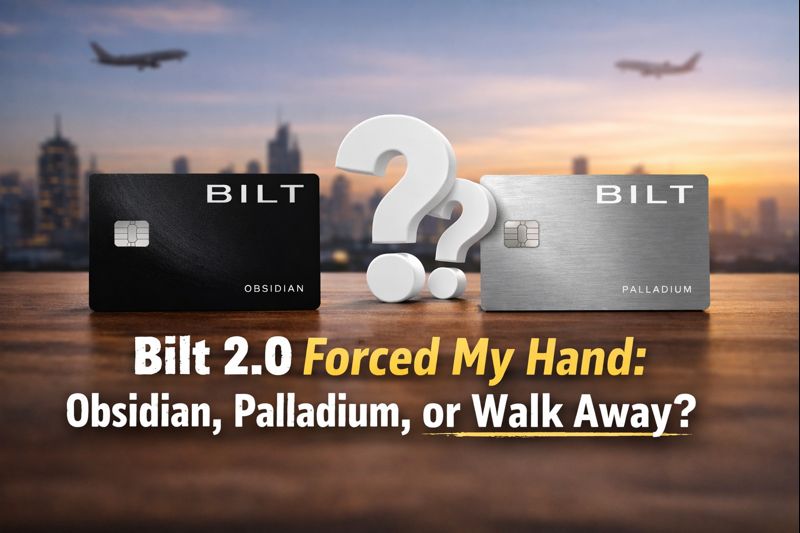
With Bilt 2.0, the lineup effectively breaks down like this for cards I’m interested in:
- Obsidian lives in the same space as Sapphire Preferred and Citi Strata Premier — mid-tier cards with an annual fee and transferable points.
- Palladium clearly aims higher, positioning itself closer to something like the Capital One Venture X, especially with its 2x earning structure.
Once you frame it that way, the decision becomes less about which Bilt card is “best” and more about what role — if any — I want another card to play in my wallet.
Obsidian: Familiar, but Redundant
The Obsidian card is the closest thing to the original Bilt card. Conceptually, it makes sense as a way to stay in the ecosystem without going fully premium.
There’s a $200 Bilt Cash sign-up bonus, which easily offsets the ~$95 annual fee in the first year. But long-term, Obsidian overlaps heavily with cards I already carry. I already “need” to keep my Sapphire Preferred and Citi Strata Premier open to preserve the ability to transfer points.
At that point, Obsidian risks becoming a third mid-tier card doing roughly the same job — just with more moving parts.
Palladium: The Math Actually Works (At Least in Year One)
The Palladium card is harder to dismiss.
Between the sign-up bonus and ongoing benefits, the first-year math looks like this:
- 50,000 Bilt points, conservatively worth $500 (and potentially more via transfers)
- $300 in Bilt Cash as a sign-up bonus
- $400 annual Bilt Travel hotel credit, issued as two $200 credits
- $200 in annual Bilt Cash, with limited rollover
Against a $495 annual fee, the first year more than pays for itself — even if you discount the Bilt Cash somewhat because it’s not actual cash.
The catch, of course, is friction. The hotel credit is portal-restricted. The Bilt Cash requires tracking and intentional use. None of this is as clean as the Venture X’s credits.
But the math is real.
Why This Still Scans for Points-and-Miles People
Stepping back, I can see why this still works for points-and-miles people — even if it’s not as elegant as Bilt used to be.
We don’t evaluate programs in a vacuum. We remember how they worked before. We know how issuers behave when annual fees come due. And we understand that programs rarely ask customers to swallow new complexity without eventually offering something to keep them from walking away.
So I’m willing to bet — at roughly break-even odds — that staying in the Bilt ecosystem for a year could come with upside that isn’t obvious yet. Retention offers, targeted bonuses, or enhanced earn opportunities wouldn’t be surprising when that next annual fee approaches.
That’s not blind loyalty. It’s optionality.
For a points-and-miles person, year one is about extracting clear value. Year two is about seeing whether the program evolves in a way that rewards sticking around. And if it doesn’t, walking away is always an option.
In that sense, committing for a year isn’t a leap of faith. It’s a calculated bet.
Final Thoughts
After walking through all of this, I don’t think the right question is whether Bilt 2.0 is “good” or “bad.” The better question is whether it still makes sense for me — and for people who approach points and miles the same way I do.
Bilt hasn’t lost sight of the audience that understands why Hyatt and American Airlines matter. That alone puts it ahead of many loyalty programs. But the refresh clearly adds complexity, particularly with the introduction of Bilt Cash, and that changes how value is delivered. Some people will happily optimize it. Others will see it as friction.
The Obsidian card feels like the spiritual successor to the original Bilt card — familiar, reasonable, and easy to justify in the short term. The problem is that it now overlaps heavily with other mid-tier transferable-points cards I already keep open. Staying in the ecosystem is comforting, but redundancy is real.
The Palladium card, on the other hand, is much harder to ignore. Between the sign-up bonus and the ongoing credits, the first-year math clearly works—even after discounting some of the coupon-book-style value. It’s not the cleanest premium card on the market, but it is an honest one: front-loaded value now, with a decision deferred until next year.
And that’s where this ultimately lands for me.
Want to comment on this post? Great! Read this first to help ensure it gets approved.
Want to sponsor a post, write something for Your Mileage May Vary, or put ads on our site? Click here for more info.
Like this post? Please share it! We have plenty more just like it and would love it if you decided to hang around and sign up to get emailed notifications of when we post.
Whether you’ve read our articles before or this is the first time you’re stopping by, we’re really glad you’re here and hope you come back to visit again!
This post first appeared on Your Mileage May Vary

2 comments
You are one of the only bloggers that left a truly honest review of the Bilt card. TPG, View from the Wing, frequent miler, etc. all had been given promotional trips and compensation for their promotion of Bilt and anyone looking at it with clear eyes can see how they tried to spin the whole program as it was good…. even after it was a flop and everyone called Bilt out on it. The bloggers then pretended it was confusing amd they were puzzled by it, but you could tell that all of them were still pimping it while saying that by their tone and numerous links to their affiliate cc links. Anyways, thank you for an honest summary and opinion of it.
Didn’t they end transfers to AA?