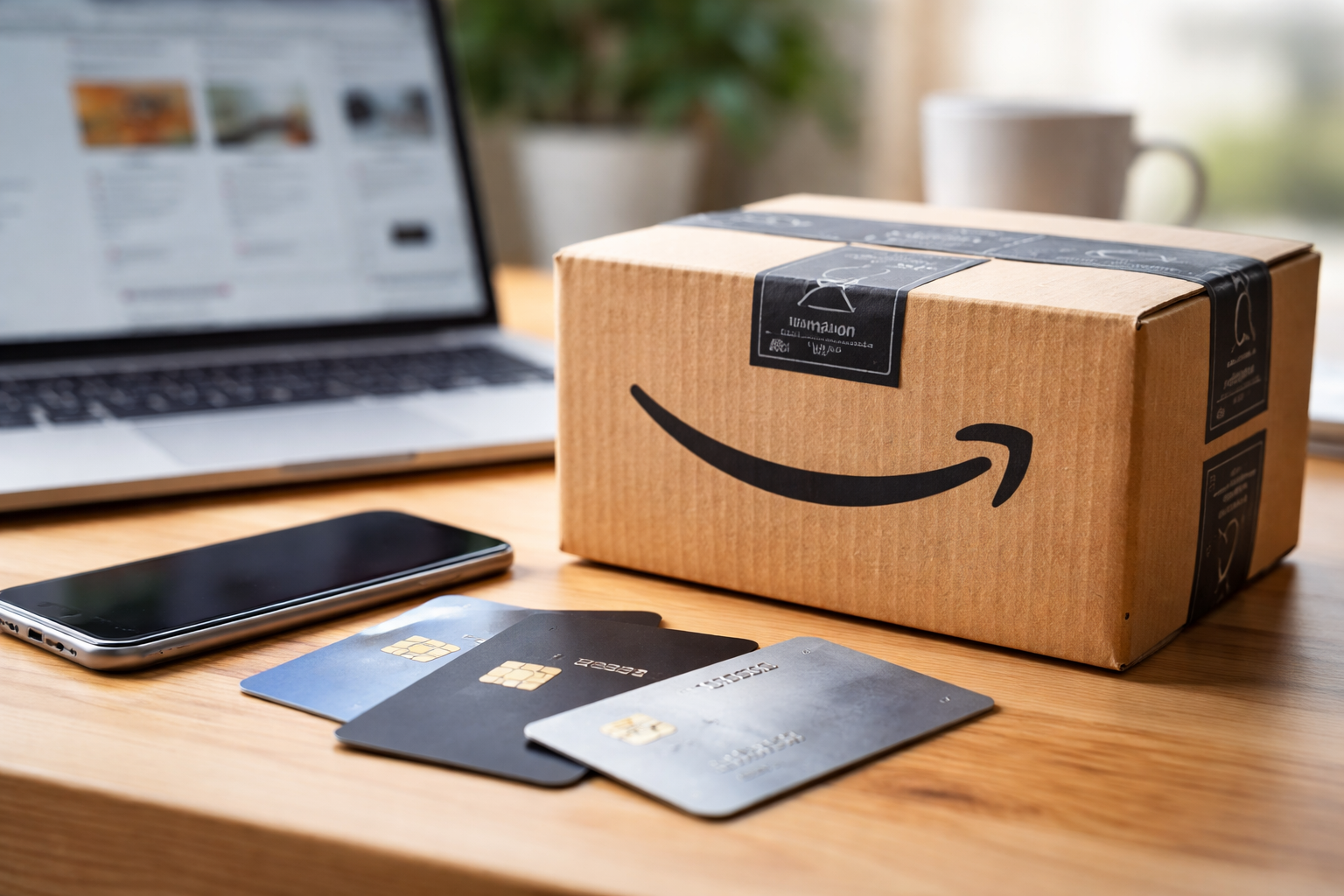
Amazon is the largest company by revenue. So it manages to sneak into almost everyone’s budget — household basics, random gadgets, and last-minute gifts.
And if you’re into points and miles, Amazon can be frustrating. Unlike travel, dining, or groceries, Amazon purchases usually don’t earn a special bonus on most rewards cards. So it’s easy to assume the best you can do is… whatever you get by default.
But you actually have options.
Some are dead simple. Some take one extra step. And a few only matter during specific promo windows. The trick is choosing the approach that fits how much effort you want to put in — and what kind of rewards you’re trying to earn.
Option 1: The Obvious Choice — The Amazon Visa
If you want the most straightforward answer, it’s the Amazon Visa from Chase.
For many shoppers, this is the baseline option because it’s simple, consistent, and designed specifically for Amazon purchases. But there’s one detail that confuses a lot of people:
The earning rate depends on whether you have an active Amazon Prime membership.
Prime Visa vs. Amazon Visa: What’s The Difference?
The Amazon card earns different rewards depending on whether you have an active Prime membership. Same card, same benefits — just different earning rates.
- With Prime (Amazon Prime Visa):
5% back at Amazon & Whole Foods; 2% back at restaurants, gas stations & transit; 1% back everywhere else - Without Prime (Amazon Visa):
3% back at Amazon & Whole Foods; 2% back at restaurants, gas stations & transit; 1% back everywhere else
Bottom line: If you already pay for Prime, the Prime version unlocks the higher Amazon earnings rate. If you don’t have Prime, the card still works — it just earns less at Amazon.
The tradeoff is that this is a cashback play. You’re earning value, but not flexible points that you can transfer to airline or hotel partners. For points people, that’s where the “best” option depends on what you’re collecting and how you redeem.
Option 2: The Points-Nerd Move — Buy Amazon Gift Cards
Amazon itself rarely falls into a bonus category on most cards. But stores that sell Amazon gift cards often do.
So instead of earning 1X on an Amazon checkout, you can buy Amazon gift cards at places that code as a bonus category — then use those gift cards later for your Amazon purchases.
This can be an easy way to turn “boring” Amazon spend into something like 3X, 4X, or even 5X — depending on what card you’re using.
Common examples
- Drugstores: Some cards earn extra points at pharmacies like Walgreens or CVS
- Grocery stores: Many cards offer elevated rewards at U.S. supermarkets
- Office supply stores: Certain business cards offer big multipliers at places like Staples or Office Depot
This isn’t necessarily “manufactured spending.” For most people, it’s just re-routing spending through a category that earns more.
Important note if you’re doing this with American Express
Using an Amex card for small, occasional gift card purchases can be fine. But if you’re consistently buying large amounts — especially if you’re obviously hitting the gift card rack hard — you’re more likely to draw attention from American Express’s rewards abuse monitoring (often called the “RAT” team).
If Amex decides your activity looks excessive or inconsistent with normal spending, they can:
- claw back points
- exclude purchases from spending requirements
- or in extreme cases, close accounts and prevent you from getting new sign-up bonuses
So if you’re still going to use your Amex for this strategy, it’s one of those situations where moderation matters.
Option 3: Easy Mode — Use a 2X Everywhere Card
Not everyone wants to track categories or buy gift cards.
If you want a simple “set it and forget it” option, a 2X everywhere card can be a really solid Amazon default.
You won’t beat the 5% return of the Amazon Visa, but you will beat earning 1X on a random card — and you don’t have to do anything special.
This is especially useful if you’re trying to keep your wallet simple, or if you’re consolidating spending into one points ecosystem. Think cards like the Citi Double Cash (effectively 2% back) or a card like the Capital One Venture X that earns a steady return on all purchases.
Option 4: The Forgotten Option — Temporary Bonus Categories
This is the one people miss, even if they’re into points.
Cards with rotating quarterly categories can turn Amazon spending into a big return — but only during certain windows.
Examples include cards like:
- Chase Freedom Flex / Freedom
- Discover it
Sometimes Amazon itself appears as a quarterly category. Other times it’s a category that can still work for Amazon indirectly, like:
- digital wallets
- PayPal
- grocery/drugstores (for gift cards)
The main takeaway: even if Amazon isn’t a permanent bonus category, it sometimes becomes one temporarily — and those are the best times to stock up on purchases you know you’ll make anyway.
What Not To Do (Quick Hits)
- Don’t redeem points at Amazon checkout (unless you’re triggering a promo like “use 1 point, get 30–50% off”).
- Don’t assume the Amazon Visa is automatically the best choice for everyone.
- Don’t overcomplicate it — the “best” strategy is the one you’ll actually use.
Final Thought
There isn’t one perfect Amazon strategy.
If you want simplicity, the Amazon Visa or a 2X everywhere card does the job. If you want transferable points, buying Amazon gift cards in bonus categories can be an easy upgrade. And if you’re willing to pay attention a few times a year, rotating categories can turn Amazon into a surprisingly good points play.
The real win is just realizing that Amazon spend doesn’t have to be stuck at 1X.
Want to comment on this post? Great! Read this first to help ensure it gets approved.
Want to sponsor a post, write something for Your Mileage May Vary, or put ads on our site? Click here for more info.
Like this post? Please share it! We have plenty more just like it and would love it if you decided to hang around and sign up to get emailed notifications of when we post.
Whether you’ve read our articles before or this is the first time you’re stopping by, we’re really glad you’re here and hope you come back to visit again!
This post first appeared on Your Mileage May Vary