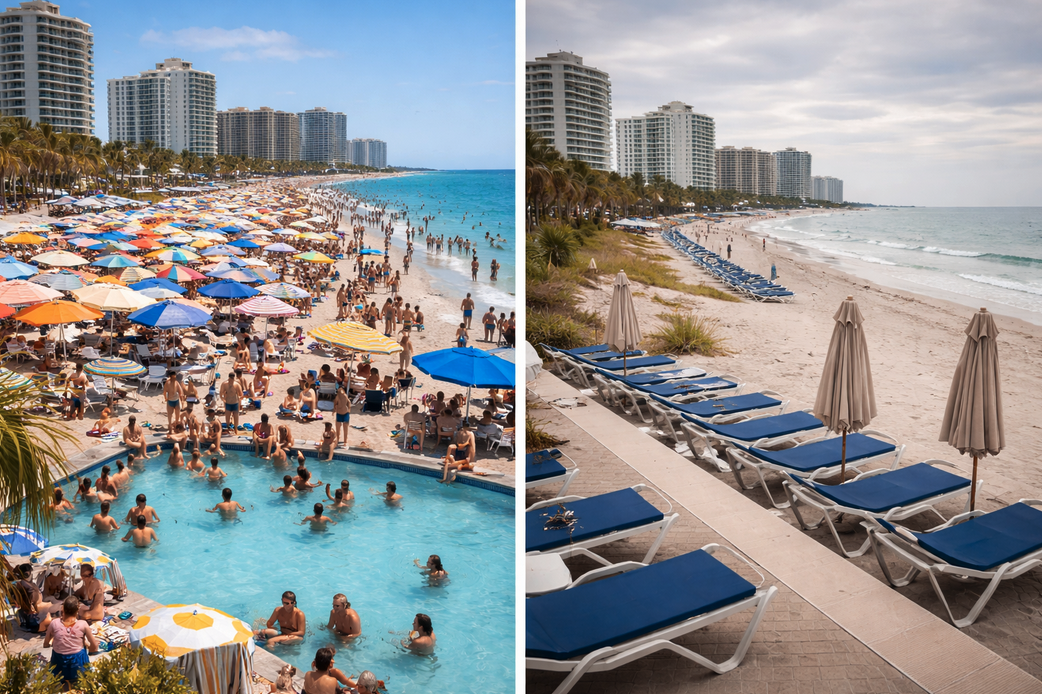
For decades, savvy travelers knew how to save money: booking trips during something called shoulder season.
Many travel destinations once had predictable busy seasons and quiet seasons.
Beach towns filled up between spring break and Labor Day. Ski resorts thrived during the winter but slowed dramatically once the snow melted. Even places like Walt Disney World had predictable busy and quiet periods throughout the year.
Savvy travelers learned how to take advantage of those patterns by booking trips during shoulder season.
But in recent years, those quieter and cheaper travel windows have been getting harder to find.
In fact, travel demand has surged in recent years — with the U.S. TSA regularly screening more than 2.5 million passengers per day during busy periods. Including during traditional shoulder seasons.
What is shoulder season?
Shoulder season is the time between “peak” season and “off-season.” Shoulder season is known for lower costs, fewer crowds and, for many travelers, a better experience overall.
Of course, traveling to somewhere during its shoulder season always had its risks – if you scheduled a long weekend at a beach in early May and it turned out to be several days in the low 70s, you might have to change what you planned to do at the beach. But a good time could almost always be had – for a much cheaper price.
Shoulder season is starting to disappear
Unfortunately, a lot of travelers will tell you that those shoulder-season prices have gone away, and tourism at some locations seems to never slow down – not even during times that used to turn some places into virtual tourist ghost towns.
Why shoulder season is getting smaller
There are lots of reasons why it’s harder to find shoulder season travel, but it all boils down to a few categories:
1. Travel locations have gotten smarter
Walt Disney World is a perfect example of a location getting smarter about its slower shoulder seasons.
For years, there was a quiet time between Labor Day and Christmas week. Then, in 1996, Disney introduced their Epcot Food & Wine Festival – a program with kiosks that sold “sample” sized food and beverage, along with opportunities to attend special dinners and food-related classes. Over time it became an extremely popular event, to the point that people now purposely visit in the fall to be able to attend the festival (which has also increased in length from 30 days to 5 months).
Since then, Disney has also introduced other special events during their slower seasons to help boost overall park attendance (and, of course, spending). As a result, save for a couple of weeks in early January, shoulder season pretty much no longer exists at Walt Disney World.
Ski resorts have also introduced more ways their locations can be used when there’s no snow on the ground. Vail Ski Resort in Colorado is a perfect example. They now offer zip-lining, mountain biking and white water rafting. The town of Vail also hosts numerous events during the summer, such as art festivals and outdoor concerts, to get people to visit even if they’re not going to ski.
Other vacation hot spots have also begun advertising staycations, “microvacations,” etc., and get a whole new group of visitors during what had typically been “slow season.”
2. The way people work and go to school has changed
When most school-aged kids were in traditional schools throughout fall, winter and spring, parents who didn’t want to pull their kids out of school for travel would typically vacation during Presidents’ Week, spring break, summer vacation, fall break or whatever “holiday time” the school district used.
Nowadays, kids who are homeschooled aren’t in traditional classrooms; they can learn on the road, on a plane and yes, even while on vacation. So the “quiet times” when families didn’t visit are now busy.
The same can be said for remote workers who aren’t necessarily chained to their desk 40 hours per week. If you can work out of your house, you can work from anywhere and don’t have to worry as much about accumulating vacation time. And if you can plan that vacation during a cheaper time of year, why not do it? Except when enough people are planning vacations during cheaper times of year, the vacation places make their prices “not so cheap” ;-).
3. Social media, influencers and FOMO
Influencers have had a lot of, well, influence on travelers over the past few years. Look at how many more people are now flocking to Japan, the Cotswolds and, until recently, Dubai. FOMO (Fear Of Missing Out) is a real thing.
With so many more people visiting these locations, there becomes a breaking point; hotel will eventually sell out, so only “so many” people can go to Kyoto during cherry blossom season. But if you can go just before or after the trees peak, you might still get a taste of what it’s like. And there goes THAT shoulder season, too.
All told, with more people traveling throughout the year, demand stays high — and so do prices.
So is shoulder season gone?
Shoulder season hasn’t disappeared entirely — but it’s definitely shrinking.
Travel windows that once lasted months are now often reduced to just a few weeks. Some destinations still have quieter periods — winter in some parts of Europe, for example — but the deals and empty crowds many travelers remember are becoming harder to find.
These days, finding shoulder-season prices often comes down to flexibility, careful planning, and a bit of luck.
Want to comment on this post? Great! Read this first to help ensure it gets approved.
Want to sponsor a post, write something for Your Mileage May Vary, or put ads on our site? Click here for more info.
Like this post? Please share it! We have plenty more just like it and would love it if you decided to hang around and sign up to get emailed notifications of when we post.
Whether you’ve read our articles before or this is the first time you’re stopping by, we’re really glad you’re here and hope you come back to visit again!
This post first appeared on Your Mileage May Vary

1 comment
The other reason not mentioned here is that so many baby boomers retired during Covid and have a newfound ability to travel. They are mostly in their 70s, worked for many years without seeing the world, and now have both time and money and are mostly healthy enough to still travel but probably not for much longer. They can travel wherever and whenever. I see them all the time in airport and hotel lounges in Europe, and most US carriers are expanding their premium seating because of increased premium leisure demand. I would venture to say that this demographic is much of the reason why.