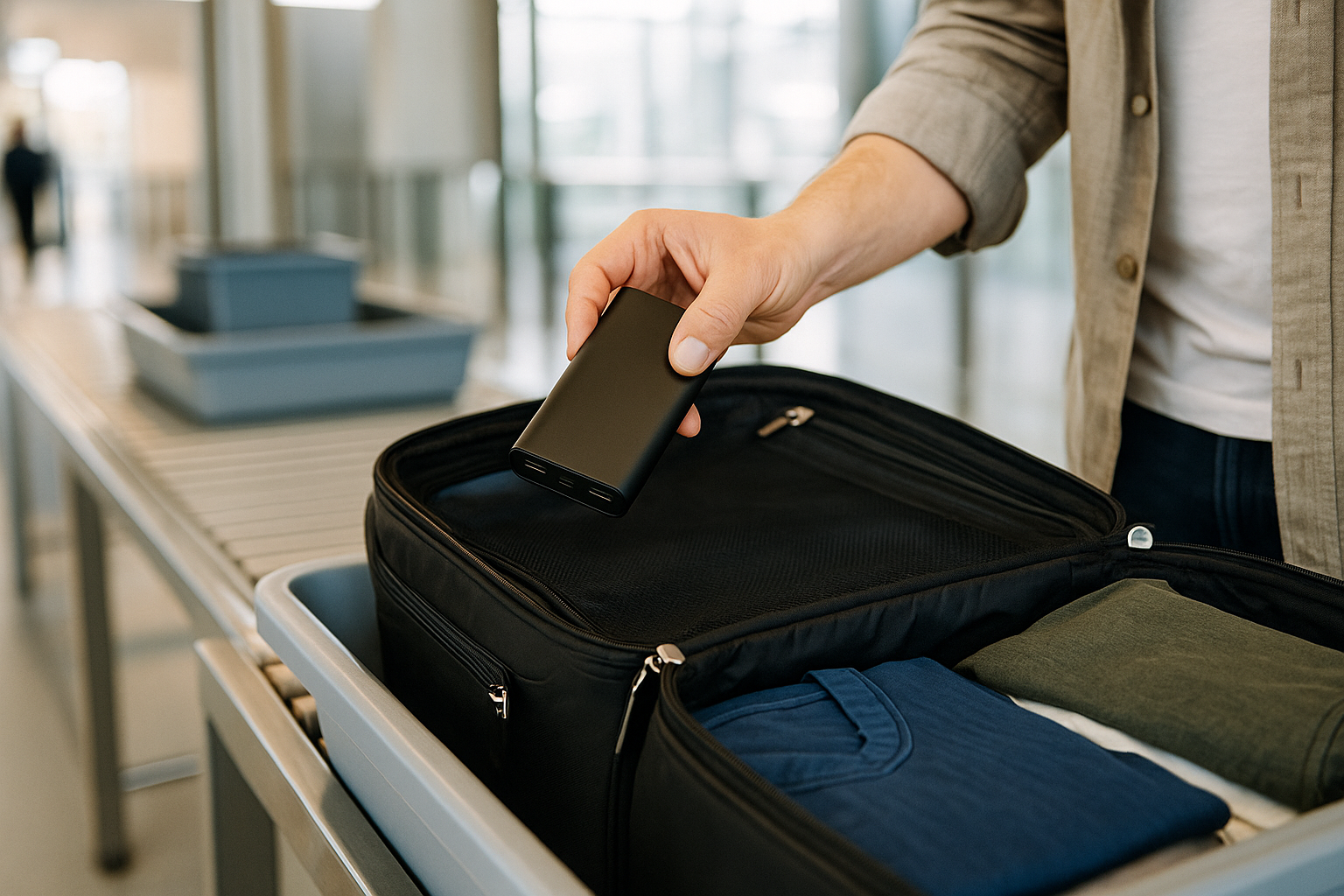
Flying with a power bank used to be fairly straightforward: keep it in your carry-on bag and don’t bring one that’s too large.
That’s still the basic rule. But airlines have become more specific about where portable chargers can be stored, whether they can be used during the flight and how many batteries you can bring.
In the United States, the Federal Aviation Administration sets the baseline rules. Airlines can then impose stricter limits of their own.
Here’s an updated, alphabetical look at the power bank and lithium battery policies for major U.S. airlines.
FAA Rules For Power Banks And Spare Batteries
The FAA considers power banks, portable chargers and spare lithium batteries to be spare batteries. That means they must remain in the aircraft cabin, where the crew can respond if one overheats, catches fire or begins producing smoke.
You can find the complete rules on the FAA’s Airline Passengers and Batteries page.
- Power banks and spare lithium batteries are prohibited in checked baggage. They must be carried in your carry-on bag or on your person.
- 100 watt-hours or less: Generally permitted without advance airline approval when carried for personal use.
- More than 100 Wh but no more than 160 Wh: Airline approval is required, with no more than two spare batteries per passenger.
- More than 160 Wh: Prohibited on passenger aircraft, except for certain batteries used with approved mobility devices.
- Battery terminals must be protected from short circuits. This can be done by keeping the battery in its original packaging, covering exposed terminals or placing each battery in a separate protective case or plastic bag.
- Damaged, swollen, defective or recalled batteries are not permitted.
- If your carry-on bag is gate-checked, you must remove all power banks and spare batteries before handing over the bag.
- Power banks should remain accessible during the flight rather than being buried inside an overhead bag.
Most ordinary phone chargers fall well below the 100 Wh limit. However, you should check the label on the power bank rather than relying only on its advertised milliamp-hour capacity.
Airline-By-Airline Power Bank Policies
Alaska Airlines
- Policy: Batteries and Electronic Devices
- Power banks and spare lithium batteries must be packed in carry-on baggage.
- Batteries of 100 Wh or less are generally permitted for personal use.
- Up to two batteries between 101 and 160 Wh may be carried with airline approval.
- Terminals must be protected against short circuits.
- Smart luggage must have a removable battery. If the bag is checked, the battery must be removed and carried in the cabin.
Allegiant Air
- Policy: Prohibited and Restricted Items
- Spare lithium batteries and portable chargers must be carried in the cabin.
- Allegiant permits lithium-ion batteries of less than 100 Wh, subject to its quantity restrictions.
- The airline lists a maximum of 20 spare lithium batteries rated below 100 Wh.
- Batteries over 160 Wh are prohibited.
- Damaged or recalled batteries are not accepted.
- Spare batteries must be protected from damage and short circuits.
American Airlines
- Policy: Restricted Items
- Lithium batteries and power banks must be carried in carry-on baggage.
- American permits up to four spare batteries of less than 100 Wh.
- Up to two spare batteries between 100 and 160 Wh are permitted.
- Batteries over 160 Wh are generally prohibited, apart from certain approved mobility-device batteries.
- Each spare battery must be individually protected.
- Smart luggage must have a removable battery. Bags with non-removable lithium batteries will not be accepted.
Avelo Airlines
- Policy: Traveling With Lithium Batteries and Portable Chargers
- Power banks and spare lithium batteries must be packed in carry-on baggage.
- While charging a device, the power bank must remain visible.
- It should not be used while stored inside a bag or in an overhead bin.
- Avelo otherwise directs passengers to follow the FAA’s battery-size and packing requirements.
Breeze Airways
- Policy: Breeze Travel Tips
- Portable chargers and spare lithium batteries should be packed in carry-on baggage rather than checked luggage.
- Spare batteries must be protected from short circuits.
- Breeze generally follows federal limits for battery size and quantity.
Delta Air Lines
- Policy: Battery or Fuel-Powered Items
- Power banks and other spare lithium batteries must be carried in carry-on baggage.
- Batteries of 100 Wh or less are permitted for personal use.
- Up to two spare batteries between 100 and 160 Wh are allowed.
- Batteries over 160 Wh are prohibited.
- Delta limits each passenger to a maximum of 20 spare batteries.
- Damaged, defective or recalled batteries are not accepted.
Frontier Airlines
- Policy: Smart Luggage Battery Rules
- Spare lithium batteries must remain in carry-on baggage and be protected from short circuits.
- Frontier’s current smart-luggage policy requires batteries to be removable and no larger than 100 Wh.
- The battery must be removed before boarding and kept in the passenger’s carry-on bag for the flight.
- Smart luggage with a damaged, defective, oversized or non-removable battery is not permitted.
Hawaiian Airlines
Hawaiian Airlines is now part of Alaska Air Group, and its baggage pages direct travelers to the same battery guidance used by Alaska Airlines.
- Policy: Batteries and Electronic Devices
- Power banks and spare lithium batteries must remain in carry-on baggage.
- Batteries of 100 Wh or less are generally permitted.
- Up to two batteries between 101 and 160 Wh may be carried with airline approval.
- Smart luggage must have a removable battery. If the bag is checked, the battery must be removed and carried in the cabin.
JetBlue
- Policy: JetBlue Battery Requirements
- Power banks and spare lithium batteries must be carried in carry-on baggage.
- If a carry-on bag is checked at the gate, all spare batteries must be removed and kept with the passenger.
- JetBlue’s current guidance lists a 100 Wh limit for batteries used with ordinary, non-mobility electronic devices.
- Batteries must be in their original packaging or have their terminals insulated to prevent a short circuit.
- Damaged or recalled batteries are prohibited.
- If a battery becomes unusually hot or begins smoking, passengers should immediately notify a crewmember.
Southwest Airlines
- Policy: Traveling With Lithium Batteries and Chargers
- Power banks and spare batteries must be carried in the cabin and are prohibited in checked baggage.
- When a power bank is being used, it must remain visible and cannot be stored inside a bag.
- A power bank may not be charged onboard using the aircraft’s in-seat power supply.
- Southwest otherwise applies the FAA’s limits for battery size, approval and terminal protection.
Sun Country Airlines
- Policy: Hazardous Materials and Prohibited Items
- Power banks, secondary charging devices and spare lithium batteries must be carried in carry-on baggage.
- Batteries of 100 Wh or less are generally permitted.
- Batteries over 100 Wh but no more than 160 Wh require airline approval.
- Batteries over 160 Wh are prohibited.
- Battery terminals must be protected from short circuits.
United Airlines
- Policy: Electronic Devices and Batteries
- Loose batteries and portable chargers must be packed in cabin baggage only.
- Ordinary spare batteries must be less than 100 Wh.
- United permits up to two lithium-ion batteries with a maximum capacity of 160 Wh, subject to approval.
- Each loose battery must be separated and protected from metal objects and short circuits.
- If a carry-on bag is checked, all portable chargers and spare batteries must be removed first.
- Smart-bag batteries must be removable.
Can You Use A Power Bank During The Flight?
Carrying a power bank aboard an aircraft does not automatically mean the airline guarantees you can use it throughout the flight.
Southwest and Avelo specifically state that a power bank must remain visible while charging another device. Southwest also says the power bank itself may not be recharged from the aircraft’s power supply.
Other airlines may not publish a separate power-bank usage rule, but the flight crew always has the authority to tell passengers to disconnect or stow an electronic device.
No matter which airline you’re flying:
- Do not use a power bank while it is buried inside a backpack, purse or suitcase.
- Do not leave it charging unattended.
- Keep it somewhere you can quickly reach and monitor it.
- Disconnect it immediately if it becomes unusually warm, expands, smells strange or produces smoke.
- Tell a flight attendant immediately if you suspect a battery problem.
How To Find Your Power Bank’s Watt-Hour Rating
Most power banks have their watt-hour rating printed somewhere on the case. It may appear as “Wh” in small print near the battery capacity and electrical specifications.
If only milliamp-hours and voltage are shown, you can estimate the rating using this formula:
Watt-hours = milliamp-hours × voltage ÷ 1,000
For example, a 20,000 mAh power bank rated at 3.7 volts would be approximately:
20,000 × 3.7 ÷ 1,000 = 74 Wh
That would fall below the FAA’s standard 100 Wh limit.
However, airline employees may rely on the manufacturer’s printed rating. A power bank with no readable capacity label could be questioned or refused, especially on an international itinerary.
Final Thought
The basic rule hasn’t changed: power banks belong in the cabin, not in checked luggage.
What has changed is the amount of attention airlines are paying to where the charger is stored and how it is used. Southwest and Avelo now specifically require portable chargers to remain visible while powering another device, and other airlines may eventually adopt similar rules.
Before leaving for the airport, check that your power bank has a readable watt-hour rating, shows no signs of damage and is packed somewhere accessible. If your carry-on bag gets gate-checked, remove the charger before handing over the bag.
And once you’re on the plane, don’t leave it charging out of sight.
Want to comment on this post? Great! Read this first to help ensure it gets approved.
Want to sponsor a post, write something for Your Mileage May Vary, or put ads on our site? Click here for more info.
Like this post? Please share it! We have plenty more just like it and would love it if you decided to hang around and sign up to get emailed notifications of when we post.
Whether you’ve read our articles before or this is the first time you’re stopping by, we’re really glad you’re here and hope you come back to visit again!
This post first appeared on Your Mileage May Vary