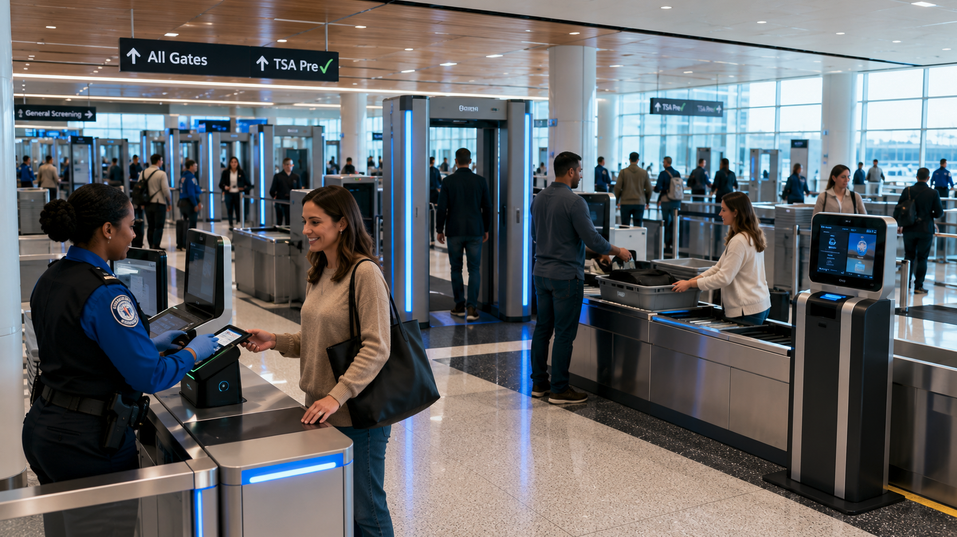
The Transportation Security Administration is about to turn 25 years old.
And if TSA’s brand-new boss gets his way, the airport security checkpoint we know (and sometimes tolerate) today could look very different during the agency’s next 25 years.
David P. Cummins was sworn in on August 10 as the eighth Administrator of the TSA, and the first permanent administrator of President Trump’s second term. The agency had gone through four acting administrators since Trump returned to office in January 2025.
Just two weeks into the job, Cummins is already talking about what comes next.
And for those of us who fly, some of it could eventually affect what happens every time we go through airport security.
TSA Is Getting Ready For Its Next 25 Years
As the agency approaches its 25th anniversary, Cummins has laid out the Horizon 25 Strategy, essentially TSA’s roadmap for modernizing for the future.
The official description, as you might expect from a government agency, contains plenty of phrases such as agile, resilient and evolving threats.
But buried underneath all the government-speak are some things travelers may actually care about.
“President Trump and Secretary Mullin have entrusted me with the task of modernizing TSA,” Cummins said on August 24. “In its first 25 years, this agency has performed its critical Homeland Security mission with dedication and excellence. As we look forward to the next 25 years, we must constantly work to stay ahead of evolving threats and deliver a Golden Age of Travel. Through the Horizon 25 Strategy, we will build a TSA that is agile, resilient and ready for tomorrow’s challenges.”
So what does that potentially mean when you’re standing in the security line with your belt, laptop, liquids and everything else?
Modernizing The TSA Checkpoint
One of Cummins’ main goals is to modernize airport checkpoints while improving the passenger experience.
Those last four words obviously got my attention.
The plan includes an evolved version of TSA’s Screening Partnership Program, which will replace TSA Gold+. TSA says the idea is to better use the private sector to create a safer, more secure and more efficient aviation system.
Exactly what that will ultimately look like for the average passenger isn’t particularly clear yet.
But “more efficient checkpoint” is certainly something most of us can potentially get behind.
Getting New Technology Into Airports Faster
Another part of Horizon 25 involves changing how TSA acquires new technology.
That’s potentially important because airport security technology doesn’t exactly stand still. New scanners, biometric systems and other screening equipment continue to be developed, but getting new technology from “Hey, this works” to “There’s one at your airport” can take a very long time.
TSA apparently wants to streamline that process.
The agency also plans to expand its ability to deal with threats from unmanned aircraft systems (in other words, drones).
To start working toward these goals, Cummins says TSA will bring together employees from both the field and headquarters in September to help determine how to move forward.
And then he made a promise that frequent flyers may want to remember:
“TSA does not have to choose between a secure checkpoint, an efficient checkpoint, and an elevated passenger experience. Through Horizon 25, TSA can, and will, deliver all three at once.”
Secure, efficient AND a better passenger experience?
OK. You have my attention.
The Big Question: What Will Passengers Actually Notice?
Right now, Horizon 25 is much more of a plan than a finished product.
There aren’t announcements that your local airport is getting some magical new checkpoint next Tuesday. And phrases such as “modernization,” “private-sector involvement,” and “streamlined technology acquisition” don’t necessarily tell us what you and I will experience when we hand over our IDs.
But the direction is interesting.
For years, TSA has been introducing more biometrics, newer scanners, automated screening equipment and other technology intended to make security both more effective and less cumbersome.
Cummins is essentially saying TSA wants to accelerate that evolution—and that making security better for passengers is supposed to be part of the equation rather than an afterthought.
Whether TSA can actually deliver better security, faster checkpoints AND a better passenger experience all at the same time?
Well, that’s the part I’ll be watching. I bet many of you reading this will be, too.
Because after nearly 25 years of taking off certain pieces of clothing, pulling things out of bags, putting things back into bags and standing in airport security lines, I think most travelers would happily welcome TSA’s next era.
Well, as long as “modernization” doesn’t somehow result in another line we have to stand in. 😉
Want to comment on this post? Great! Read this first to help ensure it gets approved.
Want to sponsor a post, write something for Your Mileage May Vary, or put ads on our site? Click here for more info.
Like this post? Please share it! We have plenty more just like it and would love it if you decided to hang around and sign up to get emailed notifications of when we post.
Whether you’ve read our articles before or this is the first time you’re stopping by, we’re really glad you’re here and hope you come back to visit again!
This post first appeared on Your Mileage May Vary