Although English is the primary language used in the United States (these are the most popular languages in each state), the country has had no official national language for most of its history. The Founding Fathers believed that designating a single language could be divisive in a nation made up of immigrants from many countries.
In fact, Manhattan Island alone had at least 18 languages spoken there as early as 1646, including Dutch, French, Danish, Swedish, English, German, Italian and Portuguese.
Because of America’s long history of immigration, many cities include multilingual signage in areas with large populations of non-English speakers. That linguistic diversity still shows up today in subtle ways—including airport signage.
Why some places include multiple languages on signs
In areas where large numbers of visitors or residents speak other languages, it’s common to see translations on signs. Cities may add Spanish, Chinese, Arabic, or other languages as a courtesy to travelers and residents.
You’ll often see the same idea internationally. In places that attract a lot of English-speaking tourists, English translations frequently appear alongside the local language.
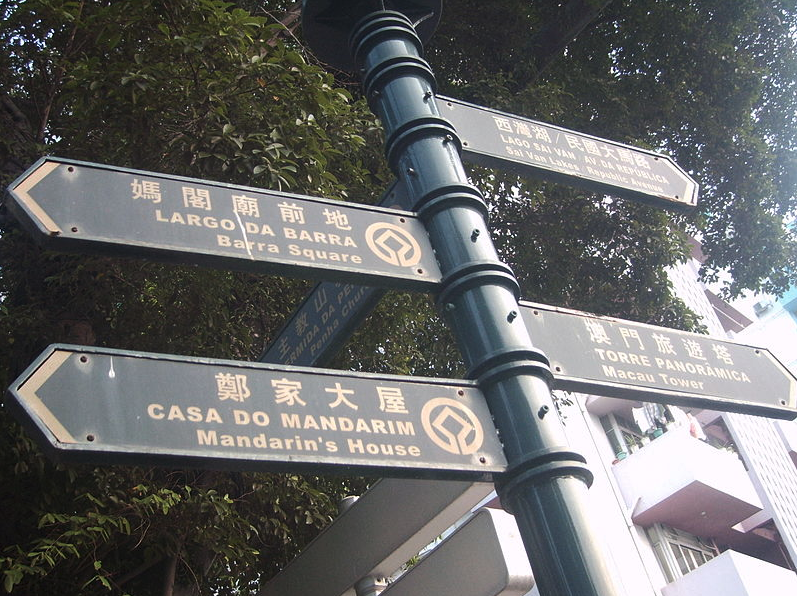
For example, some signs in Macau include both Chinese and Portuguese, reflecting the region’s colonial history and international visitors.
PC (cropped): Destron Commander / Wikimedia / CC BY-SA 3.0
But one U.S. airport has been puzzling travelers for years because its signs are translated into a language most visitors wouldn’t expect: Japanese.
Why Detroit Airport Has Japanese Signs
Detroit Metropolitan Airport (DTW) has something that has puzzled travelers for years.
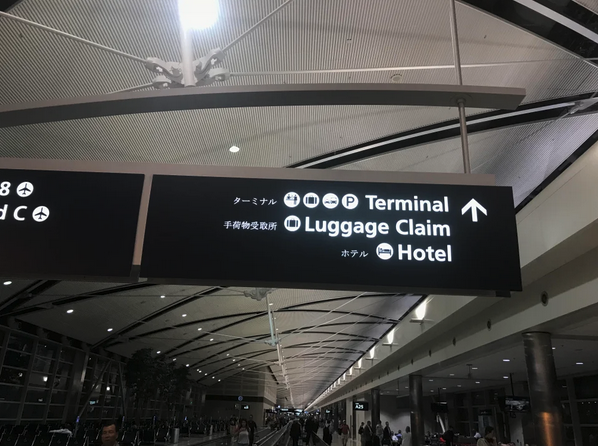
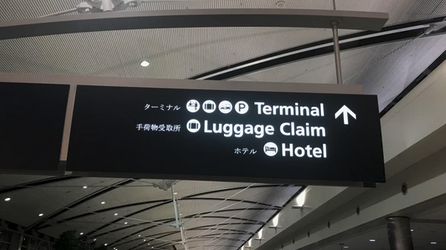
Inside the McNamara Terminal, many directional signs are translated into Japanese.
PC: Imgur
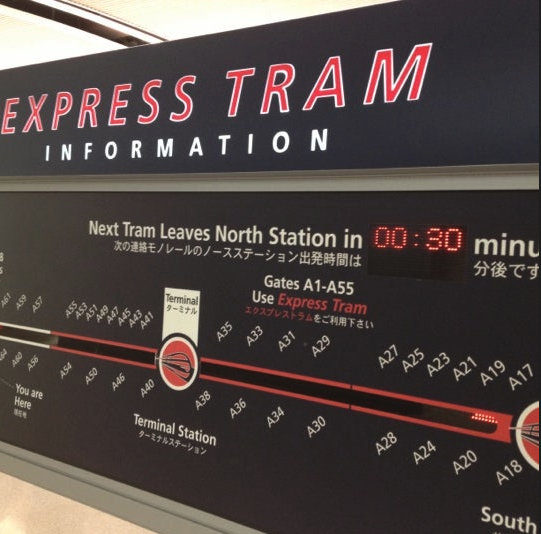
Even informational signs—like those for the Express Tram inside the terminal—include Japanese translations.
PC: Foursquare
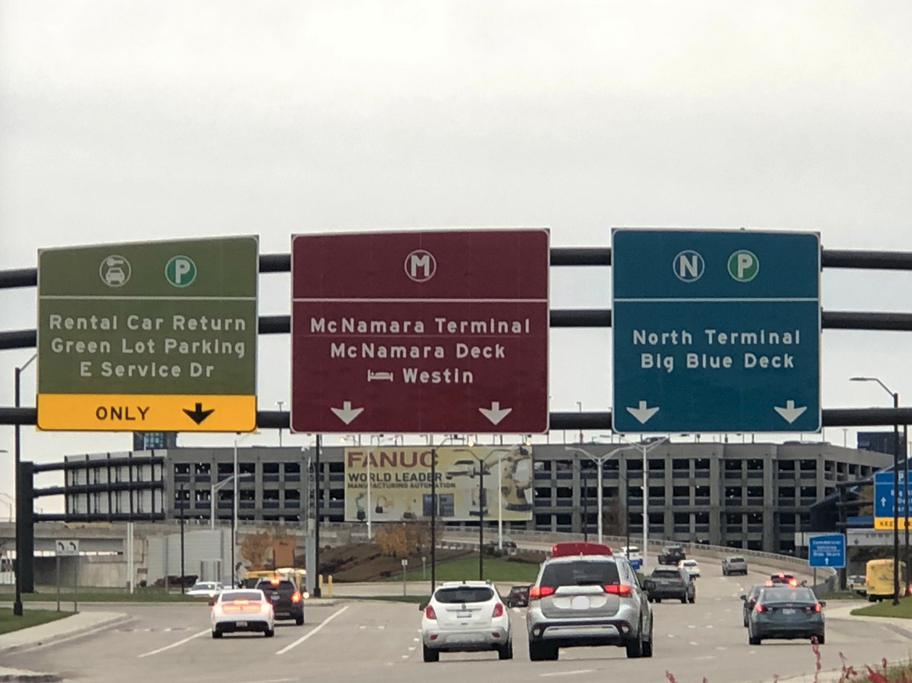
But outside the terminal, the signs are only in English.
PC: DTW / Facebook
And you don’t find any signs translated into Japanese throughout the rest of the city, either.
But Detroit isn’t a city with a large Japanese-speaking population—so why are the airport signs translated?
Why many people guessed wrong
For years, many people assumed the translations were related to Detroit’s automobile industry.
Detroit has long been synonymous with car manufacturing. Companies like Ford, General Motors, and Chrysler dominated the city’s economy throughout much of the 20th century, and Japanese automotive executives frequently traveled there for meetings and partnerships.
So the theory seemed plausible.
But it turns out the real explanation has nothing to do with Detroit’s auto industry—and everything to do with one airline.
The real reason Detroit Airport has Japanese signs
The explanation actually traces back to Northwest Airlines.
According to airport spokesperson Erica Donerson, when McNamara Terminal opened in 2002, Northwest Airlines was the primary carrier operating there.
At the time, Tokyo was one of Northwest’s major international hubs, and Detroit served as a key connection point for travelers flying between Japan and cities across the United States.
Because Detroit was a key gateway between the United States and Japan, the terminal’s designers included Japanese translations to help passengers traveling to, from, or connecting through Detroit on flights to Tokyo.
In other words, the Japanese signage was simply a courtesy to international travelers.
Why are the signs still there today
Northwest Airlines merged with Delta Air Lines in 2008, and Delta became the primary airline operating out of McNamara Terminal.
Delta still operates flights between Detroit and Tokyo, so Japanese travelers continue to pass through the airport.
Because of that—and because replacing airport signage is expensive—the translations have remained in place.
However, airport officials have suggested that if the signs are ever replaced in the future, the Japanese translations might not necessarily return.
FAQ
Why does Detroit Airport have Japanese signs?
Japanese translations were added when the McNamara Terminal opened in 2002 to help passengers traveling between Detroit and Tokyo on Northwest Airlines, which had a major hub in Japan.
H/T Axios
Want to comment on this post? Great! Read this first to help ensure it gets approved.
Want to sponsor a post, write something for Your Mileage May Vary, or put ads on our site? Click here for more info.
Like this post? Please share it! We have plenty more just like it and would love it if you decided to hang around and sign up to get emailed notifications of when we post.
Whether you’ve read our articles before or this is the first time you’re stopping by, we’re really glad you’re here and hope you come back to visit again!
This post first appeared on Your Mileage May Vary

3 comments
What a {REDACTED}. This wasn’t {REDACTED} and the explanation is {REDACTED} but you {REDACTED} is it {REDACTED}?
{Comment redacted by YMMV to remove portions that were against YMMV’s requirements for approval.
In this case, practically all of it. Womp womp. ¯\_(ツ)_/¯}
I only flew Northwest Orient once but they were a force to be reckoned with for aviation in the Pacific. Nice to see that some remnant of their existence remains. After all, what’s it hurt to have signage in another language?
At one point, NWA had as many as 5 747s a day arriving from Narita, Nagoya and Osaka, so this made a lot of sense.