Any time we even THINK about renting a car in another country, I ask my husband the same question:
“Wait…do they drive on the same side of the road as us?”
Because honestly, that feels like a pretty important detail.
I mean, to be honest, when we travel internationally, we generally don’t need to rent a car. We’re very comfortable with public transportation and have no qualms about taking trains, subways, buses or taxi/rideshares to get from Point A to Point B.
However, sometimes public transportation just isn’t practical. Case in point, when we explored the southern half of Iceland’s Golden Circle a few years ago. And when we started planning our trip around Germany, it eventually dawned on us that for part of the trip, when we were going from small town to small town, renting a car seemed the most practical option.
Any time we start considering driving in a foreign country, I always ask my husband the same thing: ” Do they drive on the same side of the road as us?”
Why do so many countries drive on the left?
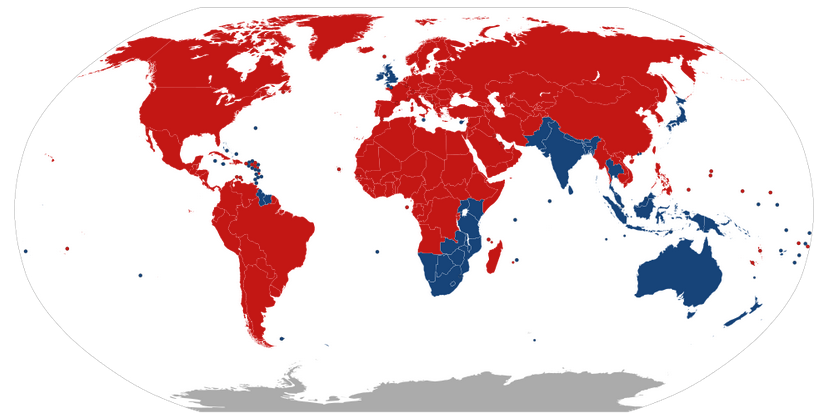
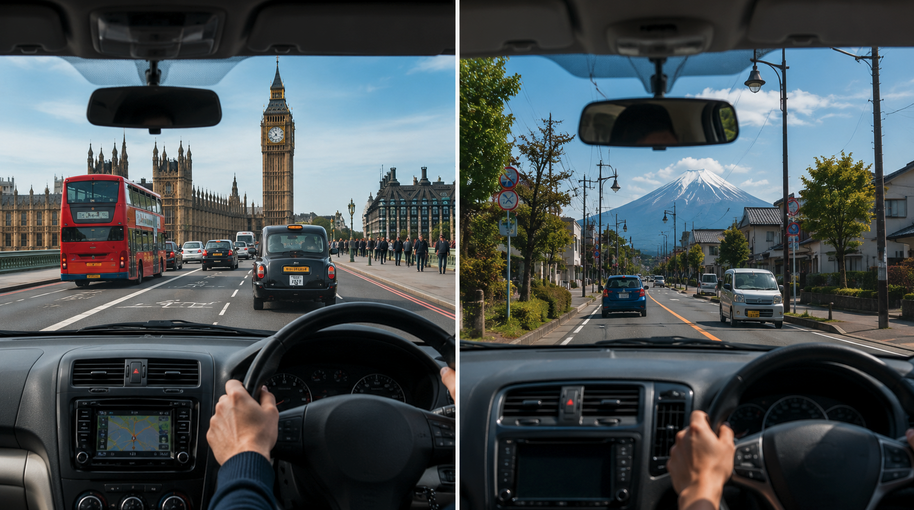
About 35% of the world’s population drives on the left side of the road. Most of them are old British colonies (Australia, Grenada, New Zealand, Ireland, etc.), although there’s a decent amount of Asian countries that drive on the left side, as well (Bhutan, Nepal, Japan, Thailand, etc.)
All told, there are 54 countries that do so.
Theories going back to ancient Rome
Archaeological evidence suggests that the ancient Romans may have driven their carts and chariots on the left. Since all roads lead to (and from) Rome, the practice apparently carried over into parts of medieval Europe as well. The reasons for this aren’t 100% clear, but some believe it was for safety, convenience or possibly political reasons.
For example, one theory suggests that most people are right-handed, so driving or riding on the left would have allowed them to wield their weapon with their dominant hand if they happened to cross paths with an enemy.
Japan’s preference for the left side of the road is said to originate in the practice of avoiding the accidental clashing of swords among pedestrians and travelers.
Then again, until the 1700s, horse-and-wagon traffic was very light. So much so that the decision to drive on the left or right often varied according to local custom.
How Britain and France influenced the world
Traffic staying to the left became the law of the land in Britain after laws saying so were passed in 1773 and 1835. But the opposite happened in France – since the 18th century, they decided that staying to the right was better.
These two countries were both powerful entities that eventually introduced their driving preferences to their respective colonies. That would easily explain why, for example, so many former British territories still drive on the left. And as Napoleon became more powerful, he was able to influence countries such as Germany, Poland and Switzerland to drive on the right.
Why the U.S. drives on the right
Here in the U.S., researchers have traced the beginning of driving to the right to the 18th century. That’s when freight wagons were being pulled by large teams of horses. These vehicles usually had no driver’s seat, so drivers tended to ride on the left side to make it easier to control their horses, etc. with their right hand. Then, as the wagons became more popular, traffic naturally shifted to the right so drivers could sit closer to the center of the road, see oncoming traffic more clearly, and therefore avoid collisions.
Other researchers believe our driving on the right side was simply an effort to thumb our nose at England in the mid-late 1700s.
Fast forward to the early 20th century, and when Henry Ford started making his Model Ts, he did so with the steering wheel on the left. That made it necessary to drive on the right.
Countries that switched sides
These days, left-hand traffic remains the norm in Britain and many of its former colonies as well as in Japan, Indonesia, Thailand and several other nations. Nevertheless, with the rise of the automobile, many countries have switched to the right to fit in with their neighbors.
In modern-day times, it’s happened here and there.
Canada used to drive on the left side because of their relationship with England. But in the 1920s, they were more interested in fitting in with the U.S., so they switched.
In 1967, Sweden spent about $120 million to prepare its citizens to switch from driving on the left to the right. Called Dagen H (“H Day.” Nowadays it’s called “Högertrafikomläggningen”), the government made the change at 5 am on September 3, 1967 – it took them 10 minutes (and the story of how they got it done is fascinating!).
At this point, the side of the road a country drives on is usually less about practicality and more about history, politics, geography, and tradition.
Once a country builds its roads, designs its vehicles, trains drivers, and develops decades (or centuries) of driving habits around one system, changing it becomes an enormous undertaking. That’s why modern-day switches are relatively rare — and why Sweden’s successful transition is still considered such a remarkable feat.
So yes, if you ever rent a car abroad, it’s definitely worth double-checking which side of the road you’re supposed to be on first.
Preferably before leaving the rental car lot…Because accidentally driving on the wrong side of the road is probably not the kind of “immersive cultural experience” most travelers are looking for. 😏.
Want to comment on this post? Great! Read this first to help ensure it gets approved.
Want to sponsor a post, write something for Your Mileage May Vary, or put ads on our site? Click here for more info.
Like this post? Please share it! We have plenty more just like it and would love it if you decided to hang around and sign up to get emailed notifications of when we post.
Whether you’ve read our articles before or this is the first time you’re stopping by, we’re really glad you’re here and hope you come back to visit again!
This post first appeared on Your Mileage May Vary

2 comments
We should offer the Brits a deal: They switch to driving on the right and we switch to the metric system.
Spain used to drive on the left and switched to the right.
Samoa switched to the left to be more aligned with Australia.