After our United flight to Frankfurt turned around mid-flight and stranded us back in Washington D.C., the compensation process was almost as confusing as the disruption itself.
If you’ve been following along with our Germany trip saga, you already know things didn’t exactly go according to plan.
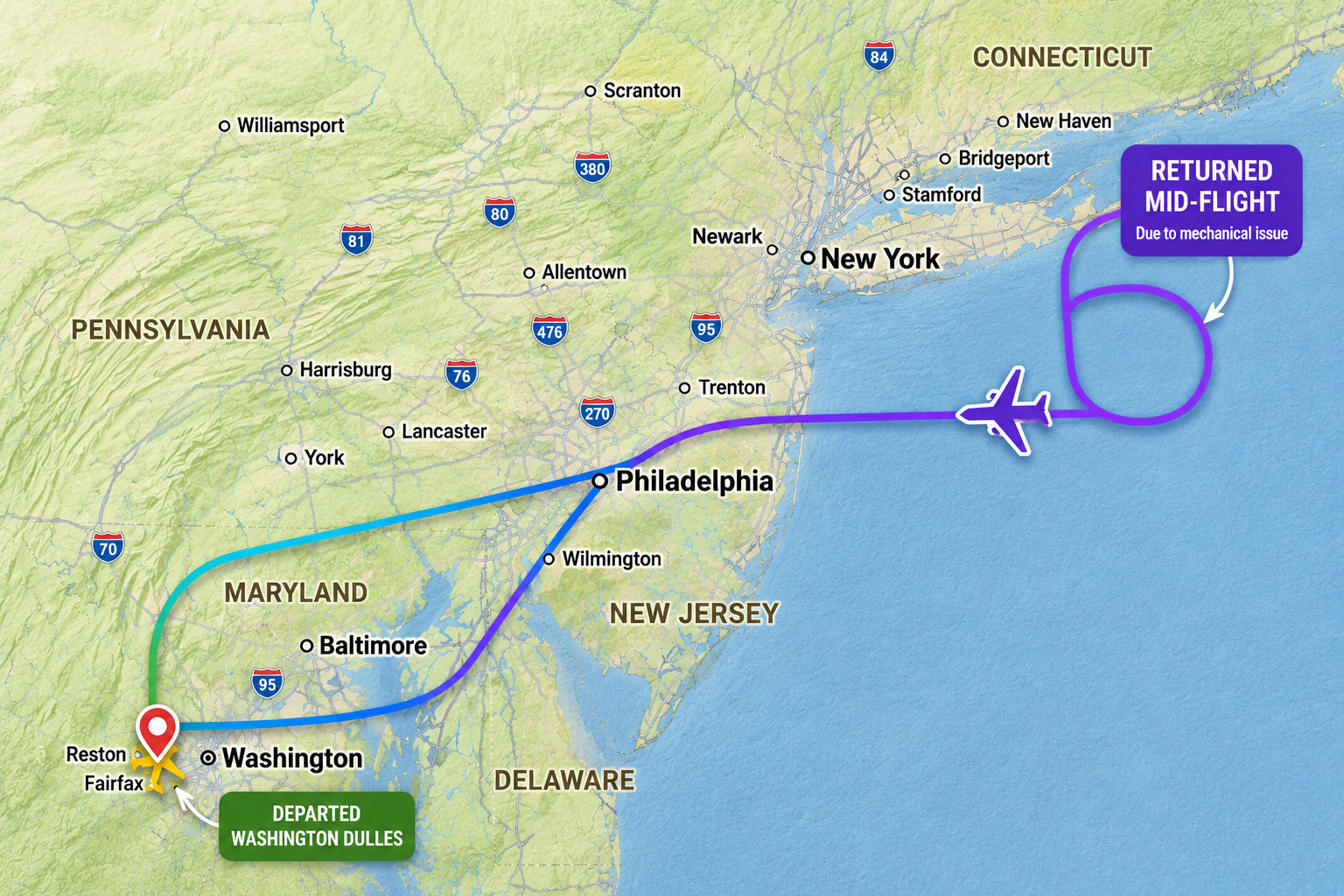
Our original Lufthansa flight was canceled due to a strike, so we were rebooked on a United flight from Washington Dulles to Frankfurt. After boarding, taking off, and spending roughly 90 minutes in the air, the plane returned to D.C. due to a mechanical issue.
That’s where things really started to spiral.
We were suddenly competing with hundreds of other passengers trying to rebook international flights before seats disappeared, while also scrambling to find a hotel room in the middle of the night near Dulles Airport.
And right in the middle of all that chaos, I got an email from United.
The email honestly looked suspicious
The subject line?
“Customer Appreciation.”
Not “Flight Disruption.” Not “Important Information About Your Flight.” Just “Customer Appreciation.”
The email itself was basically plain text with a link to the United Cares website.
Honestly, if I hadn’t been actively dealing with United at that exact moment, I probably would have assumed it was phishing spam.
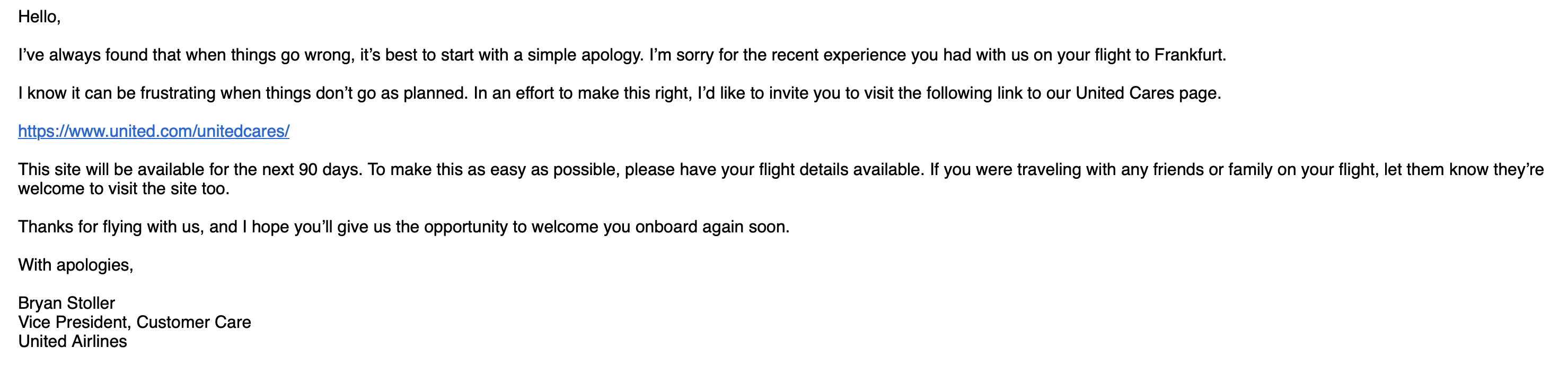
Even the website itself felt oddly generic. Before getting to any offer, it asked for personal information and flight details to verify eligibility.
At 2 AM, exhausted, stressed, and trying to salvage an international trip, it wasn’t exactly the smoothest customer service experience.
I skimmed the email when it arrived, mostly to make sure it wasn’t something important related to our rebooking, but I didn’t really dig into it until the next day, once we finally had replacement flights and a hotel room sorted out.
Something interesting happened with the compensation offers
Here’s where things got even stranger.
The compensation options you received apparently depended on how you verified your identity.
The website strongly encouraged MileagePlus members to log in using their MileagePlus account number, warning that compensation options “may be affected” if you continued as a guest.
That turned out to matter.
Our friends entered their flight information as guests using their confirmation number, which the site said was perfectly acceptable. However, they were only offered a travel certificate.
Because I logged in with my MileagePlus account, I was given two choices:
- $175 United Electronic Travel Certificate (ETC)
- 8,750 MileagePlus miles
That’s a pretty important detail that I imagine many passengers probably missed.
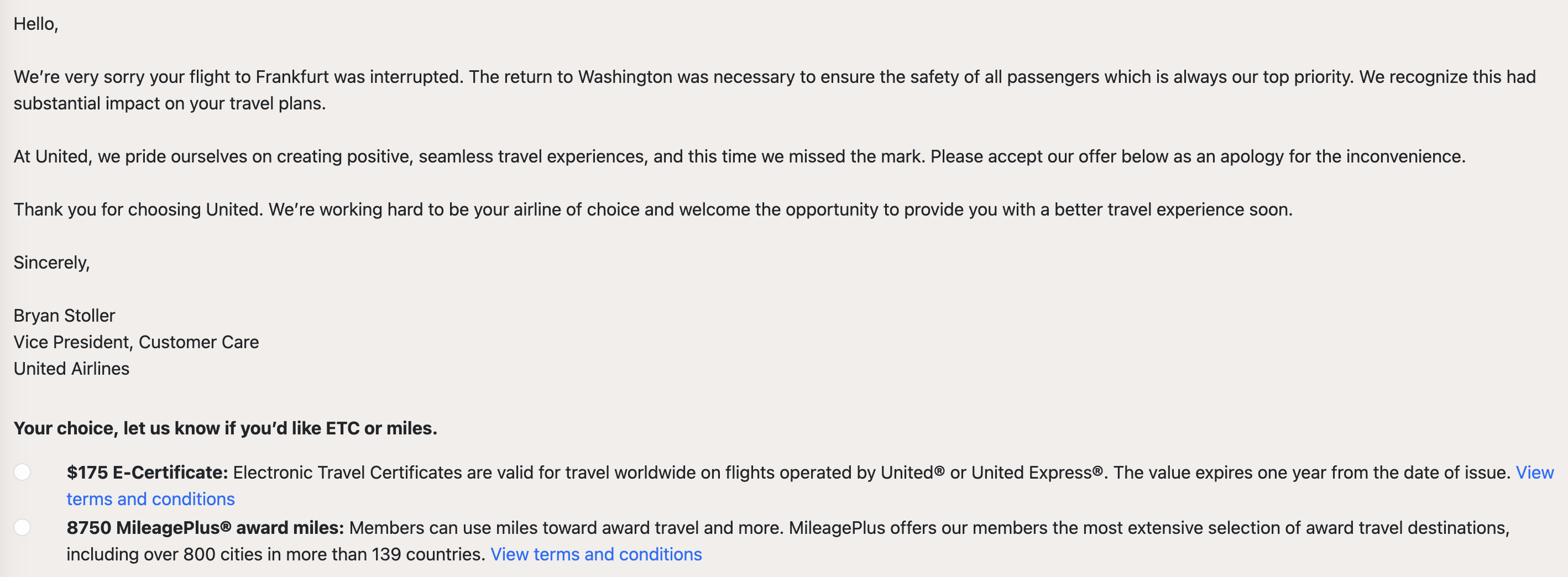
Which option is actually better?
At first glance, the miles option sounds tempting. After all, points-and-miles people are conditioned to think in miles.
But the math here strongly favors the travel certificate.
Most people value United miles somewhere around 1.1 to 1.3 cents each. Even at a generous valuation, 8,750 miles are probably worth around $100-$130 in practical terms.
Meanwhile, the ETC is worth a straight $175 toward a future United ticket.
So mathematically, the ETC is the better deal.
But there’s a catch. Actually, several catches.
The ETC has a lot of restrictions
The travel certificate:
- Expires in one year
- Only works on United-operated flights and United Express
- Does not work on Star Alliance partner flights
- Can’t be used for baggage fees, seat fees, upgrades, or other extras
So while the ETC is technically more valuable, it’s also far less flexible.
Was this reasonable compensation?
That’s the bigger question.
To United’s credit, they did proactively offer compensation without us even asking. Plenty of airlines make customers fight for every dollar after a disruption.
But at the same time, this wasn’t a minor delay.
Our replacement international flight turned around mid-flight, we lost essentially a full day of our trip, had to scramble for a last-minute hotel near Dulles, rebook transportation to Hamburg, deal with checked baggage confusion, and spend additional money on seat assignments and other unexpected expenses.
So while $175 or 8,750 miles isn’t insulting by current U.S. airline standards, it also doesn’t exactly feel generous considering the scale of the disruption and the cost of the ticket.
At least to me, it felt more like a goodwill gesture than true compensation.
And honestly? We still haven’t decided which option we’re taking.
The ETC is clearly worth more on paper, but we also don’t currently have any upcoming trips where flying on United-operated flights would be our preferred option.
So now I’m curious.
If you were in this situation, which would you take: the $175 ETC or the 8,750 MileagePlus miles?
Want to comment on this post? Great! Read this first to help ensure it gets approved.
Want to sponsor a post, write something for Your Mileage May Vary, or put ads on our site? Click here for more info..
Like this post? Please share it! We have plenty more just like it and would love it if you decided to hang around and sign up to get emailed notifications of when we post.
Whether you’ve read our articles before or this is the first time you’re stopping by, we’re really glad you’re here and hope you come back to visit again!
This post first appeared on Your Mileage May Vary

2 comments
Does this disqualify Eu261 compensation?
As it was a US carrier on a flight TO the EU, EU261 does not apply.