If you’ve ever watched your flight map while traveling between the U.S. and Asia, you may have noticed something odd.
The plane almost never seems to fly where you’d expect it to.
Have you ever seen the flight patterns of flights from Japan to the United States? They never go directly across the Pacific Ocean to get to, say, San Francisco. They take a curved pattern that brings them, if not over Canada, then near it.
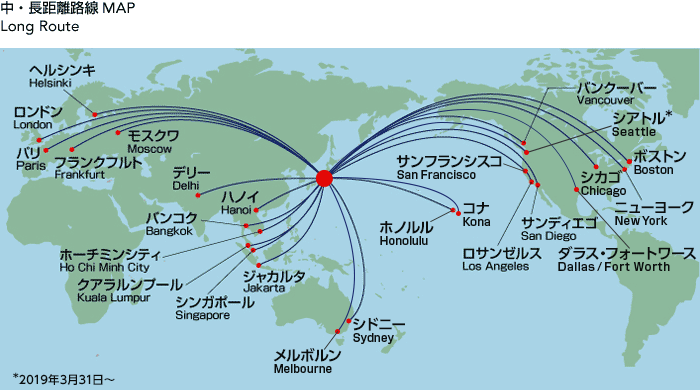
PC: JAL
The same goes for flights between, for example, Los Angeles and Beijing – they take an upward curved route that hugs Canada, Alaska, Russia, etc., before reaching their destination in China.
So what’s up with that? Why don’t planes fly over the Pacific Ocean?
Well, of course, SOME planes fly over the Pacific. Lots of them, really. I mean, there’s no way you can get to Hawaii from anywhere else without flying over the ocean. Flights between the U.S. & Australia or New Zealand go directly over the Pacific waters, too. And, of course, if the jet stream is working with or against you, you may fly over the ocean regardless.
In a nutshell, it all has to do with saving time, saving fuel, distance, safety, and a few other factors. Watch this:
So while those curved routes may look strange on a flat map, they’re often actually the fastest, safest, and most fuel-efficient option for airlines.
It’s also a good reminder that the Earth is round — something flight maps make very obvious very quickly. 😏
And these days, with airlines avoiding certain airspace over Russia, Ukraine, and other conflict zones, some routes have become even more unusual-looking than before.
But basically, pilots aren’t taking the scenic route just to mess with your in-flight map obsession. 😆
Want to comment on this post? Great! Read this first to help ensure it gets approved.
Want to sponsor a post, write something for Your Mileage May Vary, or put ads on our site? Click here for more info.
Like this post? Please share it! We have plenty more just like it and would love it if you decided to hang around and sign up to get emailed notifications of when we post.
Whether you’ve read our articles before or this is the first time you’re stopping by, we’re really glad you’re here and hope you come back to visit again!
This post first appeared on Your Mileage May Vary

2 comments
Please don’t fly over the Pacific Ocean because the Earth is flat Just look at the flat earth map and you’ll understand it very clearly
This is misleading: plenty of aircraft cross the Pacific Ocean. While the great circle route makes a crossing that stays near Alaska, the Aleutians and just east of Russian airspace is the main jetway to much of east Asia there are other routings. For example, flights from Taiwan to the west coast of the USA often travel straight across if the wind patterns favor it. Flights from some cities in the PRC do the same.
And don’t get me started with flighs that travel from the western hemisphere to Australia and NZ which traverse as much Pacific Ocean as you’d want to see. So the {REDACTED}
{Comment redacted by YMMV to remove portion(s) that is/are against YMMV’s requirements for approval}