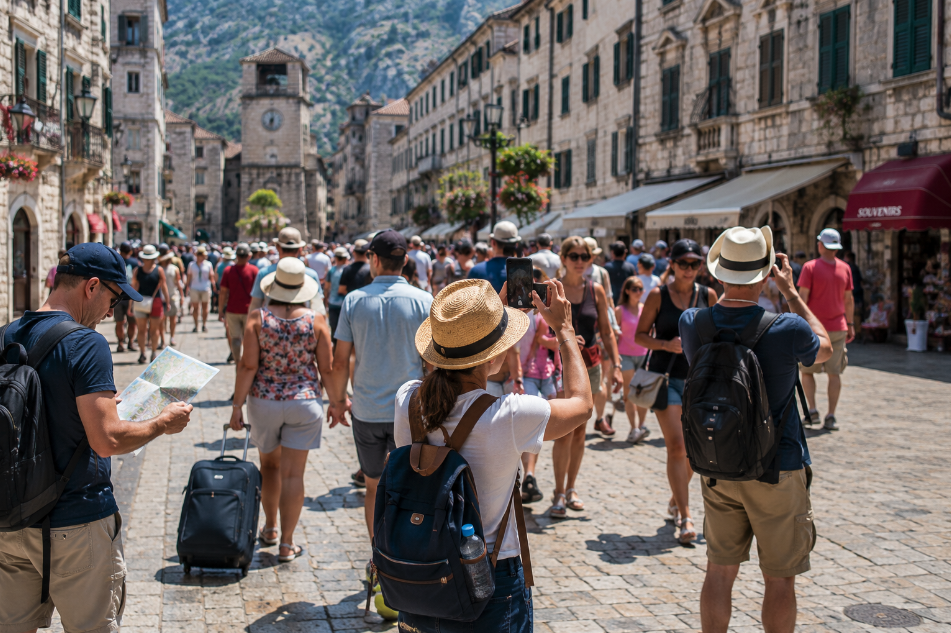
If you’ve ever visited a tourist destination, there’s a decent chance the locals had a name for people like you.
Most of the time, you’ll never hear it. These nicknames are usually reserved for conversations among residents dealing with crowded roads, packed restaurants, sold-out parking lots, and visitors who don’t quite understand the local way of doing things.
Some are harmless. Some are hilarious. And some are definitely not compliments.
From “shoobies” and “fudgies” to “gringos” and “guiris,” tourist destinations around the world have come up with some surprisingly creative names for the people who visit them. Here are some of the funniest, weirdest, and occasionally most brutal examples we’ve found.
Note: As always, we’ve altered the terms that include adult verbiage in the English language. We realize that some of these words/terms are NSFW in their own language. However in English, well, we don’t know any better, so we’ve not taken the liberty to alter them.
In the U.S.
Alaska
- Tourists from the “Lower 48” are often called Outsiders. However if they’re from anywhere else (read: Hawaii, Denmark, wherever), they’re identified by wherever they call home.
California
- Just like in Delaware and parts of New Jersey, Shoobie is a slang term for a tourist who visits the seashore for a day (a daytripper) or summer-only residents.
- Sometimes people who live in the suburbs of San Francisco, who just visit for the day, are called the “bridge & tunnel crowd.”
- Tourists who visit the Hollywood area are sometimes called “Starf**kers.”
Delaware
- Like California and parts of New Jersey, Shoobie is a slang term for a tourist who visits the seashore for a day (a daytripper) or summer-only residents.
Hawaii
- Haole – Hawaiians use this word to identify a foreigner, sometimes as slang or a racist term. Nowadays it can also be used to reflect the white/Anglo European attitude.
- Malihini – a newcomer or stranger among the people of Hawaii
Kentucky
- From Memorial Day to Labor Day, Lake Cumberland, in Somerset KY, gets a lot of tourists from Ohio. According to the locals, they kind of take over the lake for the entire season. So they’re oftentimes called the Ohio Navy.
Maine
- Flatlander – visitors from far away
- Mass-holes -visitors from Massachusetts (combination of Massachusetts and A-holes)
Michigan
- Citiots – what locals of small beach towns call visitors from big cities
- Flatlanders – what people from the Upper Peninsula call visitors from the Lower Peninsula
- FIB – What people in the Upper Penninsula call visitors from Illinois. It stands for “F**king Illinoise B**tards”
- FIP and FOP – specific to Southwestern Michigan, locals use these to refer to visitors from Illinois and Ohio. FIP stands for “Friendly Illinois Person” and FOP is for “Friendly Ohio Person.” Sometimes, though, the visitors are rude, so locals will trade the first word for an F-bomb.
- Fudgies – this one is specific to Mackinac Island because tourists go up there to buy fudge.
New Jersey
- The Jersey Shore has its own unique culture, different from the rest of the state. The population of the Jersey Shore also grows immensely with Bennies/Bennys, Day-Trippers, Shoobies (that one’s particularly derogatory in NJ. Less so in California and Delaware) and Weekenders during “season.”
New York
- Sometimes people who live in the suburbs of Manhattan, who just visit for the day, are called the “bridge & tunnel crowd.”
North Carolina
- This one isn’t really about tourists, but it’s such a fun term that I’m going to include it anyway. Apparently people from New York and New Jersey move to Florida. They decide they don’t want to live down there after all, so they move halfway up the country and settle in North Carolina. Such people are called “Halfbacks.”

Virginia
- In the Williamsburg area, they call the fall season the time for the newly-weds and nearly-deads because after kids go back to school and before field trips start up (plus the weather), it’s prime wedding and retiree season.
Used throughout the country
- G***amn tourists, F**king tourists, or plain old “tourists” (oftentimes said with a sneer or a shaking fist) are used in several places. New York City, New Orleans, Dallas and many areas of Florida all lay claim to this one. So does the Washington D.C. area when it’s cherry blossom season.
- Leaf Peepers (or just Peepers) – used in certain areas of the country where tourists visit to see the leaves changing color on the trees in the autumn.
- Snowbirds are people who come from the north and live in more southern locales in the winter. This one isn’t a “bad” name; many snowbirds even refer to themselves as “snowbirds.”
- Touron – combination of the words “tourist” and “moron”
Outside the U.S.
Don’t think it’s just rude Americans calling tourist names. Several places outside the U.S. have colloquialisms for visitors and non-locals, too.
Canada
- Gorby – generally refers to loud, vulgar tourists
- Terrorists – this one isn’t really used anymore. But back in the late 20th and early 21st century, the small vacation town of Sylvan Lake, in Alberta, only had about 7000 residents. Yet they had over a million visitors during May through August. The locals were overwhelmed (read: “terrorized”) with the noise and mess, so they called these vacationers “terrorists.” Sylvan Lake has grown considerably since then; they have almost 17,000 residents now. So although the onslaught of annual tourists continues to happen, it doesn’t have quite the impact as previously.
- CFA – Specific to Newfoundland. It stands for Come From Away (yep, that was the name of the Broadway show, too) and means someone who isn’t from there.
China
- China has multiple dialects. But Laowai is a term that’s used to describe foreigners of non-Asian origin and ethnicity. It’s meant to be used to refer to foreigners in affectionate ways.
Ghana
- Oburoni – the Akan word for foreigner, literally meaning “those who come from over the horizon.” It’s often colloquially translated into “white person.” For most Ghanaians, an oborɔnyi refers to any person with lighter skin or straighter hair than a dark skinned Ghanaian. Asians, Middle-Easterners, Whites, Latinos and sometimes, by extension, even dark-skinned people who are regarded as having been heavily influenced by foreign cultures (i.a. African-Americans) may be labeled an “oborɔnyi.”
Indonesia
- Bule – it literally means a “foreigner,” or a “non-Indonesian national,” and is generally used to describe white/Caucasian people. But many Westerners find the term offensive, so many Indonesians who deal with said tourists are switching to “Mr./Mister” (who had some kick a$$ songs, way back when ).
Japan
- Gaijin – Japanese word for “outsider” or “alien” but is usually used to refer to Western foreigners.
Mexico (and other Latin American countries)
- Gabacho – not-nice term for tourists from the U.S.
- Gringo – This one is usually used to refer to a foreigner (especially someone from the United States or another native English speaker).
The Netherlands
- Rolkoffer Tourists – tourists who come with rolling suitcases. It’s said in a negative way.
New Zealand
- Pakeha is the Māori term for non-Māori, but it applies to people born in NZ as much as people who are visiting.
Spain
- Guiri – This one is a colloquial Spanish word often used in Spain to refer to uncouth foreign tourists, particularly from the United Kingdom. However, it can be applied to people from other Northern European countries. It’s meant to be pretty offensive.
Thailand
- Farang – It’s the Thai word to describe white foreigners, but is not meant as an insult. However it CAN be an insult depending on on it’s used. A farang kee nok mean “bird poop foreigner” and is used to describe a farang with no money, or one who is stingy with it (oftentimes, in recent years, a backpacker).
United Kingdom
- In the coastal areas of Cornwall, Devon and Somerset, the word grockle is thrown around. It’s usually used to describe visitors who are perceived as being overly touristy, intrusive, or ignorant of local customs.
- Cornish people have also been known to call tourists emmets, incomers and blow-ins.
Whether they’re playful, affectionate, sarcastic, or downright insulting, these nicknames all have one thing in common: they exist because tourism changes places.
For many communities, visitors are a vital part of the local economy. They support restaurants, hotels, attractions, and thousands of jobs. At the same time, they can also bring traffic, crowds, noise, and plenty of opportunities for locals to shake their heads and mutter something under their breath.
Of course, every tourist is a local somewhere else. So the next time you’re visiting a new destination and hear a term you’ve never encountered before, there’s always a chance it’s the local nickname for people exactly like you.
And if you’re lucky, you may never find out what they’re calling you. 😏
*** Many thanks to Angelique M., Evelyn V., Jimmy P-M., John B., Josh W., Leah C., Linda E., Maryann C., Mary Lee C., Nancy B., Samantha S., Sonny D., Remy G., Tereen H., Trysh P. and Whitney S. for their “local” help!
Want to comment on this post? Great! Read this first to help ensure it gets approved.
Want to sponsor a post, write something for Your Mileage May Vary, or put ads on our site? Click here for more info.
Like this post? Please share it! We have plenty more just like it and would love it if you decided to hang around and sign up to get emailed notifications of when we post.
Whether you’ve read our articles before or this is the first time you’re stopping by, we’re really glad you’re here and hope you come back to visit again!
This post first appeared on Your Mileage May Vary