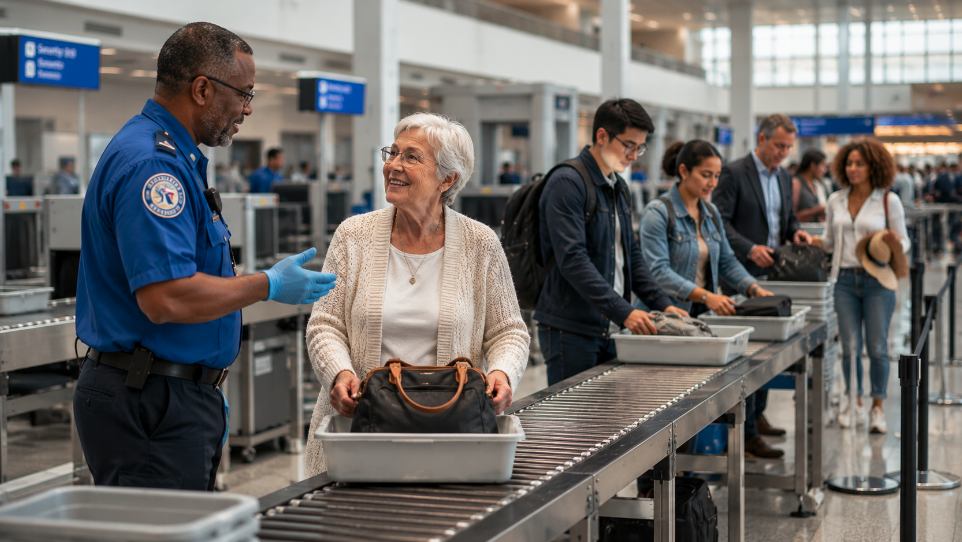
If you don’t fly very often, going through TSA can feel overwhelming.
There are signs everywhere, bins flying around, people taking off jackets, emptying pockets, removing laptops, and somehow everyone behind you seems to know exactly what they’re doing.
The good news is that once you understand the process, it’s actually pretty straightforward. And spending just a few minutes preparing before you get to the checkpoint can make the experience less stressful—not just for you, but for everyone else in line, too.
Whether you’re flying for the first time or just haven’t been on a plane in years, here’s how to get through TSA security as quickly and easily as possible.
BEFORE YOU GET TO THE AIRPORT
Be prepared. Educate yourself. Know what to expect by reading guides like this one and reviewing TSA’s website before you travel. Oh, and before you get to the airport, make sure to give yourself plenty of extra time before your plane is scheduled to leave (here’s how to figure out how much time), especially if you’re going through a particularly busy airport.
GETTING ON LINE
If you’re planning on using the REGULAR line, just go to any line (or follow directions to any line). Be aware of signs for TSA PreCheck, Global Entry, CLEAR, Airport/Airline/TSA Employees and avoid those lines because the TSA agent won’t let you continue through them and you’ll have to go to the end of another line and start all over again.
If your boarding pass says you’re approved for TSA PreCheck, follow the signs to get there (children age 17 and under can also go to TSA PreCheck if their adult companions are approved to go there). Depending on the airport, it may not be super easy to find those signs because you sometimes have to go 3/4 of the way around the queue of people in the regular line to see it. The signage seems to be getting better, though.
The first thing that will happen when you get on line for the TSA checkpoint is a TSA screener will check your government-issued ID (You rarely, if ever need to show TSA your boarding pass anymore. Here’s why). It will save everyone time if you have your ID already in your hand before you get to the TSA screener.
THINGS IN YOUR POCKETS
REGULAR LINE and TSA PreCheck: Once you’re ready for you and your stuff to go through the respective scanners, everything needs to come out of the pockets of what you’re wearing. Coins, keys, your phone, your wallet, even pieces of paper. Everything. Your pockets need to be empty. It will save everyone time if you remove everything from your pockets and put them into your carry on before you are on line (you can put them into a bin too, but you’re going to take up extra time waiting for the bin to come through and organizing everything in all your bins and carry-ons. Plus, smaller items are easily stolen from bins. don’t make yourself a victim).
LAPTOP COMPUTERS
REGULAR LINE: Your computer will have to be removed from its bag and put into a bin before it goes through the scanner. It will save everyone time if you can carry the bin-with-computer to the “reorganizing/repacking” area set up post-scanners to put it back into its bag.
TSA PreCheck: Your computer can stay in its bag. 
BRINGING LIQUIDS IN YOUR CARRY-ON
REGULAR X-RAY and TSA Pre✓®: As per the TSA.gov website, “You are allowed to bring a quart-sized zip-top bag of liquids, aerosols, gels, creams and pastes in your carry-on bag and through the checkpoint. These are limited to travel-sized containers that are 3.4 ounces (100 milliliters) or less per item. Placing these items in the small bag and separating them from your carry-on baggage facilitates the screening process (read: “Makes it go faster” Why can’t they write in normal layman’s terms?). Pack items that are in containers larger than 3.4 ounces or 100 milliliters in checked baggage.”
Keep in mind that containers that are larger than 3.4 ounces, regardless of the amount inside must be in checked baggage (so you may only have 1 ounce of mouthwash left but if it’s in a 24-ounce bottle, it can’t go in your carry on). Exemptions include medications and infant/child nourishment.
REGULAR LINE: You’ll have to remove your quart-sized bag of liquids from your carry-on and place it in a bin to go through the scanner. It will save everyone time if you pack that quart bag so it’s easily accessible so you can quickly grab it to put it into a bin.
TSA PreCheck: You don’t need to remove your bag o’ liquids from your carry on.
BRINGING CANDY/FOOD IN YOUR CARRY-ON
REGULAR X-RAY and TSA PreCheck: As long as your food/candy is not a liquid or gel over 3.4 ounces (if it’s a liquid or gel under 3.4 ounces, it must be in your 1 quart ziplocked bag), you can bring it in your carry-on. However as per this page of the TSA.gov website, “TSA officers may instruct travelers to separate items from carry-on bags such as foods, powders, and any materials that can clutter bags and obstruct clear images on the X-ray machine.” So be prepared to possibly be asked to remove your food/candy from your carry-on.
BRINGING POWDERS IN YOUR CARRY-ON
REGULAR line: As per this page of the TSA.gov website, “Powder-like substances greater than 12 oz. / 350 mL must be placed in a separate bin for X-ray screening. They may require additional screening and containers may need to be opened. For your convenience, we encourage you to place non-essential powders greater than 12 oz. in checked bags.”
TSA PreCheck: As of this writing, it has not been documented on the TSA.gov website if passengers with TSA Pre-Check status are required to remove powder larger than 12oz/350ml from their carry-on bags. If possible, consider packing larger quantities of powder in your checked luggage to avoid any potential delays.
BRINGING MEDICATION IN YOUR CARRY-ON
REGULAR LINE and TSA PreCheck: We’ve said it a thousand times and will say it a thousand more times – ALWAYS travel with your medication in your carry-on luggage, NEVER your checked luggage, because if your luggage is delayed or lost, you’re still going to need your meds. This page has more information about traveling with medication.
IF YOU HAVE AN IMPLANT/JOINT REPLACEMENT/CAN’T GO THROUGH THE SCANNER
REGULAR LINE and TSA PreCheck: Tell the TSA officer that you have an implant/joint replacement or that you can’t go through the scanner because of “_____”. They’ll be able to work with you and do a pat down instead.
REMOVING YOUR BELT/LIGHT JACKET
REGULAR LINE: Your jacket must be removed and put into a bin before you get to X-ray (travelers over the age of 75 are exempt) and more often than not, many travelers are asked to remove their belt, as well.
TSA PreCheck: You can keep your light jacket and belt on.
Note: It is no longer required to remove your shoes at the TSA security area.
REMOVING BULKY JEWELRY
According to the TSA blog, you don’t have to remove your jewelry, but if it’s so bulky that it sets off the X-ray, you may have to remove it at that time, possibly have it get a pat down, etc. It looks as if it varies with circumstance.
NOTES FOR SENIOR TRAVELERS AND TRAVELERS WITH DISABILITIES
This page of the TSA’s website has lots of information for people with disabilities and medical conditions who require special assistance and procedures.
NOTES FOR FAMILIES TRAVELING WITH YOUNG CHILDREN
This page has a good guide to the process for getting through X-ray with children and their “stuff” (strollers, toys, blankets, special food/drink, etc.)
A FINAL WORD OF ADVICE: DON’T SAY ANYTHING STUPID
I wish I didn’t even have to cover this, but we all know the kind of person I’m talking about. In fact, my great uncle was one of those people. Uncle J has passed on now, but in the early 1990s he was “only” in his late 80s and still healthy enough to travel by plane to visit his daughter in California. And one day Uncle J jokingly said to the guys at X-ray that he had a bomb in his bag. Well, he and his bag were quickly escorted somewhere, where he was detained and questioned and they went through all of his stuff, and they finally let him go with, “We take comments like that very seriously, sir. Don’t ever do that again.” He didn’t. And that was BEFORE 9/11. Nowadays they’re even more stringent and careful. So really – don’t say anything stupid or inappropriate that will get you into trouble.
As with most things involving air travel, TSA procedures continue to evolve. Rules change, technology changes, and airports sometimes have their own little quirks.
But the basics haven’t changed: arrive prepared, pay attention to the instructions from TSA officers, and think a couple of steps ahead instead of waiting until you’re standing at the conveyor belt.
You’ll spend less time holding up the line, less time feeling flustered, and more time doing what you came to the airport to do—getting to your destination.
So now that I’ve written all that…what did I miss? Let me know and I’ll add it. Thanks!
Want to comment on this post? Great! Read this first to help ensure it gets approved.
Want to sponsor a post, write something for Your Mileage May Vary or put ads on our site? Click here for more info.
Like this post? Please share it! We have plenty more just like it and would love it if you decided to hang around and sign up to get emailed notifications of when we post.
Whether you’ve read our articles before or this is the first time you’re stopping by, we’re really glad you’re here and hope you come back to visit again!
This post first appeared on Your Mileage May Vary