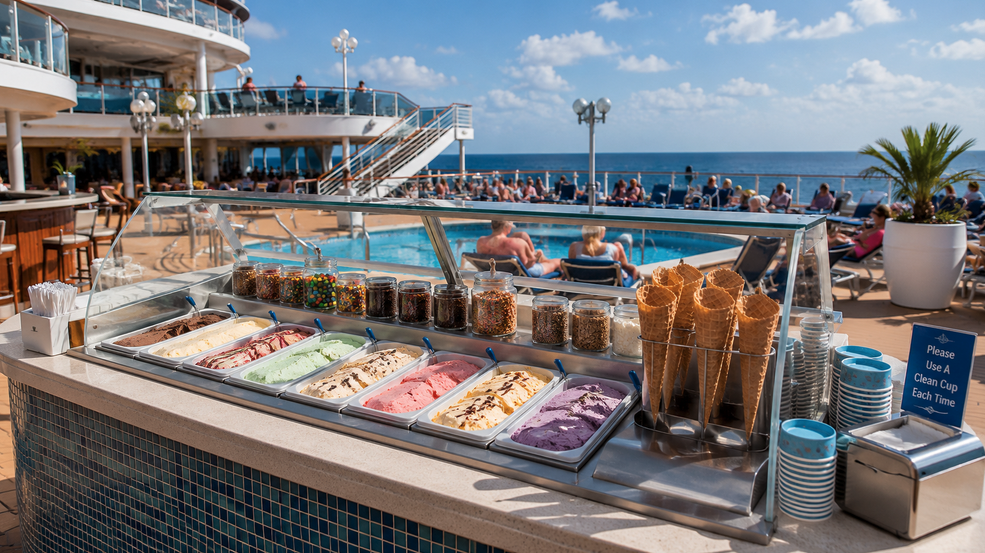
A surprise ice cream party sounds like one of the more enjoyable perks of cruising.
Unless, of course, you’ve heard one of the internet’s longest-running cruise myths.
According to the rumor, an unexpected ice cream social means the ship is trying to empty freezer space because someone has died on board.
It’s a creepy story.
It’s also not true.
And now a cruise ship crew member has explained what actually happens.
The Cruise Ship Ice Cream Party Myth, Explained
Lucy, known on social media as Cruising as Crew, has spent the past decade working on cruise ships. Her YouTube channel has over 500 videos on pretty much everything related to working on a cruise ship.
And in one of her more recent YouTube videos, she insists that these ‘ice cream parties to empty the ship’s freezer” are definitely not something that ever happens onboard.
“It sounds like something I wouldn’t put a cruise company past doing but I think we can all rest a little bit easier when I say this is absolutely not the case,” she said in her video.
“Cruise ships are legally required to have a dedicated refrigerated morgue separate from the food storage, because this would be quite a large health and safety violation.
“Trust me, no one working in the F&B department wants to go and rummage around in the fridge for the corpse for more ice cream. That’s not happening.”
So what actually happens when someone dies on a cruise ship?
It would be lovely to say that these “ice cream parties” don’t happen on cruise ships because people don’t die on cruise ships. But, of course, they do. It’s hard to say exactly how many, because not all cruise lines or countries share their death statistics. So the best anyone can really do is make an educated guesstimate. One cruise blogger put it at roughly one death per 150,000 passengers.
Anyway, cruise ships have secret code words and phrases to let the crew know what’s happening.
Many major cruise lines use some version of the phrase “Code Alpha” to get the word out that someone is in the midst of a medical emergency (the wording can also be “Alpha, Alpha, Alpha,” “Alpha Team” repeated 3 times, etc.) and when that’s announced, certain members of the crew need to go to where the emergency is, so they can be of assistance. These people may or may not be at risk of passing away, but there’s definitely a major medical event happening. It could be someone who’s fallen and broken a bone. Or maybe someone’s experiencing chest pain or is having problems breathing.
“The one code most people do not know about is Operation Bright Star,” Lucy continues. That the code is used in the event of a serious medical emergency, such as cardiac arrest.
“The sad fact about this is that when Operation Bright Star is called, the ventilation officer is also alerted,” Lucy says in the video. “Their job is to start the cooling power in the morgue.
“They’re not going to have it turned on if no one’s in it, but if they think someone might be going in soon, they need to cool it down. That is how prepared these ships are.
“Then there is Operating Rising Star. This is the code that confirms death has actually occurred. This announcement is not made ship-wide. This is an announcement between specific people who need to know about this.”
Do passengers know that all this is happening?
Nope.
In fact, crew members will do everything they can to ensure their response to a death is as quiet as possible so they don’t disturb other passengers.
Lucy explained that after a doctor has confirmed death and the captain has been informed, a ‘specific and quiet operation begins.’
“The body is moved to the ship’s morgue,” she said. “[The morgue is] located on a lower deck, away from the passenger areas. That will hold three to six bodies, sometimes even up to 10.
“The family or traveling companions are going to be notified that the person they’re traveling with has passed away, if they don’t already know.
“Then a member of the guest care team, which is a specifically trained role that exists on every major cruise ship, is assigned immediately and stays with that person or those people to help them through the rest of the cruise and be there for them, watch over them.
“The captain then has to file a report to the relevant authorities, and if the ship is heading to a US port, the death has to be reported to the CDC immediately. That’s every death, including deaths of natural causes. If there’s any suspicion of criminal activity, the FBI or even the Coast Guard has to be notified.
“All of this is going on. Meanwhile, on the rest of the ship, nothing changes. Trivia night continues, the pool deck stays open, because 3,000 other passengers are on their holiday. They want to make sure they manage the situation, so the impact on the broader voyage is minimal.”
So, despite what the internet has insisted for years… nope. There are no impromptu ice cream parties to make room in the freezer.
Here’s the video:
Like so many travel myths, this one probably survives because it sounds just believable enough to repeat.
The reality, however, is both more ordinary and more compassionate. Cruise ships are well prepared to handle medical emergencies and deaths, with dedicated procedures, trained crew members and separate morgue facilities designed specifically for that purpose.
So if you’re ever invited to an unexpected ice cream party at sea, you can enjoy your cone without wondering whether there’s a darker reason behind it.
Sometimes ice cream is…just ice cream.
Want to comment on this post? Great! Read this first to help ensure it gets approved.
Want to sponsor a post, write something for Your Mileage May Vary, or put ads on our site? Click here for more info.
Like this post? Please share it! We have plenty more just like it and would love it if you decided to hang around and sign up to get emailed notifications of when we post.
Whether you’ve read our articles before or this is the first time you’re stopping by, we’re really glad you’re here and hope you come back to visit again!
This post first appeared on Your Mileage May Vary