For most passengers, the exit row is prime real estate. The extra legroom can make a long flight far more comfortable, which is why those seats are often reserved or sold for an additional fee.
But sitting in the exit row isn’t just about stretching out. It also comes with an important responsibility.
In an emergency, passengers seated there may be called upon to help open the emergency exit and assist with the evacuation of the aircraft. Because of that, the FAA has strict requirements about who can and can’t occupy those seats. To sit there, you generally must:
- Be at least 15 years old
- Be physically able to lift and move the emergency exit door (which can weigh 30 to 50 pounds)
- Be able to see, hear, understand and communicate with the flight crew
- Have the strength and mobility to assist during an evacuation
- Be willing to help in an emergency
There are also several situations that can disqualify someone from sitting in the exit row, such as needing a seat belt extender.
Which raises an interesting question:
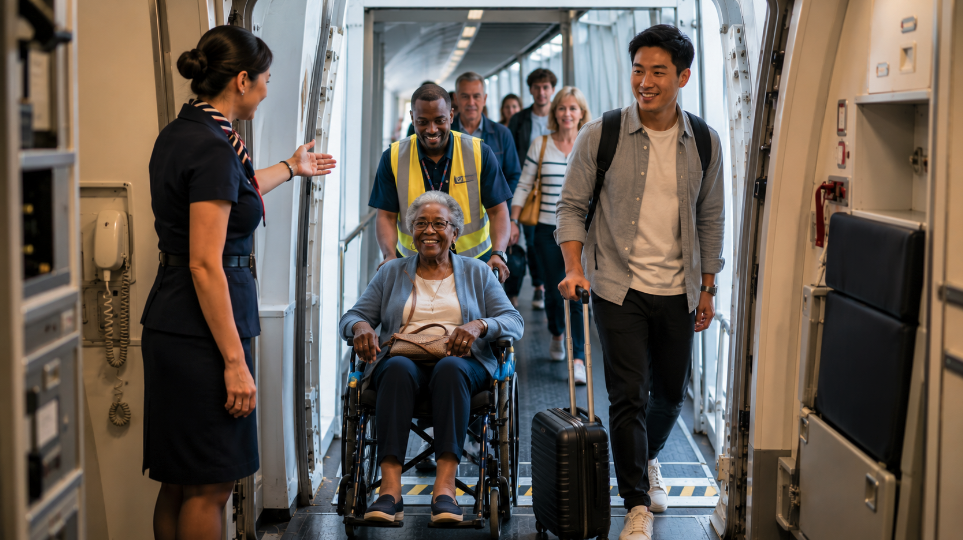
Can you sit in the exit row if you’re eligible for pre-boarding?
At first glance, it seems like the answer would be an obvious “no.” After all, many people associate pre-boarding with passengers who need additional time or assistance, or unaccompanied minors who are automatically too young to sit in an exit row.
But it’s not nearly that simple.
While the FAA sets the rules for who may occupy an exit row, it doesn’t define who qualifies for pre-boarding. That’s left up to each airline, which is why the answer varies depending on who’s operating your flight.
And here’s something many travelers don’t realize: needing extra time to board doesn’t automatically mean someone is unable to help during an emergency. A passenger with a severe food allergy may pre-board simply to wipe down their seat and tray table before everyone else boards. They’re otherwise perfectly healthy and fully capable of assisting if necessary.
With that in mind, here’s how the major U.S. airlines handle pre-boarding:
Alaska
- Guests with disabilities who need help or a little more time to board
Allegiant
- anyone needing additional time or assistance
American
- Customers who need special assistance or who are traveling with children
Delta
- Customers needing assistance for additional time to board
Frontier
-
Customers with disabilities
-
Active-duty U.S. Military personnel
-
Families traveling with children under 2 years old
-
Frontier Miles Elite Diamond members (assuming they otherwise qualify in terms of FAA’s requirements)
Hawaiian
- Guests needing assistance
- Unaccompanied minors
JetBlue
- Customers with disabilities
Southwest
- Passengers with disabilities who need additional time or assistance to board, stow accessibility equipment, or be seated
- Unaccompanied Minors
United
- Customers with disabilities
- Unaccompanied minors
- Anyone flying with children 2 or younger
- Active military members
- Global Services® and Premier® 1K® members (assuming they otherwise qualify in terms of FAA’s requirements)
As you can see, some airlines limit pre-boarding almost exclusively to passengers with disabilities, while others include groups such as active-duty military members, elite frequent flyers, families traveling with young children and passengers who simply need a little extra time.
That means there’s no universal answer.
An active-duty service member who pre-boards would almost certainly meet the FAA’s exit-row requirements. The same could be true for an elite frequent flyer or someone pre-boarding because they have a severe food allergy needs extra time to be able to wipe down their seat, tray table, etc. On the other hand, an unaccompanied minor or someone who doesn’t meet the FAA’s physical requirements would not be eligible.
So can pre-boarders sit in the exit row?
The answer is yes…sometimes.
Pre-boarding and exit-row eligibility are two completely separate issues. One determines when you board the aircraft. The other determines whether you’re physically able and willing to assist in an emergency.
That’s why the answer depends not only on why you’re pre-boarding, but also on the airline’s own pre-boarding policies. In the end, even if you’re assigned an exit-row seat, the flight attendants have the final say. Before departure, they’ll confirm that everyone seated there meets the FAA’s requirements and is willing to help if the unthinkable happens.
So while many pre-boarders won’t qualify for an exit-row seat, plenty of others absolutely can.
Want to comment on this post? Great! Read this first to help ensure it gets approved.
Want to sponsor a post, write something for Your Mileage May Vary, or put ads on our site? Click here for more info.
Like this post? Please share it! We have plenty more just like it and would love it if you decided to hang around and sign up to get emailed notifications of when we post.
Whether you’ve read our articles before or this is the first time you’re stopping by, we’re really glad you’re here and hope you come back to visit again!
This post first appeared on Your Mileage May Vary