Exit row seats are already confusing enough for some travelers.
You have to be willing to help in an emergency, physically capable of opening the door, able to hear and understand instructions, and meet a whole list of other FAA-related requirements.
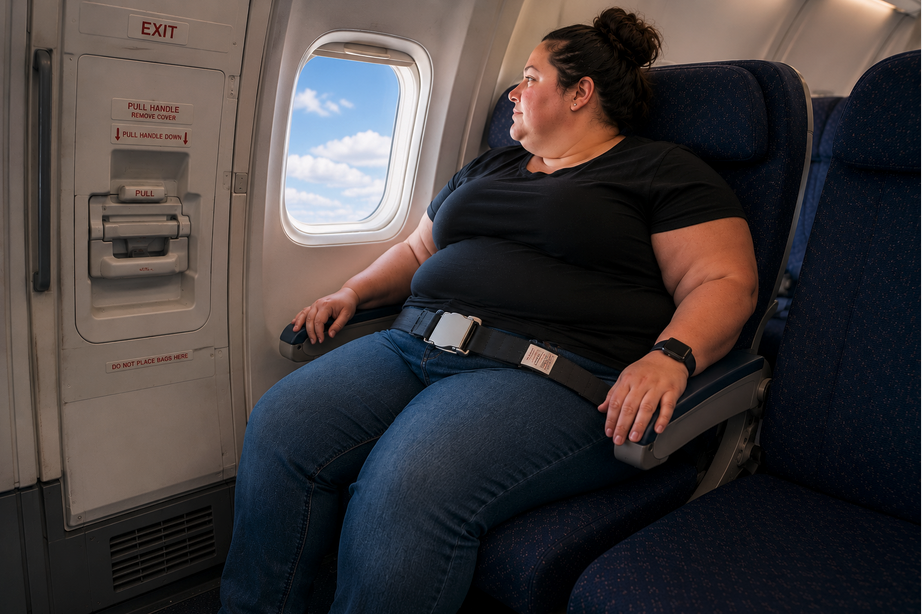
But one question that comes up surprisingly often is whether passengers who use seat belt extenders are allowed to sit there in the first place.
Some of the most sought-after seats on a plane are the seats in the exit rows. And no wonder – because the area around the seats needs to be used as an emergency exit in the event of an emergency, they have much more leg room than seats in economy. And, of course, they have the price tag to go with that, with charges ranging from $30 to $150 per segment.
Of course, sitting in an exit row is more than just legroom; you also potentially have an important job to do. If you’ve ever sat in the exit row, you’ve gotten the spiel of the “rules for sitting there” from the flight attendant; that’s dictated by the FAA and you probably know a lot of them by heart.
- You must be at least 15 years old
- You must be able to lift and move the (upwards of 50 pound) emergency door
- You must be able to see, hear, understand and speak English
- You must have sufficient mobility, strength and dexterity in both arms, hands and legs to assist in an evacuation
- You must be willing to assist in the event of an emergency
However, in this day and age, when at least 1 in 4 adults in the U.S. are considered to be obese, and airline seats are seemingly getting smaller and smaller, the need for seat belt extenders appears to be increasing. Which brings us to a very important question:
Can you sit in the exit row if you use a seat belt extender?
The topic has come up often, and the answer is no. Seat belt extenders are prohibited in exit rows on all airlines.
Of course, there’s a big safety reason for this. Passengers in an exit row are there to help, if needed, during an emergency evacuation. A seat belt extender is considered to be a potential tripping hazard or something that could potentially slow things down during the crisis of an emergency evacuation.
There’s also the consideration that if someone is large enough to require a seat belt extender (or sometimes more than one of them), there’s the question if they would have sufficient mobility to be able to assist during an evacuation. Granted, some people might, but it’s felt they would be more the exceptions.
So, if you’re sitting in an exit row, and let a flight attendant know you need a seat belt extender, they will politely help you find a new seat. It’s non-negotiable and a safety protocol designed to keep everyone safe.
Airlines have each made their own respective policy and wording about not being able to use a seat belt extender in the exit row, although some of them certainly don’t make their policy easy to find. But here are a few:
Alaska Airlines
Passengers must not require the use of a seat belt extension (it is the Company’s assessment that these could become a tripping hazard)
Allegiant Air
Exit row seating is permitted if the passenger does not require a seat belt extension due to the hazard of entanglement.
Delta Air Lines
Passengers may not sit in an exit seat if it is likely they would be unable to perform certain emergency procedures because they: Require the use of a seat belt extension. (this limitation is intended to preclude the hazard of entanglement with the additional length of the extension by those passengers attempting to expeditiously exit the aircraft.)
The other airlines undoubtedly have similar policies on their respective websites…but try to find them. HA!
What if I bring my own seat belt extender?
That’s even more against FAA regulations than sitting in an exit row with a seatbelt extender.
There are no third-party seat belt extenders that can be legally used on U.S.-based airlines. Period. The concern is that the third-party seatbelt you bought on Amazon or eBay might not have the same safety certifications, maintenance history, material strength or liability that an “official” seat belt extender issued by the airline has.
You must use one issued by the airline (and the airlines, in turn, must have one available for you to use, for free. If they don’t, federal regulations require them to accommodate you on a different flight that has an extender you can use.
Ultimately, using the airline’s extender is the only way to ensure the entire seat belt system—from the buckle in the seat to the extender’s latch—functions as a single, certified safety device.
The bottom line
At the end of the day, exit row seating is treated differently because those passengers may have to help during an emergency evacuation.
And while some travelers who use seat belt extenders may very well be physically capable of assisting, airlines and regulators tend to apply blanket safety policies rather than making case-by-case judgments in the middle of boarding.
That’s why, if you request a seat belt extender while seated in an exit row, flight attendants are required to move you somewhere else on the aircraft.
It may feel inconvenient — especially given how expensive exit row seats can be nowadays — but from the airline’s perspective, the priority is making sure the exit row remains as clear and unobstructed as possible if an evacuation ever becomes necessary.
Want to comment on this post? Great! Read this first to help ensure it gets approved.
Want to sponsor a post, write something for Your Mileage May Vary, or put ads on our site? Click here for more info.
Like this post? Please share it! We have plenty more just like it and would love it if you decided to hang around and sign up to get emailed notifications of when we post.
Whether you’ve read our articles before or this is the first time you’re stopping by, we’re really glad you’re here and hope you come back to visit again!
This post first appeared on Your Mileage May Vary

1 comment
I read the part where it says “especially given how expensive exit row seats can be nowadays” and was a little freaked out about losing that cash.
Per DOT/FAA guidelines, if the airline moves you for safety compliance, they are legally required to refund the fare difference—but the catch is that it’s never automatic. You need to be proactive about claiming your refund:
Keep the paper trail: Retain your original boarding pass and take a screenshot of your new seat assignment in the app.
Get a PNR note: Before deplaning, ask the lead FA or gate agent to log in your reservation file (PNR) that you were reseated involuntarily for operational safety compliance, if possible. This may not be logistically feasible, you can proceed without this, it’s just best practice.
File manually: Skip the phone lines and head straight to the airline’s online refund portal to request the ancillary fee difference.
The exact same rule applies to miles or upgrade certificates—you are owed a prorated redeposit! Hope this helps someone take the sting out of not being able to sit in the boarding row!