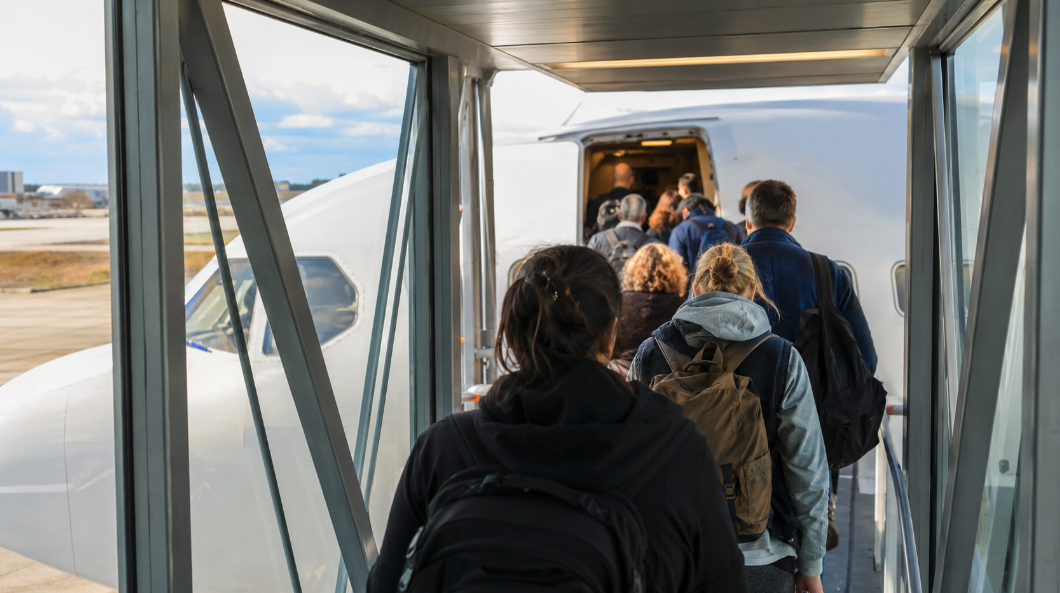
Most frequent flyers don’t think twice about it. You board through a door on the left side of the aircraft, and when you arrive, you leave through a door on the left side, too. But considering airplanes have doors on both sides, it’s fair to wonder why the industry settled on that arrangement in the first place. As it turns out, there are several practical reasons—and a little history—involved.
Have you ever noticed that if you have a reservation on a commercial airline, you almost always board and disembark on the plane’s left side? Have you ever wondered why that happens? I did. I mean, a plane isn’t like a horse (horses are traditionally trained for mounting and dismounting from the left side, and many become uncomfortable if you approach from the right), so why only the left side? Here’s what I found out about it.
There doesn’t seem to be an “airplane rule book” that says why passengers board and disembark on a plane’s left side. But it turns out there are quite a few hypotheses, all dealing with logistics and safety:
So the pilot can see
When an aircraft parks at a gate, the crew needs to line it up precisely with the stand markings and jet bridge. Since the captain typically sits on the left side of the cockpit, left-side boarding also fits neatly with the way aircraft are positioned at gates.
Where the plane gets its fuel
The grounds crew fuels the aircraft on the right side. If the passengers are on the left side, it makes the grounds crew’s job easier, especially in cases where they use stairs instead of a jetway to board and disembark.
Where luggage & cargo are loaded
Just like fueling, baggage and cargo are loaded and unloaded on the right side. The last thing airlines want is for passengers to see their luggage as it’s being unloaded – you KNOW someone is going to want to take their bags RIGHT NOW.
Where cleaning & catering vehicles park
Just like all the other “work” vehicles are on the right-hand side, so are the trucks that are used for cleaning and catering.
It’s a tradition from ships
There may also be some history borrowed from ships. Passengers traditionally embarked and disembarked from the port, or left, side of a ship. Aviation borrowed plenty of nautical language and customs, so it’s not a stretch that left-side boarding became part of the pattern.
***The exceptions***
By the way, it’s not always the case 100% of the time (just almost always LOL). Here are some rare exceptions to the rule:
A while back, IndiGo introduced a “Three Point Disembarkation System,” where they have 2 exit ramps in the front, and 1 in the back. The second of the 2 front ramps was on right side of the plane. Here’s a short video of the process in action, from CN Traveller. It’s said to save 2 to 5 minutes.
BOAC stood for British Overseas Airways Corporation, and was the British state-owned airline created in 1939 by the merger of Imperial Airways and British Airways Ltd. It stayed in business until 1974 and loaded/unloaded passengers on the right side of the plane.
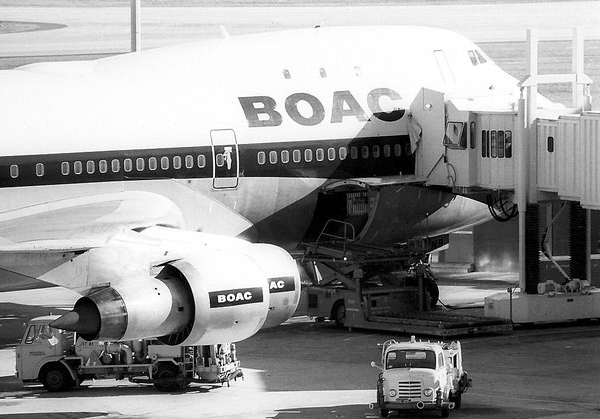
The old Denver Stapleton Airport (which closed in 1995, when Denver International Airport opened) also had gates that allowed passenger boarding on the right side. Look at the second from the right gate on the top row:
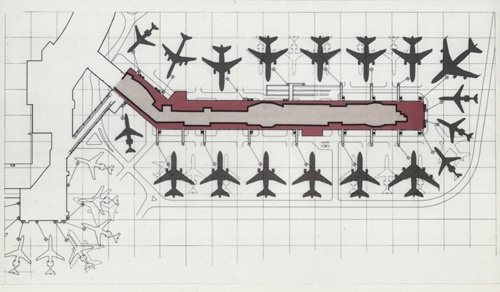
No word on how often that gate was used.
Like many things in aviation, there’s no single explanation for why passengers almost always board from the left side of an aircraft. Instead, it’s the result of decades of practical decisions that make airport operations safer, faster, and more efficient. From keeping passengers away from fueling and baggage operations to giving pilots a better view while parking at the gate, the arrangement simply works. And while there have been a few exceptions over the years, chances are your next flight will begin and end exactly where most do: through the door on the left side of the plane.
Want to comment on this post? Great! Read this first to help ensure it gets approved.
Want to sponsor a post, write something for Your Mileage May Vary, or put ads on our site? Click here for more info.
Like this post? Please share it! We have plenty more just like it and would love it if you decided to hang around and sign up to get emailed notifications of when we post.
Whether you’ve read our articles before or this is the first time you’re stopping by, we’re really glad you’re here and hope you come back to visit again!
This post first appeared on Your Mileage May Vary