Preparing for an airplane trip can be stressful. There are clothes to pack, electronics to charge, reservations to double-check and all of those little things you suddenly remember when you’re halfway to the airport.
To help keep me organized, I have a document named “Packing List” that I use before trips longer than a weekend. My wife, Sharon, still laughs at me for doing this.
Note from Sharon – Well, yeah! I can’t believe that for as often as we travel, you still need a flippin’ list?!?!?! LOLOL!
The first page is mostly clothes and things I tend to forget, like an umbrella or backpack. The second page covers toiletries and medications. Then there’s my final checklist of things I absolutely can’t forget.
The final three items are:
- MEDICINES!!!!!!
- WALLET!!!!!!!
- PASSPORT!!!!!!!
I leave the passport at home for domestic trips, but forgetting any of the other items would be a lousy way to start a vacation.
And when it comes to medications, I follow one rule.
Important Medications Stay In My Carry-On
Repeat after me:
I WILL NOT PUT IMPORTANT MEDICINES IN CHECKED BAGGAGE
Got it?
Because this isn’t just about whether an airline permanently loses your suitcase. A bag can simply be delayed for a day or two, which is inconvenient if you’re missing a shirt and potentially much more serious if you’re missing medication you need every day.
We’ve written before about what can eventually happen to luggage that never finds its owner, but even a temporary baggage delay is reason enough for me to keep essential medications with me.
I put my prescription medications in the smaller bag that stays with me on the airplane. Even if I’m forced to gate-check my roll-aboard, that smaller bag comes out first.
It contains my medications, MacBook, chargers and anything else I can’t afford to have disappear with my suitcase.
The CDC also recommends packing medications in your carry-on and taking enough for your entire trip, plus some extra in case you’re delayed.
What I Keep In My Basic Travel Medicine Kit
Beyond prescriptions, I like having a small supply of familiar over-the-counter medications with me.
This isn’t because I expect to need all of them. It’s because if one of us wakes up at 2 AM with an upset stomach or headache, I’d rather reach into my bag than start searching for an open pharmacy.
For a typical domestic trip, my small medicine kit might include:
- Pepto-Bismol – for stomach upset or diarrhea
- Imodium (loperamide) – for diarrhea
- Tums or another antacid
- Ibuprofen (Advil or Motrin) – for pain or fever
- Acetaminophen (Tylenol) – for pain or fever
- An antihistamine that we already know works for us
Obviously, not every medication is appropriate for every person. Some over-the-counter medicines can interact with prescriptions or shouldn’t be used by people with certain medical conditions. If you’re not sure what belongs in your travel kit, that’s a good question for your doctor or pharmacist.
I also usually carry:
- Prescription medications – enough for the trip plus several extra days in case of a delay
- Electrolyte or oral rehydration packets
- Band-Aids in several sizes
- Dramamine, Bonine or another motion-sickness medication if we might need it
- EarPlanes earplugs – particularly useful if I’m flying while dealing with sinus congestion or allergies
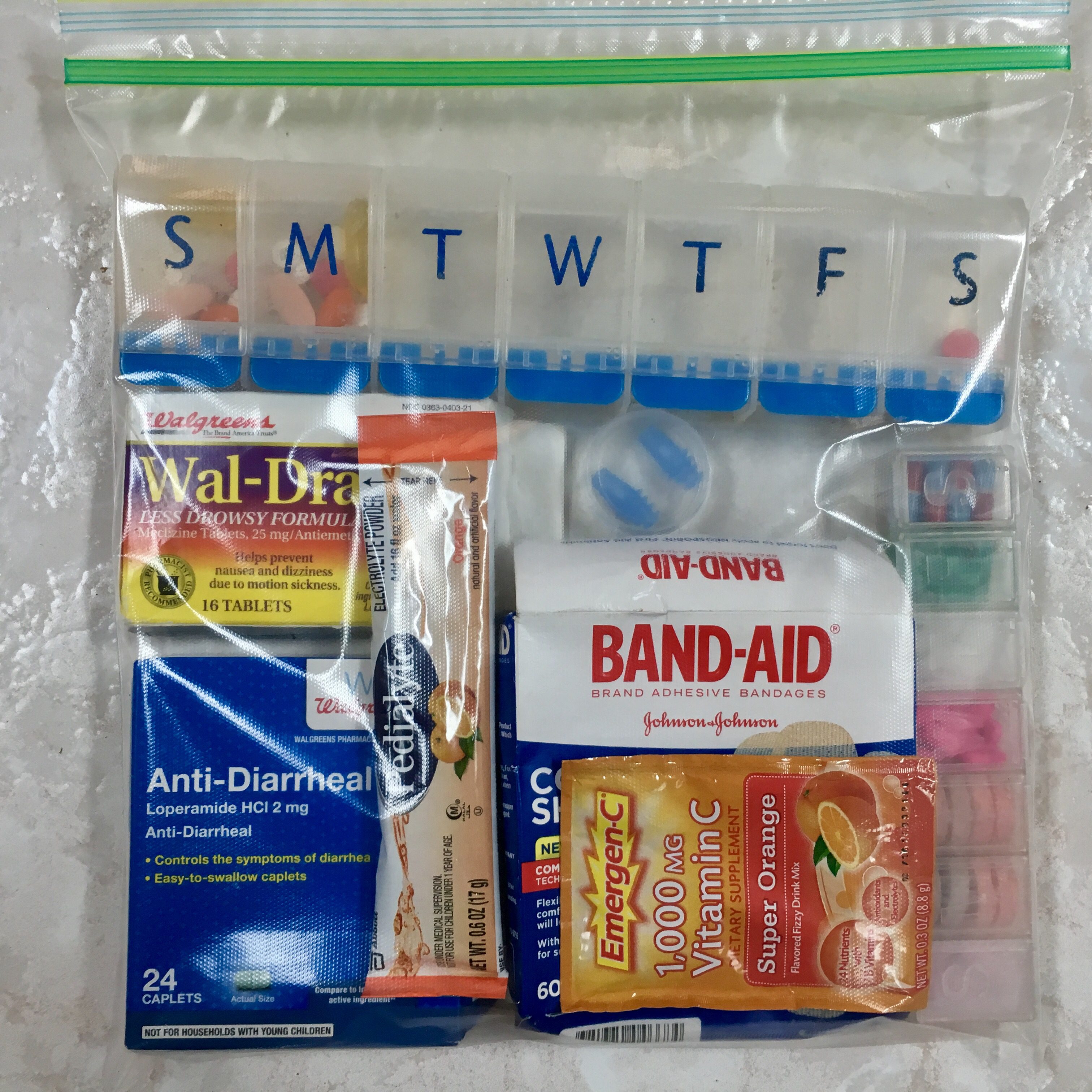
Electrolyte packets are one thing I’m especially happy to have when I need them. Vomiting and diarrhea can cause fluid and electrolyte loss, and rehydration is an important part of dealing with those illnesses. They’re also helpful if you’re spending time outside in a hot climate and aren’t drinking enough fluids.
The Other First-Aid Items I Pack
I also keep a few creams and other small items with my toiletries:
- First-aid ointment
- Hydrocortisone cream – for insect bites and minor skin irritation
- Eye drops
- Lip balm
- Hand sanitizer
Depending on the destination, I’ll also pack things such as:
- Sunscreen
- Aloe vera gel
- Diclofenac gel for joint pain
Regular liquids, gels and aerosols in a carry-on still need to meet TSA’s normal size requirements. However, medically necessary liquids, medications and creams are treated differently and can be brought through the checkpoint in larger reasonable quantities. You’ll need to tell the TSA officer about them for screening.
International Trips Require More Planning
When we’re traveling abroad or somewhere remote, my medicine kit gets larger.
My friends have called it my “traveling pharmacy.”
That’s partly because it can be harder to find the exact medication you’re familiar with in another country. Brand names can be different, formulations can vary, and there may be a language barrier. If we’re heading somewhere where medical care or pharmacies aren’t readily available, I’m even more likely to prepare ahead of time.
But international travel creates another issue: just because a medication is legal in the United States doesn’t mean you can bring it into another country.
We’ve previously written about common medications that can cause problems overseas.
Before traveling internationally, I check the rules for the countries we’re visiting – and, when necessary, countries we’re transiting through.
Some countries restrict medications that are completely routine in the United States. That can include certain decongestants, ADHD medications, pain medications, sleeping pills and anti-anxiety medications.
The U.S. State Department recommends checking with the embassy or other official government source for each country to make sure your medications are permitted.
For international travel, it’s also smart to:
- Bring enough prescription medication for your entire trip, plus extra in case you’re delayed.
- Keep prescription medications in their original labeled containers, particularly when crossing international borders.
- Bring a copy of your prescription, preferably including the medication’s generic name.
- If appropriate, carry a letter from your doctor explaining your medical condition and the medications you use.
- Check whether the country limits how much medication you can bring or requires advance approval.

What’s In My Larger International Travel Kit?
Depending on where we’re going, I might add:
- Cough suppressant and/or expectorant
- Decongestant – after checking that it’s legal at the destination
- Instant cold pack
- Throat lozenges
- Extra oral rehydration salts or electrolyte packets
- Earwax removal drops
- Any destination-specific prescription medication recommended by our doctor
For some destinations, a doctor may prescribe an antibiotic to carry in case of severe travelers’ diarrhea. I’d discuss that with a medical professional instead of assuming one particular antibiotic is appropriate everywhere.
Recommendations have changed over the years as antibiotic resistance has increased, so what a doctor gave you for a trip 10 or 15 years ago may not be what they’d recommend today.
The same applies to any other “just in case” prescription medication. If your doctor thinks it’s appropriate for you and your trip, that’s one thing. I wouldn’t borrow someone else’s medication or build an international medicine kit around old prescriptions left over from a previous illness.
Don’t Forget Travel Medical Coverage
A medicine kit can handle a headache, upset stomach or other minor problem. It’s not a substitute for medical care.
When traveling outside the United States, we recommend looking at travel insurance that includes medical coverage.
That’s particularly important because your regular U.S. health insurance may provide limited coverage – or no coverage at all – outside the country. Depending on the destination and type of trip, medical evacuation coverage can also be worth considering.
Check Vaccination And Health Recommendations Before You Go
International trips can require more than simply packing the right medication.
Before traveling, I also check the CDC Travelers’ Health destination pages to see if there are recommended or required vaccinations, disease outbreaks or other health issues we should know about.
For some destinations, it’s worth having that conversation with a doctor or travel-medicine clinic well before departure rather than waiting until you’re packing your suitcase.
Final Thought
My travel medicine kit has changed over the years, and yours will probably look different from mine.
The important part isn’t carrying every medication on this list. It’s thinking ahead about what you might reasonably need and, most importantly, making sure any medication you can’t do without stays with you.
I’ve been known to overpack my little “traveling pharmacy,” and I’m fine with that. Most of the time, everything comes home untouched.
But when one of us wakes up in a hotel room in the middle of the night and needs something that’s already in the bag, I’m very happy I packed it.
And there’s still one rule that hasn’t changed:
Prescription and other essential medications go in the carry-on. Never the checked bag.
Want to comment on this post? Great! Read this first to help ensure it gets approved.
Want to sponsor a post, write something for Your Mileage May Vary, or put ads on our site? Click here for more info.
Like this post? Please share it! We have plenty more just like it and would love it if you decided to hang around and sign up to get emailed notifications of when we post.
Whether you’ve read our articles before or this is the first time you’re stopping by, we’re really glad you’re here and hope you come back to visit again!
This post first appeared on Your Mileage May Vary
“`