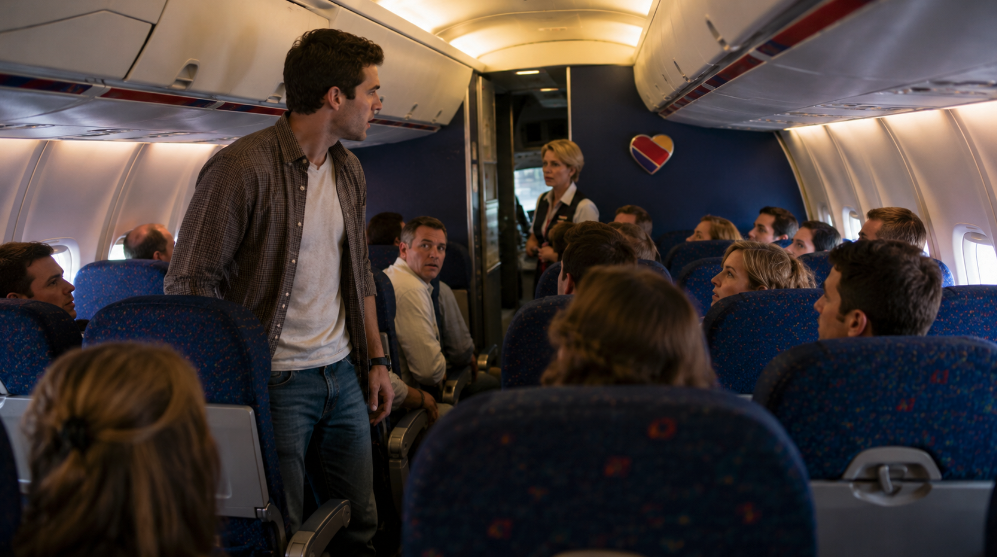
We’ve all heard about air rage. There were plenty of cases when the rules about wearing masks on planes were in place, but unruly passengers certainly aren’t anything new.
In fact, the first recorded case of air rage dates all the way back to 1947, when a drunk passenger on a flight from Havana to Miami reportedly assaulted another passenger and a flight attendant.
“Air rage” generally refers to disruptive or violent behavior aboard an aircraft. It can involve everything from arguments over seats and smoking in the lavatory to intoxicated passengers and, in extreme cases, physical violence (thanks, Wikipedia!).
Usually, these incidents end with the passenger being restrained, the plane making an emergency landing, or the situation eventually being de-escalated.
But on one Southwest flight in 2000, it ended very differently.
A 19-year-old passenger tried to enter the cockpit. Other passengers stepped in to stop him.
He didn’t survive.
A Tragic Case: Jonathan Burton on Flight 1763
On August 11, 2000, Southwest Airlines Flight 1763 was on its regularly scheduled flight from McCarran International Airport to Salt Lake City International Airport. About 20 minutes before landing, 19-year-old Jonathan Burton, suddenly stormed the cockpit door and tried to get in (this was more than a year before 9/11, when cockpit security was very different from what it is today).
Crew members tried to restrain him, but other passengers aboard the flight leapt into action to assist, and eight of them restrained Burton. Unfortunately, the force they used asphyxiated him, and he died. The autopsy also found evidence of blunt force trauma to the face, neck and torso.
The autopsy also found that Burton had low levels of marijuana in his body, but this was a ‘highly unlikely explanation’ for his violent outburst. However, he had no history of outbursts like this and no history of mental health issues or problems with violence.
Burton was flying to Utah to visit his aunt and uncle. He was looking forward to spending the summer with his family, something he had been doing since childhood.
Early Signs of Trouble
On the plane, he reportedly started acting erratically. He took a beverage from the drink cart instead of waiting to be served. He also rummaged the galley for packs of peanuts.
After a few minutes, his behavior escalated, and he started pacing up and down the aircraft. ABC News reported one passenger said that, “When he walked past me, he was mumbling and he seemed anxious.”
From Erratic to Dangerous
Towards the front of the plane by this point, Burton suddenly started shouting, “I can fly this plane, I can fly this plane,” and began kicking the cockpit door. Another passenger said it “looked like he was intent on going in there [the cockpit], but it looked like the pilots were intent on pushing him out.”
Burton was eventually led to an exit row, where several male passengers guarded him. At the same time, volunteers gathered to guard the cockpit door.
Burton seemed to calm down a bit, but reportedly still had a “spacey” look in his eyes. During the plane’s final descent, Burton escalated again, this time punching some people and spitting on others.
Attempts to Subdue Him
A group of men grabbed Burton and restrained him on the floor. Some sat on his limbs to keep him still.
One passenger said, “They were scared. It felt like he was taking over the plane.”
Another reported hearing someone shouting, “Hurt him! Beat him up!”
When Restraint Turned Violent
Yet another passenger, Canadian Dean Harvey, said some did just that. According to Harvey, a large man wearing boots repeatedly kicked Burton while he was on the floor.
Said Harvey, “I felt this group, particularly this one man, was out of control. He was stomping on Jonathan’s chest, one foot at a time, I don’t know what the rest of the group was doing other than holding him.”
“He [Burton] was basically 100 percent defenseless at this time. … I remember thinking no one can take a pounding like this.”
Harvey continued, “I asked him [the one man kicking him in the chest] to stop. I said, ‘You’ve got the guy subdued. What more do you want? You don’t have to pound his head in.’”
He later remarked to his traveling partner: “I think they’re killing him back there.”
Aftermath and Legal Response
When the police came on board, Burton was unconscious; five or six men were still restraining him, with their feet on his head, throat, and right arm. Another passenger held his left arm. He was bleeding from his mouth, had a “huge knot” and “discoloration” on his forehead, and contusions on his chest.
Burton was still alive when he was handcuffed and removed from the plane, but died at a local hospital not long afterward.
A spokesperson for Southwest Airlines said at the time: ”We stand behind the conduct and actions of our flight crew, and we understand and appreciate the feelings of the passengers on board, including those who took steps to protect themselves and others.”
”This was a stressful situation resulting from Mr. Burton’s repeated attempts to kick through the cockpit door,” the representative continued. ”The lives of 137 people were in the balance.”
However, a lawyer for Burton’s mother, Janet Burton, argued: “I’m certainly not going to say they shouldn’t have restrained him. But once he was restrained, the tables turned and the restrainers were out of control. Who was there to control them?”
The death was eventually ruled a homicide, but then-U.S. Attorney Paul M. Warner didn’t press charges, arguing that there was no evidence of criminal intent and that the other passengers acted in self-defense.
Final Thoughts
More than 25 years later, it’s still a disturbing story.
There was no question that Burton’s behavior had become dangerous and that the crew and passengers needed to stop him from getting into the cockpit. But what happened after he was restrained raises a very different question: At what point does protecting yourself and everyone else on the plane go too far?
Federal prosecutors ultimately determined that the passengers had acted in self-defense and that there wasn’t enough evidence of criminal intent to bring charges. But Burton’s death was still ruled a homicide.
It’s an unsettling reminder of just how quickly an already frightening situation on an airplane can spiral into something much, much worse.
Want to comment on this post? Great! Read this first to help ensure it gets approved.
Want to sponsor a post, write something for Your Mileage May Vary or put ads on our site? Click here for more info.
Like this post? Please share it! We have plenty more just like it and would love it if you decided to hang around and sign up to get emailed notifications of when we post.
Whether you’ve read our articles before or this is the first time you’re stopping by, we’re really glad you’re here and hope you come back to visit again!
This post first appeared on Your Mileage May Vary