A few months ago, we went over mistakes that tourists tend to make when using chopsticks in Japan. Today, we’re going to follow that up with some mistakes that sometimes happen—above and beyond those involving chopsticks—when visitors are in a Japanese restaurant.
Arriving On Time
Have a reservation? Get there on time or even a little bit early.
Being late is just not done in Japan. It’s rude. Don’t be that person.
Irasshaimase!
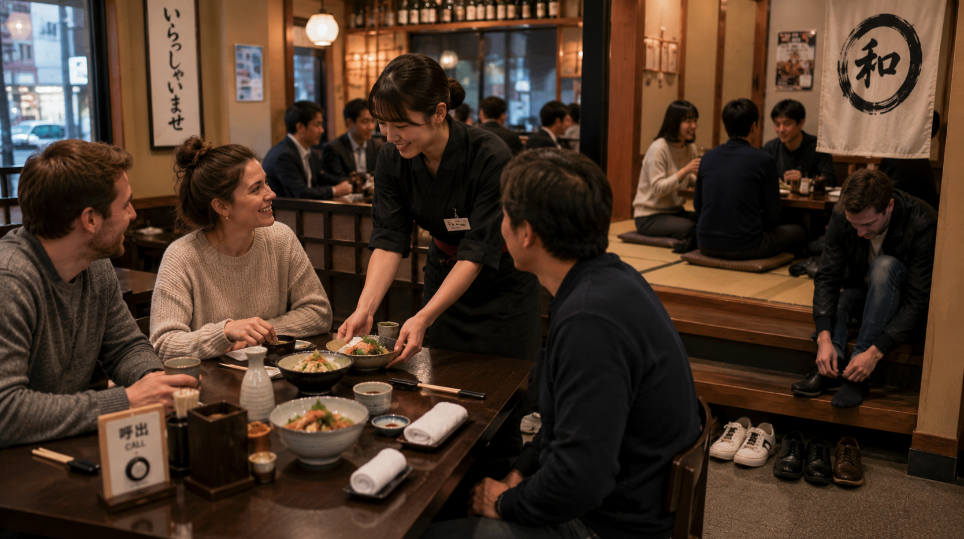
When you enter a restaurant in Japan, you’ll typically hear “Irasshaimase” (“ee-rah-shy-mah-seh,” with equal emphasis on each syllable). It means “Welcome.” It’s customary to bow slightly in response, but you don’t really have to say anything.
Taking Off Your Shoes
Traditionally, Japanese homes and some restaurants require visitors to remove their shoes. This is to maintain cleanliness and respect for the space. Whether or not you need to remove your shoes in the dining establishment you’ve just entered depends on the type of restaurant it is, as well as its seating arrangement.
Many Japanese restaurants, especially those with tatami mat seating or low tables, follow this custom, and you’ll be expected to remove your shoes at the entrance. Some places provide indoor slippers; others let you go barefoot or stay in your socks to preserve the clean environment.
Just look around when you get there and see what other guests have done. If they’re wearing their shoes, keep your shoes on. If they’ve removed their shoes, you should do the same.
The Wet Towel
This is where tourists tend to make their first “big” mistake.
If you sit down at a table in a Japanese restaurant and they give you a towel, heads up that it’s only intended to wipe your hands, not your face or neck. Once you’re done wiping your hands, fold it used-side in and place it on the dish it was served from.
(Note: If you’re in a hotel, plane, train or other non-restaurant setting and are offered a towel, then it’s fine to wipe your face and neck.)
Chopstick Etiquette
We already covered Japanese chopstick etiquette in a separate article, but it bears repeating here because it’s one of the easiest ways for visitors to accidentally commit a dining faux pas.
From sticking chopsticks upright in a bowl of rice to passing food from one person’s chopsticks to another’s, some actions have cultural associations that most tourists would never think about. Fortunately, they’re also easy mistakes to avoid once you know about them. If you’d like a refresher, here’s our guide to chopstick mistakes tourists make in Japan (and the etiquette locals notice).
Serving Drinks To Others First
If you’re at a restaurant in the U.S. and have a pitcher of beer or a bottle of wine, polite people will serve others before serving themselves. In Japan, it’s a BIG DEAL to do that. In fact, you should ONLY serve others and then let others serve you.
It’s a respect thing.
Waiting For The Server To Come To You
In the U.S., a server will come to your table here and there to see if you need anything.
In the U.K., if you’re eating at a pub, it’s customary to go to the bar to order things.
In Japan, the correct way to get a server’s attention is to call out for them.
The proper wording is “Sumimasen!” (“Soo-mee-mah-sen,” with equal emphasis on each syllable). Say it out loud and raise your hand when you see a server nearby—they’ll come to your table so you can order, get refills, ask for the check, etc.
Again, it’s a respect thing—servers don’t want to interrupt you unless there’s something you need.
Caveat: If the table has a button, use that to call for your server instead.
Be Aware Of Your Environment
Americans tend to be on the loud side. The Japanese? Not so much.
And because the concept of respect is so important in Japan, it’s important to take note of your environment. If a restaurant is more boisterous, such as an izakaya, then no worries. But if you’re in a quieter restaurant, be respectful and keep your voice down.
Match your tone to what you hear around you from other patrons.
And Finally, About Tipping
Different countries have different norms about tipping.
In Japan, don’t tip at a restaurant. At all. In fact, it’s considered rude if you try.
Of course, none of these customs are meant to intimidate visitors, and most Japanese restaurant staff understand that tourists won’t know every local expectation. That said, making even a small effort to follow local etiquette is usually appreciated. Whether it’s arriving on time, knowing what to do with the wet towel or understanding how to get your server’s attention, a little cultural awareness can go a long way. And unlike memorizing dozens of Japanese phrases, these are easy habits to pick up before your next meal.
Want to comment on this post? Great! Read this first to help ensure it gets approved.
Want to sponsor a post, write something for Your Mileage May Vary, or put ads on our site? Click here for more info.
Like this post? Please share it! We have plenty more just like it and would love it if you decided to hang around and sign up to get emailed notifications of when we post.
Whether you’ve read our articles before or this is the first time you’re stopping by, we’re really glad you’re here and hope you come back to visit again!
This post first appeared on Your Mileage May Vary

1 comment
Very useful practical tips. Thanks.