We already told you about the passenger who made, shall we say, some questionable life choices while going through U.S. Customs. She was talking on her phone, a Customs and Border Protection (CBP) officer told her to put it away…and she decided that was more of a suggestion than an order.
Spoiler alert: it didn’t end well.
As it turns out, she wasn’t the only traveler who made a spectacularly bad decision while dealing with CBP.
In fact, an Atlanta man may have made an even bigger one.
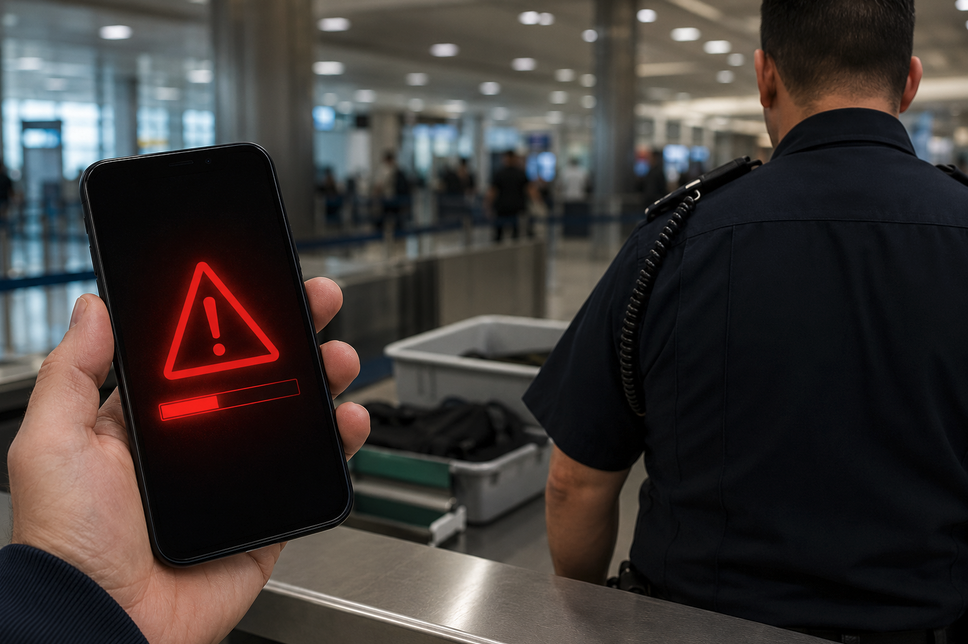
Back in January 2025, Samuel Tunick returned to Hartsfield-Jackson Atlanta International Airport after a trip to the Dominican Republic. During a secondary inspection, CBP agents wanted to search his phone. Instead of simply unlocking it, prosecutors say Tunick entered a special password that did something very different.
It erased the entire phone.
And now he’s facing federal criminal charges.
According to The Guardian, Tunick has been charged under a rarely used federal law—18 U.S.C. § 2232—which makes it illegal to knowingly destroy property in order to prevent authorities from seizing it. The publication reports that this is believed to be the first criminal prosecution in the United States involving the use of what’s known as a “duress password.”
So…what exactly is a duress password?
Think of it as a secret “panic button” for your phone.
You set up two different unlock codes. One is your normal PIN, which opens the phone exactly as you’d expect. The second looks just like an ordinary unlock code, but instead of opening the phone, it immediately wipes it clean by deleting its encryption keys—the digital locks that keep all of your data secure.
In other words, one password says, “Here’s my phone.”
The other says, “What phone?”
The feature is part of GrapheneOS, a privacy-focused version of Android that’s available exclusively for Google Pixel phones. It’s especially popular among journalists, activists and security researchers who want additional protection for sensitive information. Former NSA contractor Edward Snowden has publicly praised the operating system and said he uses it himself, although GrapheneOS has been around for years. The duress PIN feature, however, wasn’t added until June 2024, specifically for situations where someone might be physically compelled to unlock their device.
And according to prosecutors, that’s exactly what happened here.
Tunick’s attorneys say CBP officers took him to a secondary inspection room after his flight from the Dominican Republic and demanded access to his phone without a warrant, under what’s known as the border search exception to the Fourth Amendment. They also claim he wasn’t allowed to speak with a lawyer and wasn’t read his Miranda rights.
Court filings say Tunick entered a code, at which point “the screen went blank, flashed several times, and the phone appeared to restart.”
CBP agents seized the phone anyway and allowed him to continue into the country.
Federal prosecutors, meanwhile, allege that wasn’t just an unfortunate coincidence. Their indictment specifically states that Tunick knowingly entered a passcode that caused the phone to erase its contents before agents could seize it.
Whether Tunick ultimately winds up behind bars remains to be seen. He has pleaded not guilty, and a federal judge isn’t expected to rule on his motion to suppress until at least the end of October. Until then, the case—and what could become a precedent-setting prosecution over a phone’s duress password—is far from over.
Want to comment on this post? Great! Read this first to help ensure it gets approved.
Want to sponsor a post, write something for Your Mileage May Vary, or put ads on our site? Click here for more info.
Like this post? Please share it! We have plenty more just like it and would love it if you decided to hang around and sign up to get emailed notifications of when we post.
Whether you’ve read our articles before or this is the first time you’re stopping by, we’re really glad you’re here and hope you come back to visit again!
This post first appeared on Your Mileage May Vary

2 comments
So now you’re supposed to save evidence against you? That kind of seems to be absolutely contrary to the whole Constitution thingie, particularly Amendments 4 and 5. I thought only banana republics did this.
He did outsmart them. The State just wanted revenge after that.