If you never leave home without a power bank, you’ll want to pay attention to this.
New airline rules taking effect in 2027 will make flying with some portable chargers more restrictive, continuing a trend that’s been building as lithium-ion battery fires become an increasing concern for airlines and aviation regulators.
The good news? Most travelers probably won’t have to change a thing.
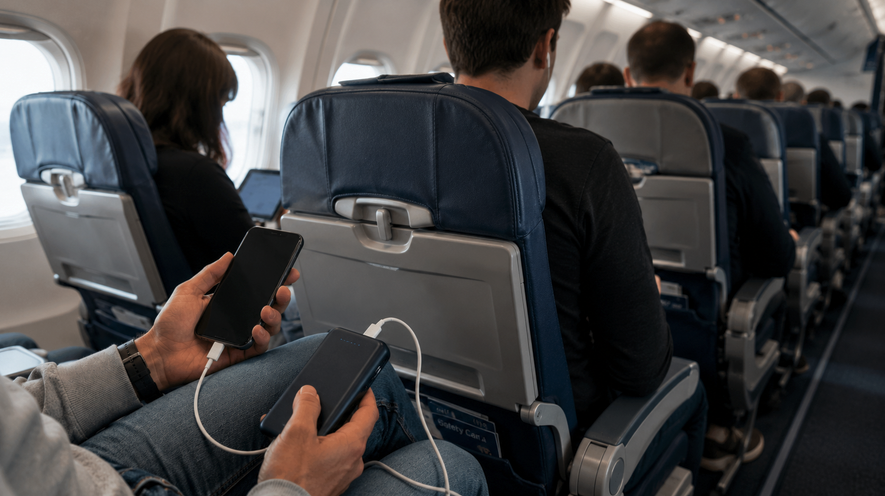
Power banks have become almost essential for many travelers, allowing them to keep phones, tablets and laptops charged throughout long travel days. In fact, roughly 44% of passengers currently travel with a power bank.
Unfortunately, it also seems like every few weeks there’s another story about a lithium-ion battery catching fire on an airplane. In the first half of 2025, the FAA recorded 28 incidents – and that’s just for the U.S. alone! This led the International Air Transport Association (IATA) to set new rules in 2026 regarding power banks on commercial passenger flights. The current rules are:
- Power banks must be in carry-on luggage, never checked
- Under 100 Wh (“watt-hours”): allowed without restriction
- 100-160 Wh: allowed with airline pre-approval, typically with a maximum of two power banks
- Over 160 Wh: prohibited on passenger flights
How airlines handle the rules today
The IATA rules are the absolute minimum. However, some airlines are even more restrictive:
Major U.S. airlines
They all follow IATA rules exactly. The FAA also says that “damaged or recalled batteries and battery-powered devices” must not be carried aboard an aircraft.
Major European airlines
Nearly all follow IATA rules. Some require power banks with more than 100 Wh to be pre-approved before booking. EasyJet automatically approves lithium-ion batteries up to 160 Wh.
Asian airlines
Most follow IATA rules, but with stricter enforcement at the gate. Singapore Airlines requires power banks above 100 Wh to be approved at check-in with a paper form (and they WILL check).
Chinese airlines are particularly strict. Uncertified power banks, or devices where the labeling or the China Compulsory Certification (CCC) mark is worn off or missing, are banned.
Middle Eastern airlines
They all strictly adhere to IATA rules. Emirates allows power banks of up to roughly 120 Wh without approval on certain routes; otherwise, the standard 100 Wh limit applies.
Australian airlines
They also follow standard IATA rules. Heads up that Australian authorities are particularly strict about damaged or visibly worn power banks, which have a higher risk of overheating or catching fire.
Low-cost carriers and regional airlines
They usually follow IATA rules but with stricter enforcement and less flexibility for approval requests. If you’re flying a budget carrier, it’s probably best to make sure your power bank is under 100 Wh, just in case.
Rules in 2027
IATA has already said the rules regarding power banks will become more stringent in 2027. The biggest change takes effect on January 1, 2027: power banks over 100 Wh will no longer be allowed on passenger aircraft.
For most travelers, the upcoming change won’t require any adjustments at all. The vast majority of commercially available power banks are under 100 Wh and will continue to be allowed in carry-on bags.
But if you rely on a larger-capacity power bank for work, photography, camping or other high-power needs, you’ll want to make sure it meets the new rules before flying in 2027.
Either way, one thing isn’t changing: power banks still belong in your carry-on, not your checked luggage. If a lithium-ion battery overheats or catches fire, the cabin crew can respond quickly. In the cargo hold, that’s a much more serious problem.
Want to comment on this post? Great! Read this first to help ensure it gets approved.
Want to sponsor a post, write something for Your Mileage May Vary, or put ads on our site? Click here for more info.
Like this post? Please share it! We have plenty more just like it and would love it if you decided to hang around and sign up to get emailed notifications of when we post.
Whether you’ve read our articles before or this is the first time you’re stopping by, we’re really glad you’re here and hope you come back to visit again!
This post first appeared on Your Mileage May Vary

1 comment
Hi, I heard that at least some airlines may require that the Wh capacity of a powerbank should be clearly visible on the outside of it.