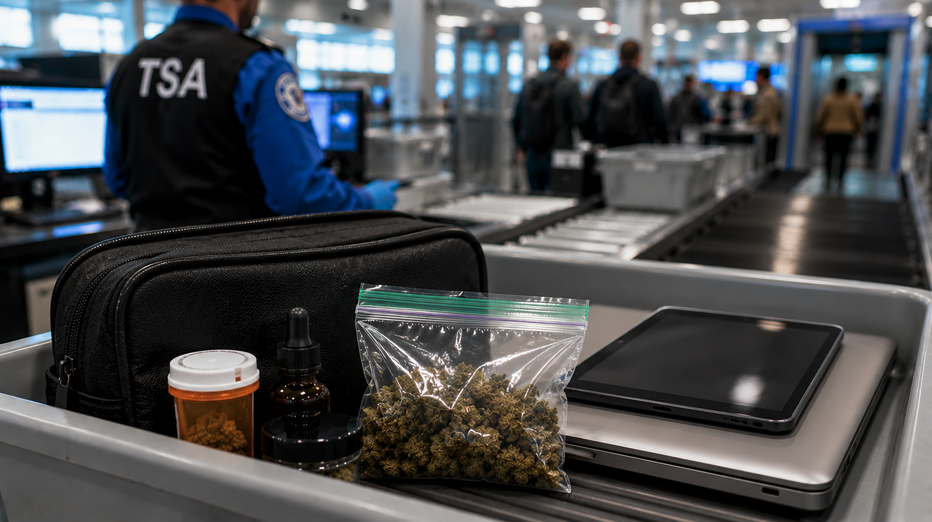
For years, marijuana and air travel have existed in a weird legal gray area.
Now the TSA has quietly updated its website in a way that could affect millions of travelers.
The TSA has continually changed what passengers can and can’t bring/do onto a plane and/or into the cabin. For example, people could smoke on plane for decades…and then they couldn’t. In the early times after 9/11, ALL scissors were forbidden in the cabin of the plane…and then they changed it to scissors with a 4″ blade or smaller were OK.
Transporting marijuana on a plane has been increasingly questioned over the years because as of early 2026, 24 states plus Washington D.C. have legalized cannabis for adult recreational use, while 40 states plus D.C. allow medical use. And yet bringing it onto a plane was still not allowed because because air travel falls under federal law and marijuana is still considered illegal on a federal level.
The TSA quietly changed its website
However late last month, in something of a surprise move, the TSA quietly updated its website to reflect an apparent change in its policy regarding medical marijuana. According to the new policy, it can now be included in both carry-on and checked baggage.
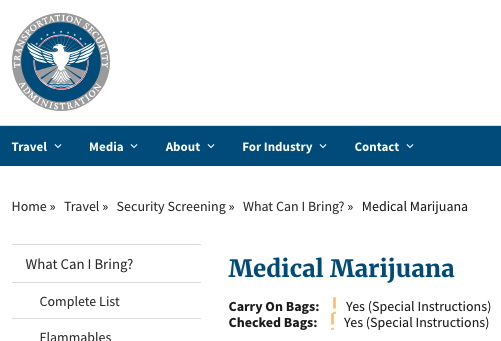
The administration’s April 27 update also added that its security procedures are focused on security threats, not drugs. Their page now states:
TSA’s screening procedures are focused on security and are designed to detect potential threats to aviation and passengers. Accordingly, TSA security officers do not search for illegal drugs, but if any illegal substance or evidence of criminal activity is discovered during security screening, TSA will refer the matter to a law enforcement officer.
The page used to have a paragraph that explained marijuana is illegal under federal law.
However the new rule is not actually cut and dried.
Why the federal government reclassified some marijuana products
On April 28th, Acting Attorney General Todd Blanche signed an order moving FDA-approved marijuana products and state-licensed medical marijuana from Schedule I to Schedule III of the Controlled Substances Act.
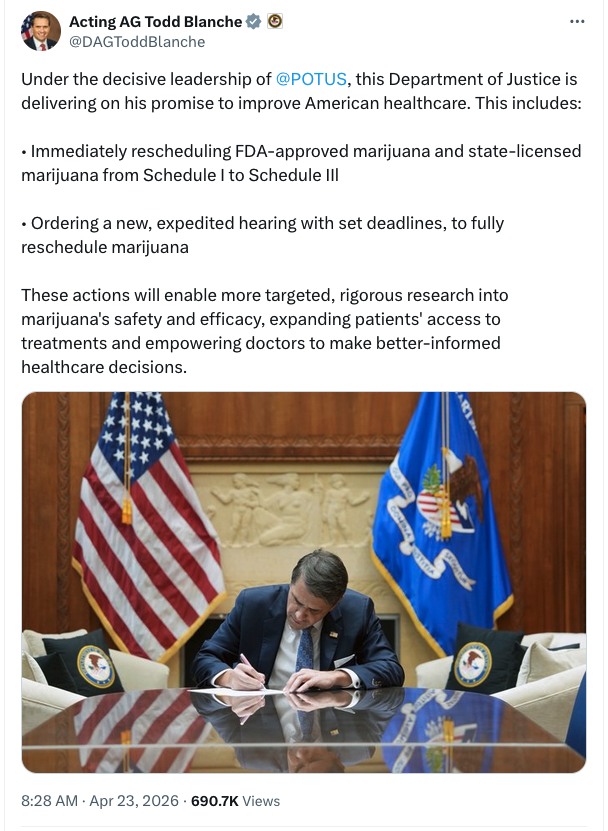
This was actually part of a long process that had begun four years ago. From High Times:
The Biden administration launched a formal review in 2022. In 2023, Health and Human Services concluded cannabis has accepted medical use and recommended Schedule III. The DEA process stalled. Hearings were delayed. Nothing was finalized before Trump took office for his second term.
What does this rescheduling mean?
Cannabis has been classified as Schedule I since Nixon made it so, back in the early 1970s. It put marijuana into the same category as heroin and LSD and was defined as having no accepted medical use. Schedule III substances are recognized as having medical value with moderate to low potential for dependence. The reclassification moves FDA-approved marijuana products (such as Epidiolex, Marinol, Syndros, Cesamet) and state-licensed medical marijuana into that category.
So a prescription bottle of Marinol from your local CVS is now Schedule III. A medical marijuana product obtained from a state-licensed Florida dispensary is also now Schedule III. Those are items that are now OK to bring on a plane.
But if you have something from a medical dispensary from a state that doesn’t have a state-licensed medical marijuana program, you can’t bring that onto the plane. If you pack your recreational edibles in your checked bag, that’s also not OK.
So it all depends on where you got it and what it is.
The TSA still really isn’t looking very hard for your pot. But if they find it and they think it’s suspicious, they can still call the police on you.
International travel is still a different story
Americans traveling to other countries with cannabis can still get them in big trouble. Some countries don’t care, but some very much do.
And having ANY form of marijuana with you, medically necessary or not, while on a cruise ship, is still against maritime law.
So while the TSA’s updated language may sound like a major shift, this definitely isn’t a free-for-all when it comes to flying with marijuana.
The legality still depends on:
- what the product is
- whether it’s medically authorized
- where it came from
- and sometimes where you’re going
In other words, this is one of those situations where travelers should probably understand the rules before tossing gummies into their carry-on and hoping for the best. 😏
Because “but the TSA website said…” probably isn’t the defense you want to test out in an airport security office.
Want to comment on this post? Great! Read this first to help ensure it gets approved.
Want to sponsor a post, write something for Your Mileage May Vary, or put ads on our site? Click here for more info.
Like this post? Please share it! We have plenty more just like it and would love it if you decided to hang around and sign up to get emailed notifications of when we post.
Whether you’ve read our articles before or this is the first time you’re stopping by, we’re really glad you’re here and hope you come back to visit again!
This post first appeared on Your Mileage May Vary