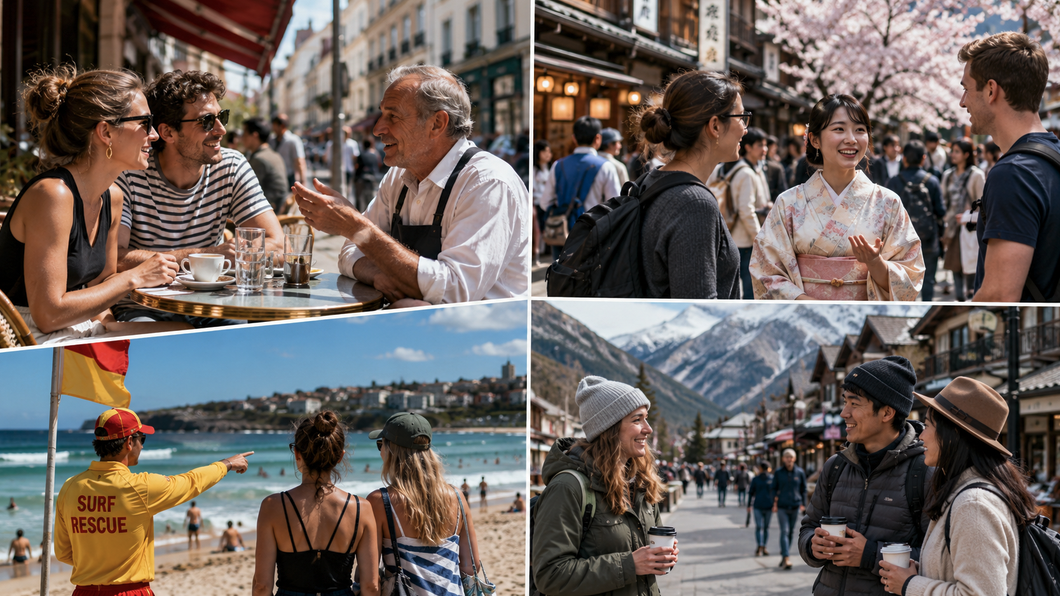
No matter where you travel, there are always unspoken rules that guide daily life. Some are practical, some are cultural, and some can leave visitors completely baffled if nobody warns them ahead of time. Locals from around the world recently shared the things they wish tourists knew before arriving, and their answers offer a fascinating glimpse into everyday life beyond the guidebooks.
Wherever you go, you’re going to encounter social norms that are specific to that particular place. Sometimes they’re big things, like how blowing your nose in public in Japan is considered rude, and sometimes they’re little ones, like whether or not to tip housekeeping and, if so, how much.
People who live in tourist towns know all the things when it comes to, well, dealing with their towns. These are some of the things they wish tourists knew to make their lives easier when they visit. They were compiled from various websites, such as Reddit, BuzzFeed, etc., and encompass questionnaires and surveys from a variety of years.
 African Continent
- Africa is a continent, and it’s more than three times the size of the USA. There are over 50 different countries and countless cultures. What is acceptable in one place may not be acceptable in another. Languages differ, climates differ and cuisines differ. — n48656c421
- Try to focus on something other than poverty. Poverty exists the world over. Don’t participate in poverty tourism so you can post about it on social media and feel better about yourself. — n48656c421
Australia
- The sun is not messing around in Australia. If you plan a day at the beach or out and about, you need to have plenty of sunscreen and reapply it regularly. The burns can be so bad they blister. — Xyz
- Swim between the flags! Australia’s beaches are dangerous. — bethanyGrace
Canada
- If you are visiting Canada in the winter and are not used to winter driving conditions, please do not drive! Specifically, in Banff and other mountain regions. You are a hazard to everyone else on the road. Driving in a blizzard or on ice takes practice, and winter conditions can change within minutes. PLEASE take public or hired private transportation. — S Cav
- When people are friendly with you, it’s typically very genuine, but depending on where you are, they can also be exceptionally cold (Vancouver). We’re very aware of our similarity to the U.S. but don’t like to acknowledge it; comparisons are generally unwelcome. — JesseHawkshot
- We say sorry a lot, but it’s mostly just to express that we don’t want conflict or aren’t mad. For example, if I’m standing still and someone bumps into me, I will say sorry, assuming it was an accident. It’s not that I think I did anything wrong; it’s more like “no worries.” But if they did it on purpose or are being aggressive, it’s a different story. — s99B88
France
- This all tracks from when I lived in France. Parisians were generally rude, though nearly everywhere else I met warm, lovely people. In small towns, younger people always spoke English with me even though I wanted to practice my French. Older people would humor me. — loveracity
- Don’t even think about trying to get lunch at a restaurant in France at any time outside of noon to 2 p.m. They will either be closed or will have run out of food. — JoeResidence
- The stereotype of French people not speaking and not wanting to speak English is the exact opposite. — Glen1648
- In Paris, if you watch me taking the subway, I will hold my phone with both hands, especially if I’m close to a door and the doors are open. — Little-kinder
Japan
- People very rarely visit each other’s houses. Houses are small, walls are thin and people are private. Even families tend to have larger gatherings at onsens or restaurants instead of anyone’s home. If people don’t invite you to their home, don’t be offended. — ninesquirrels
- So many things are still cash-only, and it’s honestly a little frustrating having to deal with pulling out a wallet and dealing with change all the time. — Bokonon10
- Things are very formulaic and by the letter here, and any well-meaning attempts to permit skipping protocol will be ignored. I dropped a 10-yen coin under a gacha machine once, and a staff member very doggedly insisted on moving the machines around to search for it. I tried to say it was OK and not to worry, and she came back with, “It’s not OK. Please wait.” — JesseHawkshow
- Trash is a very, very big deal. Some places have 10+ categories of garbage, which must be sorted, cleaned and placed out on the morning of the appropriate day, not the night before. People take this quite seriously. — ninesquirrels
- Re: technology: Japan has been stuck in the year 2000 since 1985. — RIPmyfirstaccount
Lithuania
- Most of us are really welcoming people. If you are our guest, there will be food at the table—a lot sometimes. If it’s a quick and unexpected visit, you will definitely get tea or coffee and some sweets! If you are a close friend or relative, there is a good chance you’ll get some food packed to take with you. — kareiJ
- We tend to be direct without being rude! So if you ask something that’s interesting to you and do it in a polite way, you’ll get an answer. — kareiJ
Mexico
- Pedestrians never have the right of way, so use caution when crossing. — bklynparklover
- We’re more formal here than in the U.S. People get dressed every day instead of wearing athleisure. Most people do their hair and makeup for basic errands or family days. Shorts and flip-flops are rare, even in beach towns. Think smart casual to get groceries. — blueenvy
The Netherlands
- Not everything is about drugs, sex, tulips and windmills. We have beautiful landscapes and cities. We have islands. We have so many more fun things to do and see than getting drunk and having sex. — Simon-kip
- The Dutch are known to be tolerant, which is different from being completely accepting. You can be and do whatever you want as long as it doesn’t bother or hinder someone else. This doesn’t mean everyone agrees with or accepts the choices you make. — DeletedID
- We are not hospitable people by culture, and we always eat dinner at 18:00. If there are visitors in the house, we gently shoo them out if it is near 18:00. Dining with a Dutch person is quite rare. — Les-Lanciers-Rouge
- Although the country is small, there is a distinct difference between people from the Randstad, the south and the north. The Randstad is known as the economic heart, with most of the big cities. The south is known as warm and social, while the north is known as cold and distant. — ValeNova
New Zealand
- Never sit on tables, desks or kitchen benches. It’s tapu (sacred) to Māori. Bums where you eat are gross anyway. — ponderosa
Norway
- If you’re “different” in any kind of way, people will and do talk about you. People will discriminate. — Normal-Mongoose3287
- Cash is almost never used, and a lot of places will even see you pull it out and ask you to use a card instead because they don’t want to deal with it. — sagestruggler
- People are nice to you because you’re a foreigner and they want to make a good impression. Most people are not really very friendly and helpful toward each other. — Normal-Mongoose3827
- The whole country sort of shuts down during July, as everyone’s on vacation. Yes, the entire month. — netpuppy
- All stores are closed on Sundays. If you need to buy something, you’d better hope you can find it in a convenience store, and you’ll have to pay way more than you would in a regular store on any other day. If not, tough luck. Wait until Monday and plan better next time. — Rakpthurz
- People don’t offer help because they “respect your privacy” (lmao). They don’t because they’re waiting for someone else to offer. — Normal-Mongoose3827
Poland
- Polish people tend to be racist. Most will not do anything harmful, but if you are anything other than white, you will be stared at, even in bigger cities. — Mencjusz
Portugal
- Avoid the small towns in the interior if you are not a white person of the lighter variety. — DeletedID
Singapore
- You can walk outside at 3 a.m. in the most “dangerous” part of town, and nothing will happen to you. — _malaikatmaut_
South Korea
- South Korea is almost entirely cashless but doesn’t have contactless payments. — emimagique
Spain
- Shops close in the middle of the day, not because of the siesta, but because it is a MANDATORY lunch break forced by companies so they only have to hire one person for the morning and afternoon shifts. — NewNameAgainUhg
Philippines
- Most Filipinos love gossip, but I can assure you that we are very welcoming and generous, to the point that even if we don’t have money, we will find ways to give you good food as a welcome. Strangers can also be trusted. The only problems here are the corrupt government, heavy traffic, pollution and all the dust, especially in Manila. — kendiching
Taiwan
- Despite being a rich country, plumbing is still stuck in the 1900s in many places, and you’ll need to throw your toilet paper in a bin next to the toilet after wiping your a**. — Royal-Procedure6491
- Cash is still the number one form of payment, and many places may not accept cards at all. — thickboyvibes
- Just because it’s the only country in the region that made gay marriage legal doesn’t mean that you’ve got loads of gay folks showing public displays of affection in the street. The culture is still quite reserved and introverted. No matter your orientation, you’re going to get scowled at if you’re making out with anyone in public. — Royal-Procedure6491
- The number 4 is unlucky and left off many elevators, just like 13 in the States. — thickboyvines
Turkey
- Avoid restaurants in touristy places, avoid places that actively try to attract tourists and avoid taxis as much as possible. Istanbul is a city full of hills, so be prepared for some cardio. Avoid talking about politics. Those are the first things that come to mind. — goldysir
United Kingdom
- Most places only accept payment by card, but corner shops often have a minimum spend for card payments. — Crizzy444
- Stand on the right of the escalator; walk on the left. — Crizzy444
- In the U.K., people will go to the pub to meet with their friends, but usually not to make new ones. I always see people on Reddit wanting to go to “a real British pub” on their holiday and “get to know the locals,” completely unaware that if a total stranger is talking to you in the pub, they are probably the local nutter. — Ok-Cup-1472
- You can ask for tap water anywhere that sells alcohol, and they must legally give it to you, even if you aren’t a customer. — Crizzy444
- It makes me laugh when Americans say, “British people are so polite. When they walk past you in a store, they say ‘excuse me’ in their clipped accent!” They’re completely oblivious to the fact that a British person saying “excuse me” is the equivalent of someone else saying, “GTFO of the way.” British people will stand silently behind you, waiting for you to notice them trying to pass and move out of the way. Saying “excuse me” is a last resort and an admonishment for being unaware of your surroundings. — UnderTheHarvestMoon
- Jaywalking is not a crime. It’s perfectly legal. Just do it safely. — Crizzy4444
Seemingly Everywhere
- PICK YOUR LARGE CITY is not an example of the entire COUNTRY/STATE (i.e., London/England, NYC/New York, Hollywood/California, Paris/France, Amsterdam/The Netherlands).
- PICK YOUR COUNTRY is huge. Don’t expect to see it all (i.e., Australia, the United States, China, Canada).
Of course, no list like this can capture every nuance of a country, region or city. Many of these observations come from individual locals sharing their own experiences and perspectives. Still, they highlight something every traveler should remember: the best trips happen when you approach a destination with curiosity, respect and a willingness to adapt to local customs. A little awareness can go a long way toward helping you avoid misunderstandings—and might even earn you a warmer welcome from the people who call that place home.
Want to comment on this post? Great! Read this first to help ensure it gets approved.
Want to sponsor a post, write something for Your Mileage May Vary, or put ads on our site? Click here for more info.
Like this post? Please share it! We have plenty more just like it and would love it if you decided to hang around and sign up to get emailed notifications of when we post.
Whether you’ve read our articles before or this is the first time you’re stopping by, we’re really glad you’re here and hope you come back to visit again!
This post first appeared on Your Mileage May Vary