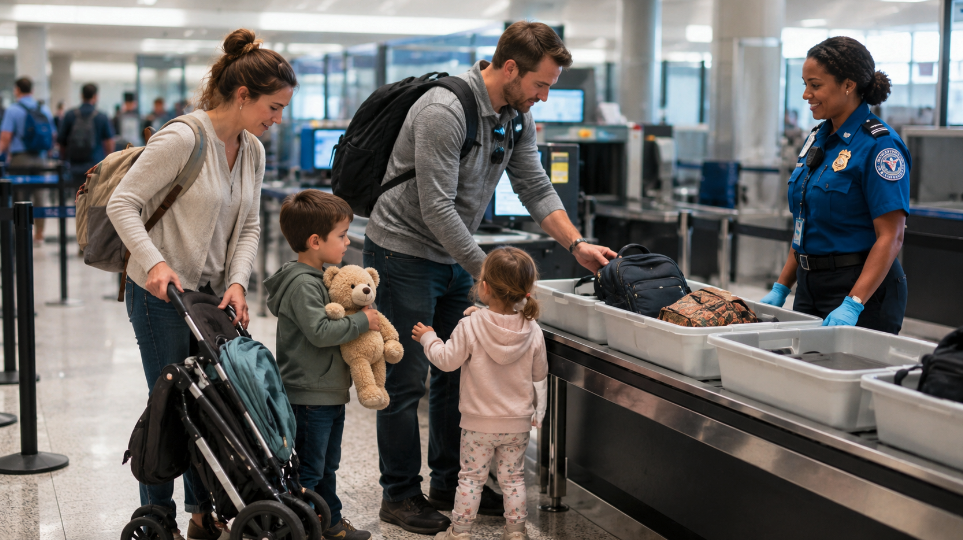
Going through a TSA checkpoint can be stressful enough. Add a stroller, diaper bag, car seat, snacks, stuffed animals and one or two young children into the mix, and things get even more complicated.
It’s not just the parents who notice. Everyone else in line does, too.
About a year ago, the TSA launched a new campaign called “Families on the Fly.” It was introduced at a handful of airports and is a dedicated TSA queue for families with children aged 12 and under who might need extra time to get through the TSA checkpoint.
The goal was twofold: families could take their time in their own line (and not get side-eye from frequent flyers), and the “regular” line could move faster. As a TSA representative said at the debut of the program, “…the family-friendly security lanes work basically the same as the regular lanes, while providing families “with their own space where they can move through security at their own pace, without feeling rushed or as though they’re inconveniencing other travelers.”
Families on the Fly has since expanded and is currently in 13 airports:
- Charleston International Airport (South Carolina)
- Charlotte Douglas International Airport (North Carolina)
- Daniel K. Inouye International Airport (Honolulu)
- Jacksonville International Airport (Florida)
- John Glenn Columbus International Airport (Ohio)
- John Wayne Airport, Orange County (Santa Ana, California)
- Luis Muñoz Marín International Airport (San Juan, Puerto Rico)
- OKC Will Rogers International Airport (Oklahoma City, Oklahoma)
- Orlando International Airport (Florida)
- Rhode Island T.F. Green International Airport (Providence, Rhode Island)
- Salt Lake City International Airport (Utah)
- Seattle-Tacoma International Airport (Washington)
- Tampa International Airport (Florida)
How’s it going?
The program appears to have its pros and its cons..
Pro: It decreased the “side eye”
The queue is specifically for families with kids aged 12 and under. So you can take as long as you need, and the people behind you aren’t going to complain because they’re in the same boat as you – they’re going to take a while, too.
Pro: The TSA officers tend to be nicer
It takes someone special to handle a queue with young kids all day. Anecdotally, families often report that the TSA officers assigned to these lanes are kinder and more patient than those in the standard screening lanes.
Pro: The rules are more consistently followed
Flying as an adult and flying with a baby are very different. There are special exceptions for liquids, formula and food, unique policies for strollers and even babywearing. Because the TSA officers are specially chosen to work with families, there’s a better chance they’ll know and understand these rules, so they may not give parents a hard time because of “reasons.”
Con: the queue has limited hours
A program can’t be utilized if it’s not running, and the Families on the Fly program does not have the same hours as the regular TSA queue (obviously, families can always use the regular queue). This could be because individual airports have only so many TSA officers willing and able to work that queue.
Con: time spent on line may not less
The Families on the Fly queue always has fewer people in it than the regular queue. But because each family is encouraged to take their time, it means the queue as a whole moves more slowly than the regular line. So you still may spend 30 minutes in line, even with only 5 families in front of you.
Con: the program isn’t well known
It appears that many families don’t know that the Families on the Fly program exists. And although airports have signage for the special queue, that doesn’t necessarily mean people see it or understand what it means.
Like many pilot programs, Families on the Fly isn’t perfect.
If you happen to be traveling during its operating hours at one of the participating airports, it can make the security experience feel a little less rushed and a little more family-friendly. Parents don’t have to feel like they’re holding up the line, and other travelers can choose a lane that’s likely to move at a more consistent pace.
On the other hand, the dedicated lanes aren’t available everywhere, they aren’t always open, and they don’t necessarily get you through security any faster.
Still, for many parents, the biggest benefit may not be saving time at all. It may simply be having a little extra patience, understanding and breathing room during one of the most stressful parts of flying with young children.
Want to comment on this post? Great! Read this first to help ensure it gets approved.
Want to sponsor a post, write something for Your Mileage May Vary, or put ads on our site? Click here for more info.
Like this post? Please share it! We have plenty more just like it and would love it if you decided to hang around and sign up to get emailed notifications of when we post.
Whether you’ve read our articles before or this is the first time you’re stopping by, we’re really glad you’re here and hope you come back to visit again!
This post first appeared on Your Mileage May Vary