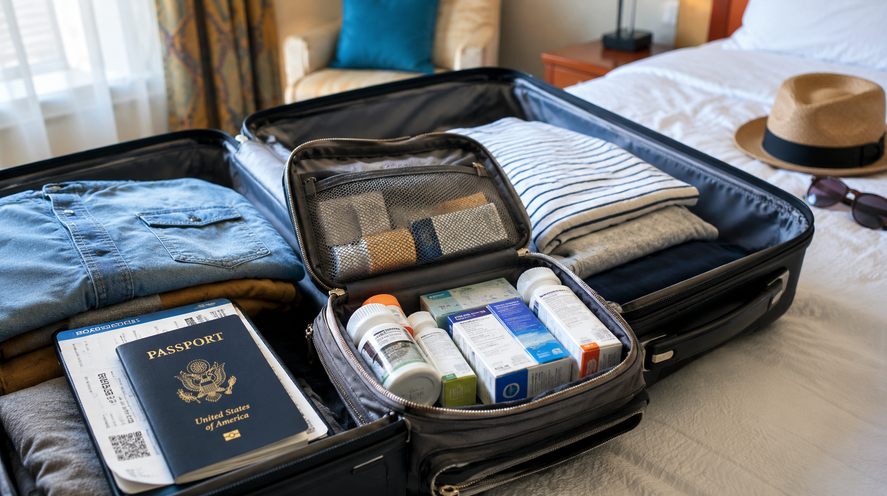
The other day we talked about the paperwork you may need to fill out if you’re bringing your prescription medications to another country. Today, let’s look at the flip side of that question: what happens if you buy medication while you’re overseas and want to bring it back into the United States?
If you’ve traveled internationally enough, you’ve probably done this—or at least thought about it. Maybe it went something like this:
- Your aunt knows you’re going to the UK and asks you to buy Co-Codamol, which contains paracetamol (what we call acetaminophen) and codeine, over the counter in the UK, and bring it home to her.
- You wind up with a horrible toothache while in India and are given Crocin Advance Tablets for the pain. You’ve only used up 1/3 of the package before you go home, so you bring it with you.
- You develop a cough in France, and the pharmacist gives you a cough suppressant with terpin hydrate and codeine. You don’t speak French, and she doesn’t speak much English. “Big spoon,” she says to you as the dosage. You don’t finish the bottle, so you bring it home with you (this really did happen to me back in the mid-90s, when I wound up with bronchitis in Paris. It wouldn’t happen nowadays – the drug is now only available in France via prescription)
In every one of those examples, the medication was perfectly legal where it was purchased. But that doesn’t necessarily mean it’s legal to bring it back into the United States. So what’s the rule? Can you bring them into the country legally?
To keep things simple, I’m going to assume you’re a U.S. citizen. (If you’re a foreign national living in the U.S., the FDA has separate guidance for you.)
 What is personal importation?
A personal importation is a product not for further sale or distribution into U.S. commerce. Please refer to the FDA’s Regulatory Procedures Manual (RPM) Chapter 9-2 for more information on “Coverage of Personal Importations”.
Can I purchase or bring drug or device products from a foreign country to the U.S.?
U.S. Citizens:
In most circumstances, it is illegal for individuals to import drugs or devices into the U.S. for personal use because these products purchased from other countries often have not been approved by the FDA for use and sale in the U.S. If a drug is approved for use in another country but is an unapproved new drug in the U.S. it is illegal to import.
The FDA cannot ensure the safety and effectiveness of medicine purchased over the Internet from foreign sources, storefront businesses that offer to buy foreign medicine for you, or during trips outside the U.S. For these reasons, the FDA recommends only obtaining medicines from legal sources in the U.S.
Are there any circumstances when I could purchase or bring an unapproved drug or device into the U.S.?
The FDA has guidance for personal importation of drug or device products. Below provides information regarding situations for which this might be allowed:
- Product is not for treatment of a serious condition and there is no known significant health risk (Over the Counter, OTC); or
- Product is for the treatment of a serious condition ( Prescription Drug Products):
- The product is for a serious condition for which effective treatment may not be available domestically either through commercial or clinical means.
- There is no known commercialization or promotion of the product to persons residing in the U.S.
- The product does not represent an unreasonable risk.
- The consumer affirms in writing that the product is for personal use.
- The quantity is generally not more than a three month supply and either:
- Provide the name and address of the doctor licensed in the U.S. responsible for your treatment with the product, or
- Provide evidence that the product is for the continuation of a treatment begun in a foreign country.
What if my prescription drug is a controlled substance?
Some medications are also controlled substances. The Drug Enforcement Agency (DEA) will generally make the decision on whether controlled substances are allowed to be imported for personal use. For those controlled substances that fall under the jurisdiction of both DEA and FDA, the two agencies will coordinate when determining the admissibility of the product.
Visit the DEA website for additional information.
When would the FDA refuse a personal importation?
- Product is on an FDA import alert for previous violations.
- Shipment appears to be intended for commercial distribution.
- Product appears to present a serious risk to health.
- FDA-regulated article that appears to represent a health fraud.
- Food imported with inadequate prior notice.
Here’s the short version
Here’s the part that catches a lot of travelers off guard: just because you were allowed to buy a medication in another country doesn’t automatically mean you’re allowed to bring it home. Why? Because the FDA hasn’t approved them as safe.
However, if the medication is an OTC med, they MAY let you keep it. Also, if it’s a prescription medication for which there’s no substitute in the U.S., it doesn’t show to have an unreasonable risk, you affirm, in writing, that it’s only for personal use, you have no more than a 3-month supply, etc., they MAY let you keep it.
Either way, ALWAYS declare the medication when you get back to the U.S. They may say it’s OK to bring it into the country. They may not. But at least you know you’re doing the right thing and following the rules.
And one more thing…always declare the medication when you return to the U.S.
Maybe they’ll let you keep it. Maybe they won’t. But at least you’ll know you followed the rules.
Especially if you have TSA PreCheck or Global Entry. Getting caught trying to bring undeclared medication into the country could be enough to jeopardize your Trusted Traveler status. That’s a pretty hefty price to pay for a box of cold medicine.
The bottom line? Don’t assume that because a medication was perfectly legal where you bought it, it’s automatically OK to bring it back into the United States. A quick look at the FDA’s guidance before you head home could save you a lot of hassle at customs—and possibly save your PreCheck or Global Entry privileges, too.
Want to comment on this post? Great! Read this first to help ensure it gets approved.
Want to sponsor a post, write something for Your Mileage May Vary, or put ads on our site? Click here for more info.
Like this post? Please share it! We have plenty more just like it and would love it if you decided to hang around and sign up to get emailed notifications of when we post.
Whether you’ve read our articles before or this is the first time you’re stopping by, we’re really glad you’re here and hope you come back to visit again!
This post first appeared on Your Mileage May Vary